

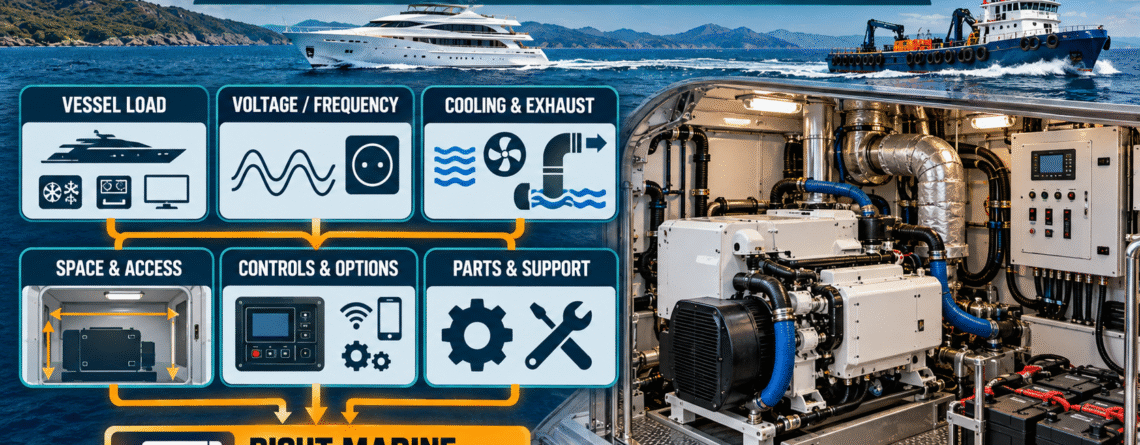
Choosing a marine diesel generator is not simply a matter of selecting the highest kW rating or the most familiar brand. The correct generator must match the vessel’s electrical system, operating profile, installation space, cooling arrangement, exhaust design, service requirements, and future power needs.
This marine diesel generator buying guide explains the main decisions buyers should make before requesting a quotation. It is intended for yacht owners, boat operators, shipyards, fishing-vessel operators, workboat owners, and commercial marine buyers comparing new generator sets or replacing an existing unit.
The key principle is simple:
The right marine diesel generator is the one that matches the vessel’s complete power system—not just its advertised output.
A generator may have the correct kW rating and still be unsuitable because it has the wrong voltage, frequency, phase, dimensions, cooling system, control panel, or motor-starting capability.
What is a marine diesel generator?
A marine diesel generator, also called a marine genset, combines a diesel engine with an alternator to produce electrical power onboard a vessel.
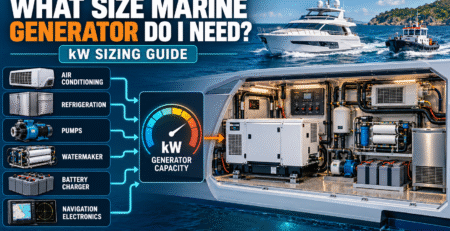
The generator may supply:
- Air-conditioning
- Refrigeration
- Battery chargers
- Watermakers
- Pumps
- Navigation electronics
- Lighting
- Galley appliances
- Water heaters
- Entertainment systems
- Hydraulic equipment
- Commercial machinery
Unlike a land-based generator, a marine unit is designed for the conditions found aboard a vessel. These may include saltwater exposure, vibration, restricted ventilation, high humidity, vessel movement, compact machinery spaces, seawater cooling, wet exhaust systems, and long periods of operation under changing loads.
Cummins’ current marine product range includes Onan marine generator sets from approximately 4 kW to 195 kW, while its larger C Power range covers substantially higher commercial outputs. This demonstrates why marine generator selection must begin with the vessel application and not only with a generic “boat generator” label. Cummins Inc.
The direct answer: how do I choose the right marine generator?
To choose the right generator, evaluate these factors in order:
- Vessel type and operating profile
- Realistic simultaneous electrical load
- Motor-starting and transient demand
- Voltage, frequency, and phase
- Prime, continuous, or standby duty
- Cooling and exhaust arrangement
- Available installation space and access
- Noise and vibration requirements
- Controls, accessories, and integration
- Parts availability, warranty, and technical support
A generator should be selected only after these requirements are documented.
Start with the vessel, not the generator catalogue
One of the most common purchasing mistakes is choosing a generator model first and then trying to make it fit the vessel.
The better approach is to begin with the boat or ship.
What type of vessel is it?
The requirements may differ considerably between:
- Sailing yachts
- Motor yachts
- Catamarans
- Fishing vessels
- Passenger boats
- Workboats
- Patrol vessels
- Trawlers
- Charter boats
- Commercial ships
A compact sailing yacht may prioritize low weight, small dimensions, and quiet operation. A fishing vessel may prioritize continuous-duty reliability, service access, refrigeration support, and parts availability. A commercial vessel may also require classification approval, three-phase power, redundancy, or automatic load sharing.
How will the generator be used?
Ask how the generator will operate:
- Occasionally at anchor
- Every day during cruising
- Continuously offshore
- As a primary power source
- As emergency or standby power
- During commercial operations
- Alongside shore power
- In hot or tropical conditions
- In cold or seasonal conditions
A generator used for occasional recreational operation may have different requirements from one running for many hours each day on a commercial vessel.
How many hours will it operate?
Operating hours affect:
- Duty rating
- Fuel consumption
- Service intervals
- Cooling requirements
- Engine loading
- Parts planning
- Warranty considerations
- Long-term operating cost
A generator that is acceptable for occasional use may not be the best choice for continuous commercial operation.
Calculate the vessel’s electrical demand
The generator must supply the electrical loads that are expected to operate at the same time.
Prepare a load schedule covering equipment such as:
- Air-conditioning compressors
- Refrigerators and freezers
- Watermakers
- Battery chargers
- Inverters
- Pumps
- Water heaters
- Electric cooking equipment
- Navigation systems
- Communication equipment
- Lighting
- Hydraulic systems
- Workshop machinery
For each load, record:
| Information | Why it matters |
|---|---|
| Running watts or amps | Establishes normal demand |
| Starting current | Shows temporary motor demand |
| Voltage | Confirms compatibility |
| Frequency | Identifies 50 Hz or 60 Hz requirements |
| Phase | Confirms single-phase or three-phase supply |
| Duty cycle | Shows how often the load operates |
| Simultaneous use | Prevents unnecessary oversizing |
Do not simply add the nameplate rating of every appliance. Some loads operate intermittently, while others may never operate at the same time.
A practical load schedule should identify at least three operating conditions:
- Essential load
- Normal cruising load
- Maximum realistic load
This gives the buyer and supplier a more accurate view of the generator requirement.
Running load versus starting load
A generator must handle both normal running power and temporary starting demand.
Air-conditioning compressors, refrigeration compressors, pumps, and other motors can draw significantly more current when they start. This temporary demand is commonly called inrush current, locked-rotor current, or starting load.
For example, a vessel may consume 7 kW while operating normally but require substantially more capacity when its largest air-conditioning compressor starts.
Cummins’ generator-sizing guidance emphasizes that generator selection should account for starting power, not only the normal running load. Its recommended approach is to combine the starting requirement of the largest motor with the running demand of the other loads expected to remain connected. www.cummins.com
A generator that appears adequate on paper may therefore experience:
- Voltage drop
- Frequency instability
- Breaker trips
- Failed motor starts
- Excessive smoke
- Overload alarms
- Control-system shutdowns
Soft starters, variable-frequency drives, load sequencing, and automatic load shedding may reduce starting demand, but they must be designed into the vessel’s electrical system rather than assumed.
Understand kW and kVA
Marine generators are commonly described using both kW and kVA.
- kW represents real electrical power.
- kVA represents apparent power.
- Power factor describes the relationship between kW and kVA.
The basic formula is:
kW = kVA × power factor
Therefore:
kVA = kW ÷ power factor
For example, a 16 kW load operating at a power factor of 0.8 requires:
16 ÷ 0.8 = 20 kVA
This distinction becomes increasingly important when a vessel operates motors, compressors, transformers, pumps, or other inductive equipment.
When comparing marine generator specifications, review:
- Rated kW
- Rated kVA
- Power factor
- Continuous or prime rating
- Standby rating
- Voltage
- Frequency
- Phase
- Motor-starting performance
A generator with the same kW rating may have different kVA capability and different starting performance.
Match voltage, frequency, and phase
Before purchasing a generator, confirm the vessel’s existing electrical configuration.
Common requirements include:
- 120 V
- 230 V
- 120/240 V split-phase
- 208 V three-phase
- 400 V three-phase
- 50 Hz
- 60 Hz
- Single-phase
- Three-phase
The selected unit must work with the vessel’s:
- Main AC distribution panel
- Shore-power system
- Transfer switch
- Battery chargers
- Air-conditioning equipment
- Pumps
- Motors
- Transformers
- Inverters
- Protection devices
- Monitoring system
A generator with the correct output in kW can still be incompatible if its voltage, frequency, phase, or alternator connection is wrong.
Cummins’ marine product finder shows that marine generator families are offered in different output ranges and frequency configurations, reinforcing the need to confirm the exact model and suffix rather than relying only on a family name. Cummins Inc.
Marine generator versus industrial generator
A standard industrial generator should not automatically be installed aboard a vessel.
A proper marine installation may require equipment designed for:
- Saltwater exposure
- Vibration
- Marine cooling
- Wet exhaust
- Restricted ventilation
- Compact engine-room spaces
- Corrosion resistance
- Marine electrical protection
- Vessel movement
- Integration with shipboard systems
The American Boat & Yacht Council identifies A-27 for alternating-current generator sets and E-11 for AC and DC electrical systems on boats. Commercial vessels may also be subject to flag-state, classification-society, or other regulatory requirements.
For a replacement or new installation, the final configuration should be reviewed by a qualified marine electrician or installer.
Prime, continuous, and standby ratings
Generator ratings must be interpreted correctly.
A generator intended for standby operation is not automatically suitable for continuous commercial service. A vessel that relies on generator power for long periods may require a prime or continuous-duty configuration.
Confirm:
- Prime-power rating
- Standby rating
- Maximum operating hours
- Permitted load profile
- Manufacturer’s service requirements
- Application limitations
Using a standby-rated unit as the vessel’s primary generator may create reliability, warranty, and maintenance problems.
Cooling systems: heat exchanger or keel cooling?
Cooling is a major selection factor in any marine diesel generator buying guide because the generator must reject heat safely in the vessel’s operating environment.
Heat-exchanger-cooled generators
Many recreational marine generators use a closed freshwater cooling circuit combined with raw seawater flowing through a heat exchanger.
The system commonly includes:
- Seawater intake
- Seawater strainer
- Raw-water pump
- Heat exchanger
- Siphon break or anti-siphon device
- Wet-exhaust mixer
- Exhaust hose and muffler
- Seawater discharge
This arrangement is common on yachts and cruising boats, but the complete installation must be designed for correct seawater flow and exhaust routing.
A generator may be technically compatible with the vessel but still require changes to the intake, strainer, hose size, siphon break, or exhaust system.
Keel-cooled generators
Keel cooling transfers engine heat through a cooler mounted externally or connected to the vessel’s cooling system.
Keel-cooled configurations may be useful for:
- Workboats
- Fishing vessels
- Commercial craft
- Shallow-water vessels
- Boats where raw-water intake is undesirable
- Vessels already designed for keel cooling
A keel-cooled generator is not automatically interchangeable with a standard heat-exchanger model. The cooling method affects the generator package, plumbing, heat rejection, installation layout, and vessel integration. marine generator cost
Before ordering, confirm whether the replacement must use:
- Heat-exchanger cooling
- Keel cooling
- Raw-water cooling
- A dry-exhaust arrangement
- A wet-exhaust arrangement
Open generator or sound-shielded generator?
Noise and vibration can strongly affect the onboard experience.
A generator located close to sleeping cabins or passenger areas may require more attention to sound control than a generator installed in a heavily insulated commercial machinery space.
Open marine generator sets
Open generator sets may offer:
- Easier service access
- Lower purchase cost
- Simpler inspection
- More flexible installation
- Easier access to filters, belts, and pumps
They may be appropriate where the machinery space already provides sufficient sound insulation and ventilation.
Sound-shielded marine generators
Sound-shielded generators may be preferred for:
- Motor yachts
- Sailing yachts
- Charter vessels
- Catamarans
- Boats with cabins near the engine room
- Passenger comfort applications
A sound shield can reduce mechanical noise, but it does not make the installation silent. Total noise also depends on:
- Engine speed
- Exhaust silencer
- Flexible mounts
- Structural vibration
- Engine-room insulation
- Ventilation openings
- Air-intake silencing
- Exhaust hose routing
Rehlko/Kohler marine product listings identify sound-shield kits, controllers, sea-spares kits, circuit breakers, remote harnesses, and other options separately on some generator models. This is why buyers should confirm the complete package instead of assuming every item shown in a product image is included. www.marine.rehlko.com
Compare engine speed and operating characteristics
Marine diesel generators may operate at different engine speeds depending on their design and frequency.
In many 60 Hz applications:
- Smaller compact units may operate at higher engine speeds.
- Larger traditional generator sets may operate around 1,800 RPM.
- Commercial units may be configured for 1,500 RPM in 50 Hz applications.
A lower-speed generator may offer advantages for long operating periods, noise control, and perceived durability. A higher-speed generator may offer a more compact and lighter package.
However, RPM should not be the only buying criterion.
Compare the entire package, including:
- Rated output
- Alternator design
- Motor-starting capability
- Fuel consumption
- Sound level
- Weight
- Dimensions
- Service access
- Warranty
- Parts availability
The best marine diesel generator for a small sailing yacht may prioritize compact size and low weight, while a commercial vessel may prioritize continuous-duty performance and easy maintenance.
Evaluate fuel consumption correctly
Fuel consumption changes according to electrical load.
A generator operating at 25% load will normally consume less fuel per hour than the same generator operating at 75% or 100% load. However, comparing only litres per hour can be misleading because the generator may be producing different amounts of electrical power.
When comparing fuel data, request manufacturer figures at several load points, such as:
- 25% load
- 50% load
- 75% load
- 100% load
Also review:
- Fuel consumption per kWh
- Rated engine speed
- Frequency
- Ambient conditions
- Cooling configuration
- Prime or standby rating
A generator that is too large for the vessel may spend most of its operating life at a very low load. Cummins’ generator guidance identifies minimum loading as an important consideration because extended light-load operation can negatively affect diesel generator performance and engine condition. www.yumpu.com
The goal is to select a generator that can handle the vessel’s maximum realistic demand while operating at a suitable load during normal use.
Measure the installation space carefully
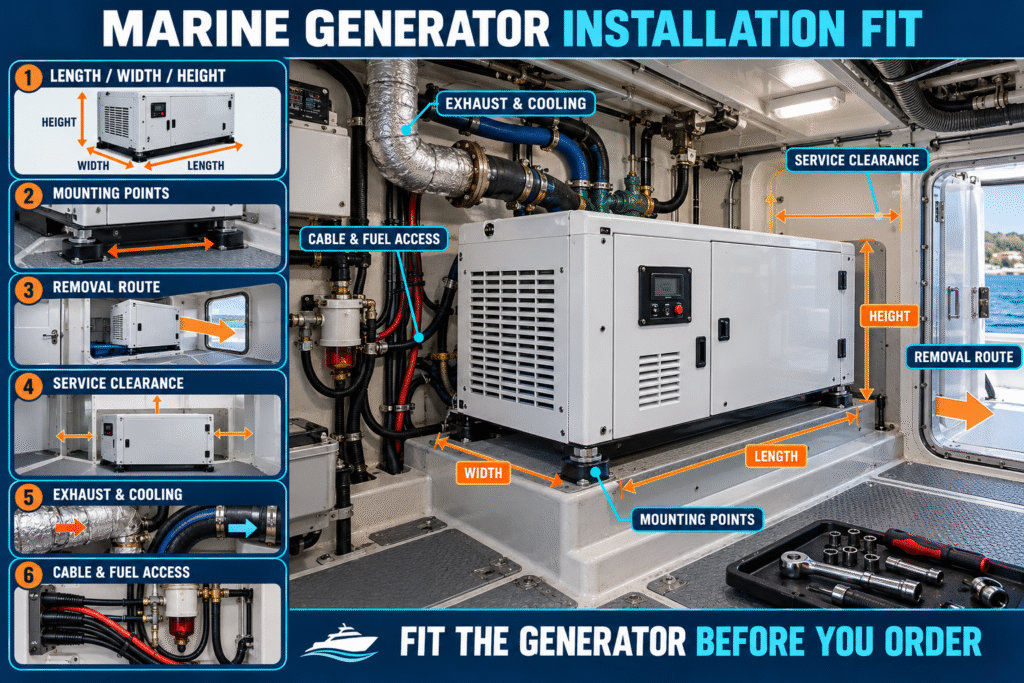
A generator must fit the machinery space, but physical fit is more than length, width, and height.
Measure:
- Overall generator length
- Overall generator width
- Overall generator height
- Mounting-foot spacing
- Mounting-bed dimensions
- Engine-room access hatch
- Doorway width and height
- Removal route
- Service clearance
- Exhaust outlet position
- Fuel connection position
- Cooling-water connections
- Battery access
- AC cable access
- Sound-shield dimensions
A generator may fit on the mounting bed but still be impossible to install because it cannot pass through the engine-room access route.
Maintenance access is equally important. After installation, technicians should be able to reach:
- Oil filter
- Fuel filter
- Air filter
- Raw-water impeller
- Belts
- Coolant filler
- Drain points
- Control panel
- Electrical connections
- Exhaust components
Saving a small amount of space during installation can create much higher maintenance costs later.
Consider the generator’s weight
Generator weight affects:
- Vessel trim
- Structural loading
- Mounting-bed strength
- Lifting arrangements
- Installation labor
- Removal procedures
- Vibration control
If a new generator is significantly heavier than the old unit, the existing mounting structure should be reviewed.
A lighter generator may also require different mounting arrangements because the existing resilient mounts may not provide the correct compression or vibration isolation.
Always compare both:
- Dry weight
- Operating weight, where relevant
Review the exhaust arrangement
The exhaust system is a critical part of a marine generator installation.
Many recreational generators use wet exhaust systems in which seawater mixes with exhaust gas after the exhaust manifold or mixing elbow. The installation may include:
- Exhaust mixing elbow
- Waterlift muffler
- Siphon break
- Exhaust hose
- High-rise elbow
- Water separator
- Through-hull outlet
The replacement generator must be compatible with the available exhaust routing and maximum allowable back pressure.
An incorrect exhaust installation may cause:
- Excessive back pressure
- Poor engine performance
- High exhaust temperature
- Water entering the engine
- Premature component failure
- Carbon monoxide hazards
Do not assume that the existing exhaust hose and elbow can be reused without checking the new manufacturer’s installation requirements.
Controls and remote monitoring
Modern marine generators may include more advanced controls than a basic start/stop switch.
Depending on the model, the control system may monitor:
- AC voltage
- Frequency
- Engine speed
- Oil pressure
- Coolant temperature
- Battery voltage
- Operating hours
- Exhaust temperature
- Cooling-water flow
- Alarm history
- Automatic shutdown conditions
Some vessels require:
- Helm-mounted remote start/stop
- Remote digital display
- Automatic start
- Automatic shutdown
- Network communication
- Generator paralleling
- Load-sharing controls
- Integration with the vessel management system
When comparing quotations, confirm whether the following are included or optional:
- Local control panel
- Remote display
- Harness
- Digital monitoring module
- Automatic transfer switch
- Circuit breaker
- Remote start wiring
- Network interface
A controller shown in a manufacturer brochure may not be part of the standard package for every configuration.
Parts availability and after-sales support
A generator is a long-term equipment decision.
Routine maintenance will require parts such as:
- Oil filters
- Fuel filters
- Air filters
- Raw-water impellers
- Belts
- Anodes
- Gaskets
- Coolant
- Sensors
- Water pumps
- Starter components
- Control-system parts
Before buying, ask:
- Where are parts stocked?
- Can routine service kits be supplied?
- Is technical support available in the vessel’s operating region?
- Are manuals and wiring diagrams available?
- How long will the model remain supported?
- What is the warranty process?
- Can emergency parts be shipped internationally?
Parts availability is especially important for vessels operating far from their home port.
A generator that is slightly cheaper to purchase but difficult to service may have a higher total cost of ownership.
How to compare marine diesel generator brands
There is no single brand that is ideal for every application.
Relevant comparison factors include:
| Selection factor | Question to ask |
|---|---|
| Output | Is the required kW or kVA available? |
| Electrical system | Does the unit match voltage, frequency, and phase? |
| Installation | Will it fit and remain serviceable? |
| Cooling | Does it match the vessel’s cooling arrangement? |
| Noise | Is an enclosure or special mounting required? |
| Duty | Is it suitable for prime, continuous, or standby operation? |
| Controls | Are local and remote controls available? |
| Support | Can parts and technical assistance be obtained? |
| Warranty | What is covered and for how long? |
| Delivery | Is the exact configuration in stock or factory order? |
Cummins, Fischer Panda, Northern Lights, Rehlko/Kohler, Westerbeke, Phasor, Next Gen, and other brands offer different combinations of compactness, output, controls, cooling, speed, sound reduction, and commercial-duty capability.
For example, Cummins identifies Onan marine generator families from compact 4–5 kW units through larger 22.5–29 kW models, as well as higher-output marine generator systems. www.cummins.com Fischer Panda’s marine range emphasizes compact, water-cooled generator designs, while Northern Lights provides configurations from smaller yacht generators to larger commercial sets. fischerpanda.com
The correct choice depends on the vessel and exact model configuration.
New versus used marine diesel generators
Buying a new generator provides greater certainty about its condition, operating history, documentation, warranty, and parts support.
A new unit may be preferable when:
- The vessel operates commercially
- Reliability is critical
- The generator will run many hours each year
- The existing unit is obsolete
- The vessel is being refitted or upgraded
- Classification or certification documentation is required
- The installation must comply with current project specifications
A used or take-out generator may be suitable when budget and availability are more important, but the unit should be inspected carefully.
Request:
- Manufacturer and model
- Serial number
- Operating hours
- Service history
- Load-test records
- Compression-test results, where available
- Generator voltage and frequency readings
- Control-panel photographs
- Cooling-system condition
- Evidence of corrosion or leakage
- Confirmation of included accessories
A generator that has been repainted may look attractive while still having worn bearings, damaged wiring, poor insulation, or a failing alternator.
Price should never replace inspection.
Replacing an existing marine generator
A replacement generator should not be selected only because it has the same kW rating as the old unit.
Compare the complete installation:
- Rated kW and kVA
- Voltage
- Frequency
- Phase
- Engine speed
- Dimensions
- Dry weight
- Mounting-foot spacing
- Exhaust outlet position
- Fuel connection position
- Cooling-water connections
- Battery requirements
- Control-panel wiring
- AC cable size
- Circuit protection
- Service access
- Sound-shield dimensions
A newer generator from the same manufacturer may still have different dimensions, connection locations, mounting points, controls, or cooling requirements.
For a replacement project, photograph the existing generator nameplate and installation before requesting a quotation. The nameplate should show the model, serial number, output, voltage, frequency, phase, and RPM.
Also photograph:
- Mounting feet
- Exhaust system
- Seawater intake
- Control panel
- Fuel connections
- Engine-room access
- Surrounding clearance
- Cable connections
This information allows the supplier and installer to evaluate compatibility before shipment.
What should a marine generator quotation include?
A professional quotation should clearly identify the exact product and the complete scope of supply.
It should state:
- Manufacturer
- Exact model
- Rated kW
- Rated kVA
- Voltage
- Frequency
- Phase
- Engine speed
- Cooling arrangement
- Exhaust configuration
- Control-panel type
- Sound-shield status
- Dimensions
- Weight
- Warranty terms
- Availability
- Estimated delivery time
- Incoterms
- Payment terms
- Quotation validity
It should also identify whether the following are included or excluded:
- Remote control panel
- Remote harness
- Flexible mounts
- Sound shield
- Exhaust elbow
- Exhaust hose
- Waterlift muffler
- Siphon break
- Sea-water strainer
- Fuel-water separator
- Battery
- Battery cables
- Circuit breaker
- Spare-parts kit
- Commissioning
- Installation labor
- Freight
- Taxes and import charges
This distinction is important because two quotations may appear to offer the same generator while covering very different packages.
A written quotation should never rely on a product photograph to define the scope of supply.
Common marine generator buying mistakes
Choosing by kW alone
The kW rating is important, but it does not confirm voltage, phase, starting capability, cooling, dimensions, or service requirements.
Selecting the biggest generator
Oversizing can increase purchase cost, weight, space requirements, and periods of light-load operation.
Ignoring motor-starting demand
Air-conditioning compressors, refrigeration systems, pumps, and watermakers may require more power during startup than during normal operation.
Assuming the same brand means direct replacement
The same manufacturer may change the footprint, controls, mounting, wiring, and connection layout between model generations.
Failing to measure the removal route
A generator may fit the engine room but not pass through the hatch, companionway, doorway, or lifting route.
Assuming accessories are included
Sound shields, remote panels, harnesses, exhaust fittings, circuit breakers, and spare-parts kits may be optional.
Ignoring parts availability
A generator that cannot be serviced easily in the vessel’s operating region may create extended downtime.
Comparing unequal quotations
Always compare quotations with the same voltage, frequency, phase, controls, accessories, delivery terms, warranty, and installation scope.
Marine diesel generator buying checklist
Before purchasing, collect the following information:
Vessel information
- Vessel make and model
- Vessel length
- Recreational or commercial use
- Cruising region
- Intended operating profile
- Expected operating hours
Electrical information
- Required kW
- Required kVA
- Voltage
- Frequency
- Phase
- Existing switchboard details
- Largest motor or compressor
- Starting-current data
- Battery-charger and inverter requirements
Installation information
- Available length, width, and height
- Mounting-foot spacing
- Engine-room access dimensions
- Removal route
- Service clearance
- Exhaust arrangement
- Fuel connection
- Seawater intake
- Cooling arrangement
- Battery location
- Control-panel location
Commercial information
- Required delivery date
- Delivery location
- Billing address
- Delivery address
- Installation responsibility
- Warranty requirement
- Spare-parts requirement
- Classification or certification requirement
The expected purchase timeline should also be confirmed early because stock allocation, production schedules, freight, and exchange-rate changes can affect the quotation.
The right buying process
A reliable purchase process usually follows these steps:
- Document the vessel and its intended use.
- Prepare a realistic electrical load schedule.
- Identify motor-starting requirements.
- Confirm voltage, frequency, and phase.
- Measure the installation space and removal route.
- Confirm cooling and exhaust arrangements.
- Decide whether noise reduction is required.
- Compare suitable manufacturer models.
- Request a quotation with a complete scope of supply.
- Have the final selection reviewed by a qualified marine installer.
This process reduces the risk of buying a generator that is electrically correct but mechanically or operationally unsuitable.Frequently asked questions
What is the most important factor when buying a marine diesel generator?
The most important factor is compatibility with the vessel’s complete electrical and mechanical system. This includes load demand, starting current, voltage, frequency, phase, cooling, exhaust, dimensions, controls, and service access.
Is a marine diesel generator better than a gasoline generator?
Diesel generators are commonly selected for longer operating periods, larger electrical systems, and commercial applications. Gasoline generators may suit some smaller boats, but fuel-system design, ventilation, ignition protection, and vessel requirements must be evaluated.
Should I buy an 1800 RPM marine generator?
An 1800 RPM generator may suit applications that prioritize long operating periods, lower speed, and traditional heavy-duty construction. However, generator speed should be evaluated together with output, noise, dimensions, fuel consumption, and service requirements.
Is a sound shield necessary?
Not always. A sound shield may be valuable where the generator is near cabins or passenger spaces. However, noise also depends on the exhaust system, engine mounts, ventilation, insulation, and installation quality.
Can I replace a marine generator with another brand?
Often, but replacement is not automatic. Confirm electrical output, voltage, frequency, phase, dimensions, mounts, cooling, exhaust, controls, battery requirements, and service clearances.
How do I know whether a generator is suitable for commercial use?
Check the manufacturer’s duty rating, certification, classification options, service support, controls, fuel system, cooling arrangement, and suitability for the vessel’s intended operating hours. Commercial vessels may require additional class or regulatory approval.
Should I buy the generator before arranging installation?
It is safer to confirm the installation requirements first. The installer should review the dimensions, mounting, exhaust, cooling, fuel, ventilation, electrical connections, and removal route before the unit is ordered.
Request a marine generator quotation
Marine Inboard Specialists supplies marine diesel generators for yachts, boats, workboats, fishing vessels, commercial vessels, replacement projects, and new installations.
To receive a suitable recommendation, provide:
- Vessel make and model
- Intended use
- Required output
- Existing generator model
- Voltage, frequency, and phase
- Installation dimensions
- Cooling and exhaust details
- Delivery location
- Expected purchase timeline
- Photographs of the current installation, if available
The quotation should then confirm the exact model, configuration, included components, optional equipment, warranty, availability, delivery terms, and exclusions.
Conclusion: choose the generator as a complete system
The central lesson of this marine diesel generator buying guide is that generator selection should be treated as a vessel-integration decision.
Do not choose only by brand, price, or kW rating. Confirm the electrical load, motor-starting demand, voltage, frequency, phase, cooling, exhaust, dimensions, weight, noise requirements, controls, parts availability, and installation scope.
The right marine diesel generator is not necessarily the largest or least expensive model. It is the unit that can provide reliable power, fit the vessel correctly, operate within its intended duty, and remain serviceable throughout its working life.
Leave a Reply