

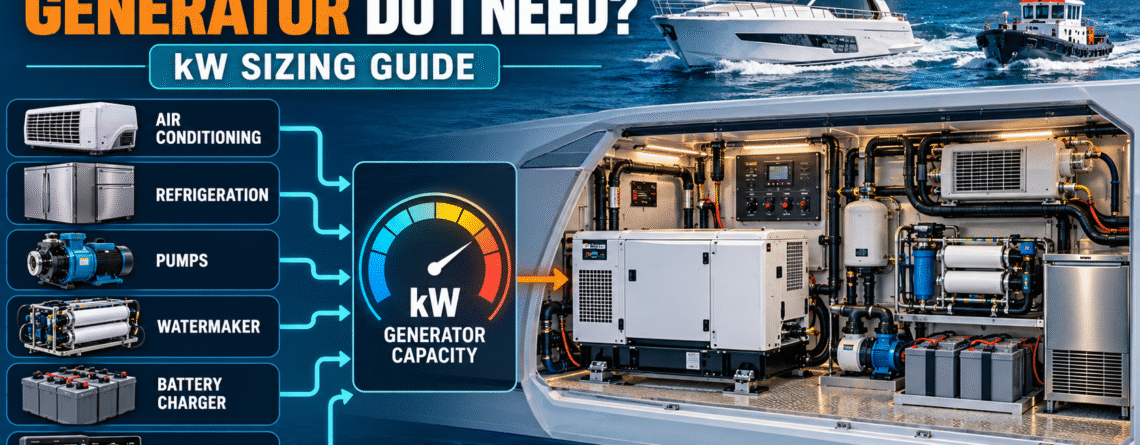
If you are asking, “what size marine generator do I need?”, the answer depends on your boat’s actual electrical load—not vessel length alone. The correct generator must support the equipment you expect to run at the same time, start motor-driven loads such as air-conditioning compressors and pumps, and match your vessel’s voltage, frequency, phase, cooling system, and installation space.
A generator that is too small may cause voltage drop, overload alarms, breaker trips, unstable frequency, or difficulty starting large motors. A generator that is substantially oversized may operate inefficiently at low load and create unnecessary purchase, installation, and maintenance costs.
The most reliable approach is to prepare a vessel load schedule, identify the largest starting load, convert the electrical requirement into the correct kW or kVA rating, and then confirm the result with the generator manufacturer or a qualified marine electrician.
Quick answer: what size marine generator do I need?
As a preliminary guide:
| Vessel or application | Possible generator range |
|---|---|
| Small sailboat with essential loads | 3–6 kW |
| Small cruising boat | 5–10 kW |
| Mid-size cruising yacht | 8–20 kW |
| Large yacht | 20–80+ kW |
| Fishing boat or workboat | 15–100+ kW |
| Commercial vessel | Based on engineered load analysis |
These figures are only starting points. A small boat with several air-conditioning units, a watermaker, electric cooking equipment, and large battery chargers may require more power than a larger vessel with limited electrical equipment.
For a proper selection, use the vessel’s real running load and motor-starting demand.
The basic marine generator sizing formula
A practical preliminary calculation is:
Required generator capacity = maximum simultaneous running load + starting allowance + design margin
For a simplified estimate:
- Add the running wattage of loads expected to operate simultaneously.
- Identify the largest motor or compressor that may start while those loads are running.
- Add its starting requirement or account for its locked-rotor current.
- Convert the result to kW or kVA as required.
- Select the next suitable standard generator size after checking voltage, frequency, phase, and transient performance.
For example:
| Load | Running demand |
|---|---|
| Air-conditioning system | 3.0 kW |
| Watermaker | 1.2 kW |
| Battery charger | 1.5 kW |
| Refrigerator and freezer | 0.6 kW |
| Pumps | 0.8 kW |
| Lighting and electronics | 0.5 kW |
| Total running load | 7.6 kW |
If the largest air-conditioning compressor requires significant starting power, a 7.6 kW generator may not be sufficient. The generator must be able to start that compressor while the other operating loads remain connected.
The final selection could therefore be a 10 kW, 11.5 kW, or larger unit, depending on the compressor’s starting characteristics, power factor, allowable voltage dip, and generator specifications.
Step 1: Create a complete boat electrical load list
Before asking what size marine generator do I need, list every electrical appliance and system that may operate from the generator.
Include:
- Air-conditioning compressors
- Refrigerators and freezers
- Watermakers
- Battery chargers
- Inverters
- Electric water heaters
- Refrigeration compressors
- Freshwater and bilge pumps
- Hydraulic pumps
- Electric cooking equipment
- Washing machines and dryers
- Navigation electronics
- Communication equipment
- Lighting
- Workshop equipment
- Power tools
- Entertainment systems
- Thrusters and other auxiliary equipment
Record the following information for each item:
| Required information | Why it matters |
|---|---|
| Rated watts or amps | Establishes normal running demand |
| Voltage | Confirms electrical compatibility |
| Frequency | Determines whether the system requires 50 Hz or 60 Hz |
| Phase | Identifies single-phase or three-phase requirements |
| Starting current | Determines motor-starting capability |
| Duty cycle | Shows whether the load runs continuously or intermittently |
| Simultaneous-use likelihood | Prevents unnecessary oversizing |
Do not simply add the nameplate rating of every appliance. Some equipment will not run at the same time, while other loads may start automatically without warning.
Step 2: Separate continuous and intermittent loads
A realistic load schedule distinguishes between equipment that operates continuously and equipment that runs occasionally.
For example, a refrigerator may cycle on and off, while a battery charger may operate for several hours after the engine starts. An air-conditioning system may run continuously in hot weather but remain off during cooler conditions.
Create at least three operating scenarios:
Minimum or essential load
This may include:
- Navigation systems
- Refrigeration
- Battery charging
- Lighting
- Bilge pumps
- Communication equipment
Normal cruising load
This may include:
- Essential loads
- One or more air-conditioning units
- Watermaker
- Refrigeration
- Galley equipment
- Entertainment systems
Maximum practical load
This may include:
- Multiple air-conditioning units
- Water heater
- Washer or dryer
- Electric cooking equipment
- Pumps
- Battery chargers
- Workshop equipment
The generator should be selected around the vessel’s realistic maximum operating condition rather than an unrealistic scenario in which every appliance runs continuously.
Step 3: Account for starting current
The most common sizing mistake is calculating only running watts.
Motors and compressors can require substantially more power when starting than when operating normally. Common high-starting-current loads include:
- Air-conditioning compressors
- Refrigeration compressors
- Watermakers
- Hydraulic pumps
- Electric motors
- Compressors
- Thrusters
- Large battery chargers
- High-capacity inverters
Cummins explains that generator sizing must consider starting power, not only normal running power. Its guidance recommends adding the starting demand of the largest motor to the running demand of the other loads expected to operate simultaneously. Cummins Inc.
Check the equipment nameplate or technical datasheet for:
- Locked-rotor amps, commonly shown as LRA
- Starting watts
- Inrush current
- Motor horsepower
- Starting kVA
- Required voltage dip
- Recommended generator size
A generator that can supply 8 kW continuously may still fail to start an air-conditioning compressor if its alternator and engine cannot handle the temporary starting demand.
What if the motor-starting load is too high?
If the calculated starting load is excessive, several solutions may be available:
- Select a generator with a larger alternator
- Use a soft starter
- Install a variable-frequency drive
- Start large motors sequentially
- Use automatic load shedding
- Prevent non-essential loads from operating during startup
- Use a larger inverter or battery-supported system
- Select equipment with lower starting current
These solutions must be evaluated against the vessel’s wiring, control system, switchboard, protection devices, and installation design.
Step 4: Understand kW, kVA, and power factor
Marine generators may be described using both kW and kVA.
- kW is real power—the power actually consumed by the equipment.
- kVA is apparent power—the combination of real power and reactive power.
- Power factor describes the relationship between kW and kVA.
The basic relationship is:
kW = kVA × power factor
Therefore:
kVA = kW ÷ power factor
For example, a load requiring 12 kW at a power factor of 0.8 requires:
12 ÷ 0.8 = 15 kVA
This is why two generators with similar kW ratings may have different kVA specifications. Motors, compressors, transformers, and some electronic equipment can have lower power factors than simple resistive loads.
Always compare the manufacturer’s rated kW, kVA, power factor, and duty rating together.
Step 5: Match voltage, frequency, and phase
A generator can have the correct power rating and still be unsuitable for the vessel.
Confirm whether the boat requires:
- 120 V
- 230 V
- 120/240 V split-phase
- 208 V three-phase
- 400 V three-phase
- 50 Hz
- 60 Hz
- Single-phase power
- Three-phase power
The generator must also be compatible with:
- The main AC distribution panel
- Shore-power input
- Transfer switch
- Battery chargers
- Air-conditioning systems
- Motors and pumps
- Transformers
- Inverters
- Monitoring and control equipment
For example, a 10 kW, 60 Hz, 120/240 V single-phase generator is not automatically interchangeable with a 10 kW, 50 Hz, 230 V single-phase generator.
Step 6: Consider the generator’s minimum operating load
Oversizing is also a problem.
If a generator spends most of its operating time at a very low load, the diesel engine may run inefficiently. Long periods of light loading can contribute to incomplete combustion, carbon buildup, wet stacking, fouling, and increased maintenance requirements.
Cummins’ generator-sizing guidance identifies minimum loading as an important consideration because prolonged light-load operation can affect generator reliability and engine condition. Cummins Inc.
A generator should therefore be large enough for the vessel’s peak practical demand but not dramatically larger than the normal operating requirement unless there is a specific reason, such as:
- Future electrical expansion
- Redundant generator operation
- Commercial duty requirements
- Heavy motor-starting demand
- Parallel generator operation
- Classification or regulatory requirements
Load management can sometimes be better than simply selecting a much larger generator.
Typical marine generator sizes by application
These are broad planning ranges, not final engineering recommendations.
3–6 kW marine generators
Often considered for:
- Small sailboats
- Compact catamarans
- Refrigeration
- Battery charging
- Lighting
- Navigation systems
- Small watermakers
- Limited air-conditioning
Compact models from brands such as Next Gen and Fischer Panda may be relevant, subject to electrical and installation requirements.
7–12 kW marine generators
Often considered for:
- Small cruising yachts
- Larger sailing yachts
- One or two modest air-conditioning systems
- Watermakers
- Refrigeration
- Battery chargers
- Galley appliances
Cummins Onan, Fischer Panda, Westerbeke, Phasor, Kohler/Rehlko, and other manufacturers offer models in or around this range.
13–25 kW marine generators
Often considered for:
- Mid-size cruising yachts
- Multiple air-conditioning units
- Electric cooking equipment
- Watermakers
- Larger battery chargers
- Pumps and refrigeration systems
- More demanding onboard hotel loads
The starting performance and phase configuration become increasingly important in this range.
30–100+ kW marine generators
Often considered for:
- Large motor yachts
- Commercial fishing vessels
- Passenger vessels
- Workboats
- Expedition vessels
- High-load commercial installations
At this level, the project may require:
- Three-phase distribution
- Multiple generators
- Automatic paralleling
- Load sharing
- Switchboard integration
- Classification approval
- Emergency power planning
- Detailed engineering calculations
ABYC identifies A-27 for alternating-current generator sets and E-11 for AC and DC electrical systems on boats. These standards should be considered during applicable recreational-vessel installations, while commercial and classed vessels may require additional flag-state, classification-society, or regulatory requirements. The American Boat & Yacht Council
Example marine generator sizing calculation
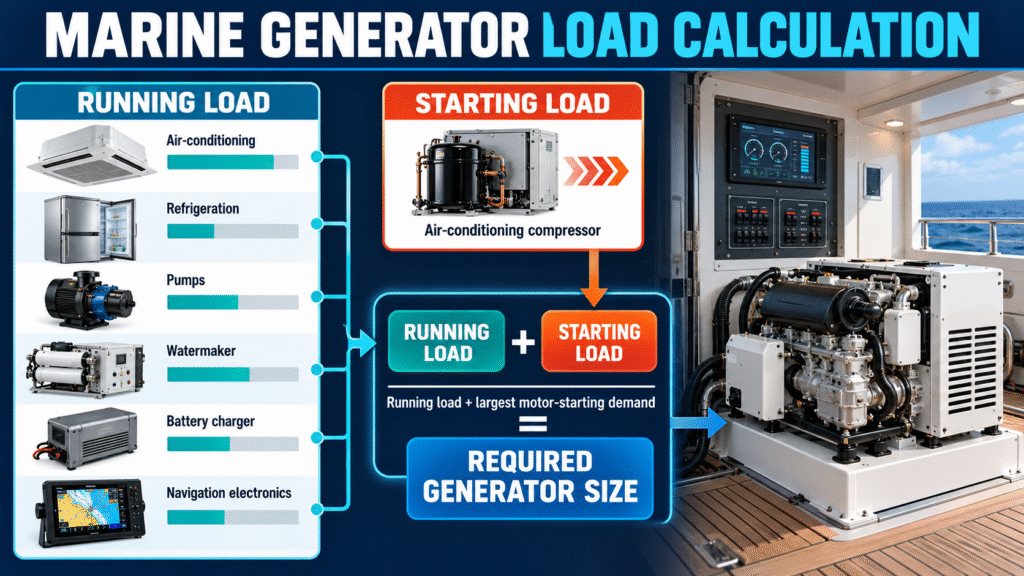
Assume a yacht has the following expected normal load:
| Equipment | Running load |
|---|---|
| Two air-conditioning units | 4.0 kW |
| Watermaker | 1.2 kW |
| Battery charger | 1.5 kW |
| Refrigeration | 0.7 kW |
| Pumps | 0.8 kW |
| Navigation and lighting | 0.6 kW |
| Total running load | 8.8 kW |
The largest air-conditioning compressor requires a starting demand equivalent to an additional 4 kW during startup.
A simplified starting assessment would be:
8.8 kW running load + 4 kW additional starting demand = 12.8 kW temporary requirement
A generator rated only at 9 kW may operate the equipment after startup but fail when the compressor starts. A suitable solution might be:
- A larger generator with adequate motor-starting performance
- A soft starter for the compressor
- Load sequencing
- Temporary load shedding
- A generator selected through a manufacturer’s sizing tool
The final choice should not be based on the arithmetic alone. The generator’s alternator, engine response, voltage dip, frequency recovery, power factor, and control system must also be checked.
Does boat length determine generator size?
No. Boat length is only a rough indicator of possible electrical demand.
Two boats of the same length may require very different generator sizes because of differences in:
- Air-conditioning capacity
- Number of cabins
- Galley equipment
- Watermaker size
- Battery-bank and inverter capacity
- Refrigeration
- Owner preferences
- Commercial equipment
- Intended climate and cruising area
- Shore-power availability
- Operating schedule
A boat operating in a hot climate with several air-conditioning units may require considerably more generator capacity than a similarly sized boat used mainly for coastal day trips.
Installation factors that affect generator selection
The generator must physically and mechanically fit the vessel.
Check:
- Length, width, and height
- Dry and wet weight
- Mounting-foot spacing
- Service access
- Removal route
- Sound-shield dimensions
- Fuel connection location
- Exhaust outlet position
- Seawater inlet and outlet
- Cooling-water connections
- Battery access
- AC cable routing
- Ventilation
- Engine-room temperature
- Vibration isolation
- Control-panel location
A generator that fits inside the engine room may still be unsuitable if technicians cannot access the oil filter, fuel filter, impeller, belts, control panel, or heat exchanger.
Cooling and exhaust arrangements must also be confirmed. Potential configurations include:
- Freshwater cooling with a heat exchanger
- Raw-water cooling
- Keel cooling
- Wet exhaust
- Dry exhaust
- Water-jacketed exhaust components
Replacement projects require special care because the new generator may not share the old unit’s mounting points, exhaust height, cooling connections, wiring, or control system.
Choosing between one large generator and two smaller generators
Larger yachts and commercial vessels may use two generators instead of one large unit.
Two generators can provide:
- Redundancy
- Better fuel efficiency at lower loads
- Flexible operation
- Easier maintenance scheduling
- Additional capacity during peak demand
However, the installation may require:
- Automatic paralleling
- Load-sharing controls
- A larger switchboard
- Additional fuel and exhaust systems
- More maintenance
- More installation space
- Higher initial cost
The best configuration depends on the vessel’s operating profile, redundancy requirements, classification rules, and expected load pattern.
Common marine generator sizing mistakes
Choosing by boat length
Boat length does not reveal the actual electrical load.
Adding every appliance together
This can produce an unnecessarily large generator if many appliances never operate simultaneously.
Ignoring motor-starting current
A generator may support running loads but fail when a compressor or pump starts.
Confusing kW and kVA
The generator must be matched to both real and apparent power requirements.
Ignoring voltage and frequency
A generator with the wrong electrical output may require expensive system changes or be unusable.
Choosing the largest generator available
Oversizing may result in poor loading, higher cost, greater fuel consumption, and unnecessary installation work.
Forgetting future loads
If the vessel will receive additional air-conditioning, battery charging, refrigeration, or workshop equipment, the future requirement should be included in the design.
Ignoring service access
Poor access can make routine maintenance difficult and increase operating costs.
Marine generator sizing checklist
Before requesting a quotation, prepare the following information:
- Vessel make and model
- Vessel length and intended use
- Existing generator model
- Desired generator output
- Voltage
- Frequency
- Phase
- Electrical load schedule
- Largest motor or compressor
- Starting-current information
- Cooling arrangement
- Exhaust arrangement
- Available installation dimensions
- Mounting-point measurements
- Sound-shield requirements
- Control-panel requirements
- Classification or certification requirements
- Delivery location
- Required purchase date
The purchase timeline is also important because model availability, production schedules, shipping, and stock allocation can affect the final quotation.
What size marine generator do I need for air conditioning?
The answer depends on the total air-conditioning running load and the compressor-starting requirement.
Do not add only the BTU rating of the air-conditioning systems. Obtain the electrical data for each unit, including:
- Running amps
- Locked-rotor amps
- Voltage
- Phase
- Frequency
- Starting method
- Soft-starter availability
A boat with one small air-conditioning unit may operate with a compact marine generator, while a yacht with several compressors may require a substantially larger generator or a load-management system.
What size marine generator do I need for a watermaker?
A watermaker’s electrical demand depends on its production capacity, high-pressure pump, motor type, voltage, and starting method.
Add the watermaker’s running demand to the other loads expected to operate simultaneously. If its pump starts while air-conditioning or refrigeration is running, its starting current must also be considered.
What size marine generator do I need for a yacht?
There is no reliable answer based only on yacht length. A compact yacht may need approximately 5–10 kW, while a larger yacht with multiple air-conditioning units, watermakers, electric cooking, and high-capacity chargers may require 20 kW, 40 kW, or more.
The correct size comes from a load schedule and starting-load assessment.
Can I use a generator with a higher kW rating?
A higher-rated generator may be suitable if it matches the vessel’s electrical system and operates at a reasonable load during normal use.
However, selecting a larger generator does not automatically solve motor-starting problems. The generator’s alternator performance, voltage dip, frequency recovery, power factor, and control system still need to be checked.
Can solar panels and batteries reduce generator size?
Yes, batteries, inverters, solar panels, and energy-management systems may reduce the generator’s operating hours or peak demand.
However, they do not necessarily eliminate the need to evaluate:
- Battery-charging demand
- Inverter surge capacity
- Air-conditioning loads
- Motor-starting requirements
- Battery-bank size
- Charging time
- Backup requirements
- Safety and ventilation
The generator may be sized for recharge and peak loads rather than for every onboard load operating continuously.
How Marine Inboard Specialists can help
Marine Inboard Specialists supplies marine generators for yachts, boats, commercial vessels, workboats, replacement projects, and new installations.
Browse the marine generator category or compare available options from:
- Cummins Onan marine generators
- Fischer Panda marine generators
- Kohler/Rehlko marine generators
- Northern Lights marine generators
- Phasor marine generators
- Westerbeke marine generators
For an accurate recommendation, provide the vessel details, electrical load information, existing generator data, installation photographs, delivery address, and expected purchase timeline.
Final answer: what size marine generator do I need?
The correct answer to “what size marine generator do I need?” is the smallest properly configured generator that can handle the vessel’s maximum realistic running load and largest starting load without unacceptable voltage or frequency instability.
Start by calculating simultaneous running loads. Then account for motor-starting current, power factor, voltage, frequency, phase, cooling, exhaust, installation dimensions, service access, and future expansion.
A qualified marine generator supplier or electrical engineer should confirm the final model selection before purchase and installation.
Leave a Reply