

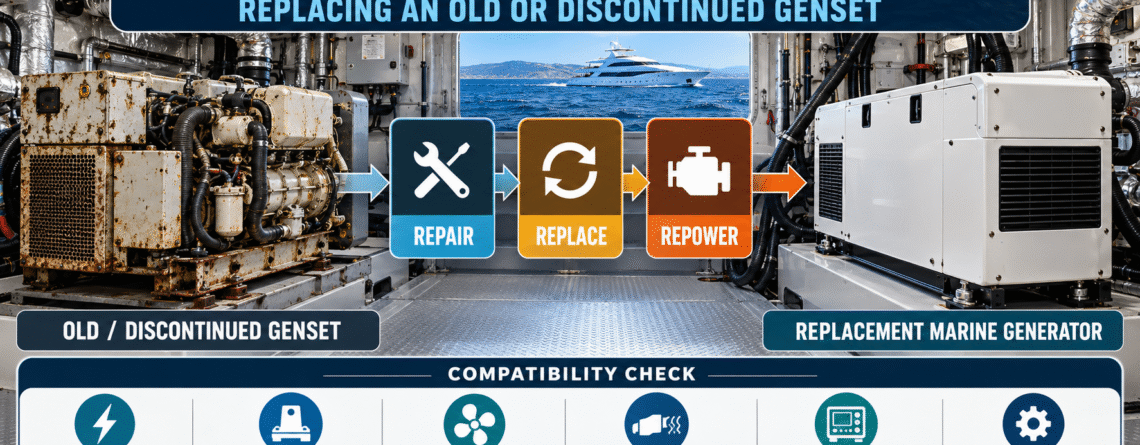
Replacing an old marine generator is rarely as simple as removing one unit and installing another with the same kilowatt rating. A suitable replacement marine generator must match the vessel’s electrical requirements, physical installation, cooling system, exhaust arrangement, controls, wiring, service access, and future operating needs.
A same-brand, same-kW generator may still require new mounts, exhaust modifications, electrical changes, control wiring, or cooling-system work. In some cases, repairing the existing genset is safer and more economical. In others, an updated generator or a complete repower is the better long-term decision.
This marine generator replacement guide explains how to evaluate those options before ordering equipment.
The safest replacement is not necessarily the model that looks most similar. It is the option that creates the lowest total installation and operating risk.
When should you replace an old marine generator?
A generator should not be replaced solely because it is old. Age matters, but condition, parts availability, reliability, and installation risk matter more.
Replacement may be appropriate when:
- The generator has repeated failures
- The engine or alternator requires a major overhaul
- The model is discontinued
- Replacement control components are unavailable
- The generator cannot support the vessel’s current electrical loads
- Fuel consumption has become unacceptable
- Noise or vibration has increased significantly
- Corrosion has affected major components
- The generator has poor service access
- The vessel’s electrical system has been upgraded
- The existing unit no longer meets project or commercial requirements
A discontinued generator may continue operating for many years if service parts remain available and the unit is maintained properly. Discontinued status alone does not automatically make replacement the correct decision.
Repair, replace, or repower?
Before selecting a new unit, compare three possible paths.
Repair the existing generator
Repair may be suitable when:
- The engine block is sound
- The alternator remains serviceable
- Parts are available
- The control system can be supported
- The required repair is clearly identified
- The vessel’s electrical demand has not changed
Repairs may include:
- Fuel-system work
- Cooling-system repairs
- Raw-water pump replacement
- Starter or alternator repair
- Control-panel replacement
- Wiring repairs
- Gasket and seal replacement
- Injector or cylinder-head work
A repair is not automatically economical if the generator requires several major components at the same time.
Replace the genset
A direct or near-direct replacement may be appropriate when:
- The existing generator is beyond economical repair
- A current successor model is available
- The vessel’s electrical demand is similar
- Existing systems can be adapted
- The mounting and access requirements are manageable
- Parts and warranty support are important
Repower or redesign the system
A repower may be the better option when:
- The vessel’s electrical demand has increased
- The existing generator is severely outdated
- The original installation is poorly arranged
- The cooling or exhaust system is inadequate
- A new voltage, frequency, or phase configuration is required
- The vessel needs improved controls or redundancy
- Two smaller generators may be more suitable than one oversized unit
A repower may involve more work initially, but it can provide a better long-term result than forcing a new unit into an unsuitable old installation.
Why the old kW rating is not enough
The existing generator’s kW rating is useful, but it should be treated as a starting point—not proof that the same output is correct today.
The vessel’s electrical requirements may have changed since the original generator was installed.
New equipment may include:
- Additional air-conditioning
- Larger battery chargers
- Lithium battery systems
- Inverters
- Watermakers
- Refrigeration
- Electric cooking equipment
- Hydraulic pumps
- Communications equipment
- Workshop machinery
Conversely, the vessel may no longer need the same capacity if older equipment has been removed.
Before choosing a replacement marine generator, prepare a current load assessment that considers:
- Running load
- Starting load
- Simultaneous equipment use
- Voltage
- Frequency
- Phase
- Power factor
- Required operating margin
For detailed electrical calculations, refer to the related marine generator sizing guide.
The V.E.S.S.E.L. replacement check
A practical way to evaluate a replacement is the V.E.S.S.E.L. framework:
| Letter | Check | Main question |
|---|---|---|
| V | Vessel demand and duty | What must the generator power, and how often will it run? |
| E | Electrical match | Do voltage, frequency, phase, kW, and kVA match? |
| S | Space and service access | Will it fit, move into position, and remain maintainable? |
| S | Systems and interfaces | Can cooling, exhaust, fuel, controls, and wiring be connected safely? |
| E | End-of-life support | Will parts, manuals, and technical support remain available? |
| L | Lifecycle and installed cost | What will the complete project cost to install and operate? |
This framework is an editorial decision tool, not an official manufacturer or classification standard. Its purpose is to prevent buyers from focusing only on price or rated output.
V — Vessel demand and duty
Begin by documenting what the generator must do.
Recreational vessel
A yacht or cruising boat may require power for:
- Air-conditioning
- Refrigeration
- Battery charging
- Watermakers
- Lighting
- Navigation electronics
- Cooking equipment
- Entertainment systems
Commercial vessel
A fishing boat, workboat, passenger vessel, or patrol craft may also require power for:
- Freezer systems
- Hydraulic equipment
- Winches
- Processing machinery
- Commercial pumps
- Workshop tools
- Communications
- Continuous hotel loads
The operating schedule is important. A generator running for a few hours each month has different lifecycle requirements from one operating every day offshore.
E — Electrical match
The replacement must match the vessel’s complete AC system.
Confirm:
- Rated kW
- Rated kVA
- Voltage
- Frequency
- Phase
- Alternator connection
- Power factor
- Motor-starting capability
- Circuit-breaker arrangement
- Transfer-switch compatibility
- Remote-start requirements
A 10 kW generator with 120/240 V, 60 Hz, single-phase output is not automatically interchangeable with a 10 kW generator configured for 230 V, 50 Hz, three-phase output.
Cummins’ marine product range demonstrates how generator families are offered in multiple output and frequency configurations, so the exact model and suffix must be verified before purchase. www.cummins.com
Is a same-brand replacement automatically safer?
No. Same-brand replacement can simplify documentation, service familiarity, or parts sourcing, but it does not guarantee a drop-in installation.
The new model may have different:
- Length
- Width
- Height
- Weight
- Mounting points
- Exhaust outlet
- Fuel connection
- Cooling connections
- Control system
- Electrical terminals
- Service-side orientation
- Sound-shield dimensions
A different-brand generator may sometimes require fewer vessel modifications if its dimensions and interfaces better match the existing installation.
The correct decision should be based on compatibility and total project risk, not brand loyalty alone.
S — Space and service access
Before ordering a replacement marine generator, measure both the existing installation and the route through which the new unit must pass.
Record:
- Generator length
- Generator width
- Generator height
- Dry weight
- Mounting-foot spacing
- Mounting-bed dimensions
- Engine-room hatch size
- Doorway and companionway dimensions
- Lifting access
- Removal route
- Service clearances
- Sound-shield dimensions
Also confirm that technicians will be able to reach:
- Oil filter
- Fuel filter
- Raw-water impeller
- Belts
- Coolant filler
- Control panel
- Battery connections
- Drain points
- Heat exchanger
- Exhaust components
Northern Lights’ installation guidance emphasizes the importance of using current dimensional drawings and planning for mounting, ventilation, cooling-water supply and discharge, exhaust, fuel lines, electrical wiring, bonding, and service access. Northern Lights generator
S — Systems and interfaces
A replacement marine generator must connect safely to the vessel’s existing systems. This is where many apparently simple replacement projects become complicated.
Review the following interfaces before ordering:
- Fuel supply and return
- Seawater intake
- Freshwater cooling circuit
- Exhaust outlet
- Wet-exhaust mixer
- Waterlift muffler
- Siphon break
- AC output cables
- Remote-start wiring
- Battery cables
- Control panel
- Grounding and bonding
- Ventilation
- Fuel and exhaust alarms
Cooling compatibility
Confirm whether the existing installation uses:
- Heat-exchanger cooling
- Keel cooling
- Raw-water cooling
- Closed-loop cooling
- Wet exhaust
- Dry exhaust
A new generator may have different water-flow requirements, hose sizes, connection locations, or siphon-break arrangements.
Changing from a heat-exchanger system to a keel-cooled system—or the reverse—may require more than replacing the generator. It can affect the vessel’s plumbing, heat-rejection capacity, exhaust design, and available installation space.
Exhaust compatibility
The existing exhaust system should be compared with the replacement generator’s requirements.
Check:
- Exhaust outlet height
- Exhaust elbow position
- Hose diameter
- Maximum back pressure
- Waterlift muffler capacity
- Siphon-break position
- Exhaust hose routing
- Through-hull discharge location
- Engine-room ventilation
Incorrect exhaust design can cause high exhaust temperatures, poor engine performance, water entering the engine, or unsafe exhaust-gas exposure.
Manufacturer installation documents should be treated as the controlling technical reference. A Northern Lights installation manual, for example, calls for attention to mounting, ventilation, cooling-water supply and discharge, exhaust discharge, fuel lines, electrical wiring, system bonding, and service access. www.northern-lights.com
Fuel-system compatibility
The replacement unit may require different fuel-flow, return-line, filtration, or connection arrangements.
Review:
- Fuel-supply line size
- Fuel-return requirements
- Fuel shutoff valve
- Fuel-water separator
- Lift-pump arrangement
- Hose type and routing
- Tank connection
- Accessibility for filter replacement
Do not assume that existing fuel hoses can be reused simply because they appear visually compatible.
Electrical and control compatibility
Electrical compatibility includes more than connecting the main AC cables.
Compare:
- Generator output
- Breaker arrangement
- Cable size
- Neutral configuration
- Grounding
- Bonding
- Remote start/stop
- Automatic transfer switch
- Monitoring system
- Alarm circuits
- Digital communications
- Battery voltage
- Preheat controls
A new generator may use a different control system from the old model. This could require a new remote panel, harness, interface module, or changes to the vessel’s monitoring system.
Discontinued genset replacement options
When a marine generator has been discontinued, there are usually several possible replacement routes.
Option 1: Find the same model
This may be possible through:
- Existing dealer stock
- Unused surplus stock
- Specialist marine suppliers
- Reconditioned equipment
- Take-out units
- International sourcing
The advantage is potential compatibility with the current installation. The disadvantage is that warranty, documentation, condition, and future parts support may be limited.
Option 2: Use the manufacturer’s successor
A current successor model may provide:
- Updated controls
- Improved emissions performance
- Current warranty
- Better parts support
- New documentation
- Improved monitoring
However, a successor is not automatically a drop-in replacement. Confirm current dimensional drawings, mounting points, exhaust position, cooling connections, and control wiring.
Option 3: Select another brand
A different manufacturer may offer:
- A better physical fit
- More suitable output
- Better service support in the vessel’s region
- Improved noise performance
- More accessible spare parts
- A lower total installation cost
The correct decision should be based on the vessel’s requirements rather than brand continuity.
Option 4: Repair the existing system
If the generator’s engine block, alternator, and major components remain serviceable, repair may avoid substantial installation modifications.
However, compare the repair estimate with:
- Remaining service life
- Parts availability
- Expected future failures
- Fuel consumption
- Noise and vibration
- Warranty
- Installation labor
- Downtime
Compatibility checklist: old versus replacement unit
Use the following comparison before placing an order.
| Item | Existing genset | Proposed replacement |
|---|---|---|
| Manufacturer and model | Record exact details | Confirm exact model |
| Rated kW/kVA | Check nameplate | Confirm specification |
| Voltage | Record output | Match vessel |
| Frequency | 50 or 60 Hz | Match vessel |
| Phase | Single or three-phase | Match vessel |
| RPM | Record | Compare operating speed |
| Length and width | Measure | Check drawing |
| Height | Measure with connections | Include sound shield |
| Weight | Confirm dry weight | Check mounting structure |
| Mounting points | Measure bolt spacing | Confirm compatibility |
| Exhaust outlet | Photograph and measure | Compare position |
| Cooling connections | Record hose locations | Confirm interface |
| Fuel connections | Record size and position | Check requirements |
| Control panel | Identify type | Confirm included controls |
| Service clearance | Measure available space | Check maintenance access |
| Removal route | Confirm access | Plan delivery path |
| Warranty | Record remaining coverage | Confirm new terms |
| Parts support | Check availability | Confirm future support |
An 8 kW replacement marine generator is not automatically compatible with an existing 8 kW unit. The output may match while the mounting, exhaust, cooling, wiring, or service access does not.
E — End-of-life support
The long-term support plan should be part of the replacement decision.
Ask the supplier or manufacturer:
- Is the proposed model current?
- Are routine service kits available?
- Can filters, belts, impellers, and anodes be sourced?
- Are control modules still supported?
- Are wiring diagrams available?
- Are technical manuals available?
- Is regional service support available?
- How are warranty claims handled?
- Can emergency parts be supplied internationally?
- Is the generator likely to remain in production?
This is especially important for vessels operating far from their home port.
A low-cost generator with poor parts availability may create more downtime and expense than a higher-priced unit with dependable support.
Common replacement parts to plan for
Prepare a basic service-parts plan containing:
- Oil filters
- Fuel filters
- Air filters
- Raw-water impellers
- Drive belts
- Anodes
- Gaskets
- Coolant
- Seawater-pump components
- Sensors
- Starter components
- Control fuses
- Replacement hoses
For a commercial vessel, consider keeping a larger onboard spare-parts inventory based on operating hours, voyage duration, and distance from service facilities.
L — Lifecycle and installed cost
The purchase price of the genset is only one part of the replacement marine generator project.
The complete cost may include:
- Generator set
- Sound enclosure
- Control panel
- Remote display
- Removal of old unit
- Freight
- Customs and taxes
- Mounting modifications
- Electrical rewiring
- Exhaust modifications
- Fuel-system changes
- Cooling-system changes
- New hoses and fittings
- Battery and cables
- Commissioning
- Load testing
- Engineering or certification
- Temporary vessel downtime
A generator that appears cheaper may require extensive modifications. Another unit with a higher purchase price may fit the existing installation more closely and reduce labor.
For broader pricing considerations, see the marine generator cost guide.
Compare the complete project, not only the genset
When reviewing quotations, separate confirmed facts from estimates.
Confirmed equipment information
The quotation should identify:
- Exact manufacturer
- Exact model
- Output
- Voltage
- Frequency
- Phase
- Dimensions
- Weight
- Controls
- Cooling
- Exhaust configuration
- Warranty
Seller inclusions
Confirm whether the price includes:
- Sound shield
- Local controller
- Remote controller
- Wiring harness
- Flexible mounts
- Exhaust elbow
- Siphon break
- Circuit breaker
- Spare-parts kit
- Freight
- Commissioning
Vessel-specific requirements
These may need separate technical review:
- Existing switchboard compatibility
- Exhaust back pressure
- Cooling-water capacity
- Mounting-bed strength
- Ventilation
- Structural changes
- Classification requirements
- Local electrical regulations
A quotation should clearly state what is included, what is excluded, and what must be confirmed by the installer.
A practical replacement example
Imagine a yacht with an old 9 kW marine generator that has become unreliable.
The owner finds a newer 9 kW model from the same manufacturer. At first, it appears to be a direct replacement.
However, the review shows:
- The new generator is taller
- The mounting feet are farther apart
- The exhaust outlet is in a different position
- The remote panel uses a different harness
- The seawater connections are on the opposite side
- The new sound shield requires additional clearance
The generator may still be suitable, but it is not a simple drop-in installation.
An alternative 8 kW or 10 kW model from another manufacturer may require fewer changes. The correct comparison is therefore not only the price of the genset. It is:
Generator price + modification cost + installation labor + downtime + future support
This is the main reason same-brand, same-kW replacement should not be treated as automatically lowest risk.
A practical marine generator replacement process
A successful replacement project begins before the old generator is removed.
Step 1: Identify the existing genset
Photograph the generator identification plate and record:
- Manufacturer
- Model
- Serial number
- Rated kW
- Rated kVA
- Voltage
- Frequency
- Phase
- Engine speed
- Battery voltage
Also photograph the control panel, mounting arrangement, exhaust, fuel lines, cooling connections, and electrical connections.
Step 2: Document the vessel’s present requirements
Record the equipment currently powered by the generator and identify any planned upgrades.
Include:
- Air-conditioning units
- Refrigeration
- Watermakers
- Pumps
- Battery chargers
- Inverters
- Water heaters
- Galley appliances
- Navigation systems
- Communication equipment
- Workshop or commercial loads
If the vessel’s electrical demand has increased, the replacement may need a different output from the original genset.
Step 3: Measure the installation
Measure the generator and the complete access route.
Check:
- Engine-room opening
- Doors and hatches
- Companionway width
- Lifting access
- Mounting-bed dimensions
- Exhaust route
- Fuel-line route
- Cooling-water route
- Service clearance
Do not measure only the space occupied by the old unit. Measure the route required to remove the old generator and deliver the new one.
Step 4: Compare technical drawings
Request the current dimensional drawing, wiring diagram, installation manual, and specification sheet for the proposed generator.
Compare those documents against the vessel’s existing installation.
Manufacturer drawings should be current because model dimensions and connection positions can change during production.
Step 5: Confirm the complete package
Ask the supplier to confirm whether the quotation includes:
- Generator set
- Sound enclosure
- Local control panel
- Remote panel
- Wiring harness
- Flexible mounts
- Exhaust elbow
- Siphon break
- Circuit breaker
- Cooling components
- Spare-parts kit
- Warranty
- Freight
- Commissioning
Step 6: Have the installation reviewed
A qualified marine technician or electrician should review:
- Fuel installation
- Exhaust routing
- Cooling system
- Electrical connections
- Ventilation
- Mounting
- Bonding
- Service access
- Load testing
- Safety requirements
This is especially important when replacing a discontinued generator with a different brand or configuration.
Replacement marine generator checklist
Use this checklist before ordering.
Existing generator
- Manufacturer and model
- Serial number
- Rated output
- Voltage
- Frequency
- Phase
- RPM
- Operating hours
- Cooling method
- Exhaust method
- Control system
Proposed generator
- Exact model
- Rated kW and kVA
- Voltage
- Frequency
- Phase
- Engine speed
- Dimensions
- Weight
- Mounting points
- Cooling arrangement
- Exhaust outlet
- Control panel
- Sound shield
- Warranty
- Availability
Vessel interfaces
- Fuel supply
- Fuel return
- Seawater intake
- Freshwater cooling
- Exhaust hose
- Waterlift muffler
- Siphon break
- Battery cables
- AC cables
- Remote-control wiring
- Grounding and bonding
- Ventilation
Commercial details
- Equipment price
- Installation estimate
- Freight
- Taxes and duties
- Delivery time
- Incoterms
- Payment terms
- Quotation validity
- Included accessories
- Exclusions
- Expected purchase date
Frequently asked questions
What is the best replacement marine generator?
The best replacement marine generator is the one that matches the vessel’s electrical output, voltage, frequency, phase, dimensions, mounting, cooling, exhaust, controls, service access, and parts-support requirements.
There is no universal replacement model for every boat.
Can I replace my old generator with the same kW rating?
You may be able to, but the same kW rating does not confirm compatibility. Check dimensions, mounting points, exhaust position, cooling connections, fuel connections, wiring, controls, and service clearances.
Can I replace a marine generator with another brand?
Yes, in many cases. A different brand may be a suitable replacement if the electrical and mechanical interfaces can be matched safely. The installation may require new mounts, wiring, exhaust components, cooling connections, or control equipment.
Is a discontinued marine generator still worth repairing?
Sometimes. Repair may be sensible if the engine block, alternator, and control system remain supportable and the repair cost is reasonable compared with replacement.
If major components are obsolete or unavailable, replacement may reduce long-term risk.
How do I replace a discontinued marine generator?
First identify the existing model and installation. Then compare a current successor, another brand, a used replacement, or a repair option. Confirm electrical output, dimensions, mounting, cooling, exhaust, wiring, controls, parts, warranty, and complete project cost before ordering.
How much does a replacement marine generator cost?
The cost depends on the generator’s output, brand, configuration, availability, freight, installation, and required vessel modifications. The equipment price may be only part of the total project cost.
For broader pricing information, read the marine generator cost guide.
Do I need to replace the control panel?
Not always, but a new generator may use a different control system or wiring harness. Confirm compatibility between the proposed generator, remote panel, monitoring system, and vessel switchboard.
Can I reuse the old exhaust system?
Possibly, but the exhaust diameter, outlet position, back pressure, water injection, muffler, hose condition, and siphon-break arrangement must be checked against the new manufacturer’s requirements.
Should I replace or upgrade to two smaller generators?
Two smaller generators may provide redundancy and better load flexibility, but the project may require a larger switchboard, automatic paralleling, load-sharing controls, additional exhaust systems, and more installation space.
Request a replacement marine generator quotation
Marine Inboard Specialists can help compare replacement marine generators for yachts, boats, workboats, fishing vessels, and commercial applications.
For an accurate recommendation, provide:
- Vessel make and model
- Existing generator manufacturer and model
- Generator nameplate photograph
- Required voltage, frequency, and phase
- Current electrical loads
- Installation dimensions
- Cooling and exhaust details
- Delivery location
- Expected purchase timeline
- Photographs of the existing installation
A strong quotation should identify the exact model, output, electrical configuration, included components, optional equipment, warranty, availability, delivery terms, and exclusions.
Browse the marine generator category or review related guidance:
Final conclusion
Replacing an old or discontinued genset is a compatibility project, not merely a product purchase.
The existing generator’s kW rating is useful, but it does not prove that another unit will fit or operate correctly. The replacement must be evaluated against the vessel’s electrical demand, voltage, frequency, phase, starting loads, dimensions, mounting, cooling, exhaust, fuel, controls, wiring, service access, parts availability, warranty, and total installed cost.
The central lesson of this article is simple:
A same-brand, same-kW generator is not automatically the lowest-risk replacement.
The right decision may be a repair, a current successor, a different brand, a used unit, or a complete repower. The best option is the one that provides dependable power while creating the lowest practical installation and lifecycle risk.

Leave a Reply