

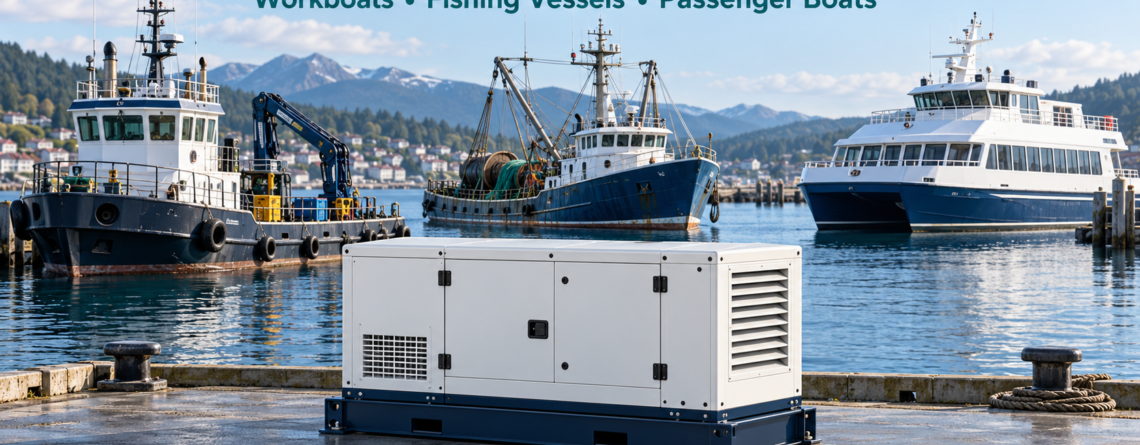
Imagine a fishing vessel returning with a valuable catch when its generator stops supplying refrigeration. Or a passenger boat losing air conditioning and galley power during a scheduled trip. The consequences extend beyond inconvenience: electrical downtime can interrupt operations, affect customers, and put revenue at risk.
Choosing a commercial marine generator therefore starts with the work the vessel must perform. Purchase price, rated output, and brand reputation matter, but they cannot replace a proper assessment of operating hours, electrical loads, maintenance access, and vessel requirements.
For marineinboardspecialists readers, the strongest buying decision is a documented match between the generator and the vessel’s operating profile.
This guide examines the differences between workboat, fishing-vessel, and passenger-boat applications, introduces manufacturer options worth investigating, and explains what to establish before requesting quotations.
What Is the Best Commercial Marine Generator?
The best commercial marine generator is the model with the appropriate duty rating, electrical configuration, load-handling capability, installation arrangement, and service support for your vessel.
There is no universal winner for every commercial boat.
A workboat operating electrical tools intermittently has different requirements from a fishing vessel maintaining refrigeration throughout a trip. A passenger boat adds another operating profile, with scheduled services, passenger comfort loads, and potentially specific survey or classification requirements.
Begin with these questions:
- What equipment must remain powered?
- Which loads operate simultaneously?
- How many hours will the generator run?
- What large motors or changing loads must it handle?
- What happens if the generator becomes unavailable?
- Which vessel-specific requirements apply?
The answers determine which models belong on the shortlist.
Commercial Generator Options Worth Investigating
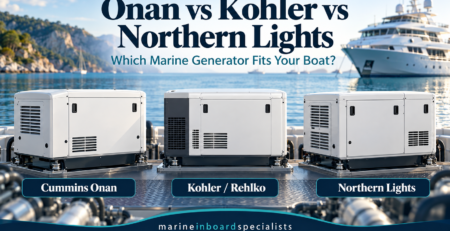
Cummins Onan, Kohler/Rehlko, and Northern Lights offer marine generator options relevant to commercial applications. Their published information provides a starting point for selection, rather than evidence of a universal reliability or value ranking.
Cummins Onan
Cummins describes its Onan Marine QD 40–110 kW family as available for recreational and commercial gensets. Buyers should identify the exact model and confirm its applicable rating, output configuration, and suitability for the intended operating profile. The family name alone does not establish that every configuration meets the same requirement. Cummins Inc.
Kohler/Rehlko
Rehlko maintains a commercial marine generator range and describes paralleling capabilities within its commercial offering. Where multiple-generator operation is required, investigate which models, controllers, accessories, and engineering arrangements support the proposed system. Do not assume these functions are included in every quotation. Global EN
Northern Lights
Northern Lights publishes dedicated commercial marine generator information, including its C4105 and C6105 series. Assess the exact configuration against your load schedule, duty requirements, installation space, and service arrangements. northern-lights.com
These manufacturers are candidates for evaluation. A meaningful comparison requires equivalent electrical configurations and documented operating requirements.
| Manufacturer | Useful starting point for comparison |
|---|---|
| Cummins Onan | Exact commercial configuration, applicable rating, and load response |
| Kohler/Rehlko | Generator configuration, controls, and any required paralleling functions |
| Northern Lights | Commercial model specifications, installation options, and service access |
Confirm current availability, included equipment, and support through the supplier before making a purchase decision.
Start With the Vessel’s Operating Profile
A marine diesel generator for commercial use should be selected around actual operations. Boat length provides context, but it does not establish electrical demand.
Write down a typical working day, including equipment use, operating duration, and periods when demand changes.
Workboats: Identify the Equipment That Does the Job
Workboats may need electrical power for tools, pumps, compressors, lighting, accommodation, or specialist equipment.
However, not every deck machine is generator-powered. Some equipment may be driven mechanically, hydraulically, or through another power source. Identify the actual electrical loads before including them in the calculation.
For a workboat generator, useful questions include:
- Will tools or welding equipment operate?
- Are pumps and compressors electrically driven?
- Which motors start while other equipment runs?
- Does specialist equipment impose particular power-quality requirements?
- Is demand steady, intermittent, or rapidly changing?
Two workboats of similar size can need substantially different generating systems.
Fishing Vessels: Account for the Catch-Handling System
A fishing vessel generator assessment should identify the equipment that supports the vessel’s particular fishing operation.
Potential loads include refrigeration, freezing equipment, ice production, pumps, lighting, and accommodation systems. Some vessels use different power arrangements, so confirm how each system is supplied.
Separate normal fishing, catch processing, transit, and overnight operating conditions.
Then identify which loads are commercially critical. If refrigeration must remain available, the buying discussion should address how that requirement will be supported during maintenance or a failure—not simply how much power it consumes.
Passenger Boats: Assess Operating Peaks and Required Services
A passenger boat generator may supply cooling, ventilation, catering equipment, lighting, sanitation systems, and other onboard services.
Demand can change during boarding, meal preparation, hot-weather operation, and turnaround periods.
List normal comfort loads separately from services with specific safety or regulatory requirements. Do not assume that choosing a suitably sized normal-service genset automatically satisfies any emergency-power obligation.
Have the vessel’s responsible designer, surveyor, or other qualified professional identify the applicable requirements before the specification is finalised.
Duty Rating Matters as Much as Advertised kW
Two generators with similar advertised output may have different permitted operating conditions.
For commercial applications, establish the rating that applies to the exact generator configuration and the duty you expect it to perform.
Record Hours and Load Patterns
Tell the supplier:
- Expected operating hours per day and year.
- Whether the load is relatively constant or variable.
- Typical and maximum demand.
- Significant starting or step loads.
- Expected periods of low load.
- The intended operating environment.
Ask for written confirmation that the quoted rating suits this profile.
Read the Manufacturer’s Rating Conditions
Terms such as prime power, continuous power, and standby power describe different rating arrangements. Review the manufacturer’s definitions and any stated operating limits rather than relying on the label alone.
For a vessel requiring extended generation, do not choose a standby-rated configuration solely because its advertised kW figure looks attractive.
Also confirm any applicable output adjustments for the proposed installation and operating conditions.
A useful quotation should identify the rating basis, not just the largest number in a brochure.
Size for Electrical Behaviour, Not Just Total Consumption
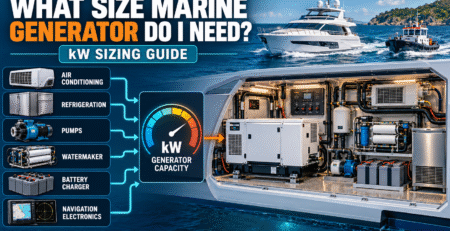
A commercial marine generator sizing assessment needs both sustained-load calculations and an examination of significant load changes.
Build Separate Operating Scenarios
Create a load schedule for the vessel’s main activities.
| Operating scenario | Equipment to identify |
|---|---|
| Normal working operation | Regular machinery and background loads |
| Peak production or processing | Equipment expected to operate together |
| Transit | Navigation-related supplies, accommodation, and retained operational loads |
| Overnight operation | Essential systems and intended comfort loads |
| Maintenance or reduced service | Equipment that must remain available |
These are planning categories, not assumptions about what your vessel carries.
Identify Motor Starts and Changing Loads
Pumps, compressors, and refrigeration equipment can create starting conditions that differ from normal operation. Welding equipment and electronically controlled loads may also require particular assessment.
Provide the exact equipment specifications where possible. Have the supplier evaluate the proposed generator’s response, including acceptable voltage and frequency behaviour.
A running-load total alone cannot establish that every intended start or load change will be successful.
Define the Consequence of Losing Power
The most useful early question may be: What must the vessel still be able to do if its main generator stops?
That question helps establish whether the project needs a single genset, an alternative supply arrangement, multiple generators, or a separately specified emergency system.
These solutions serve different purposes and require appropriate engineering. Two installed generators do not automatically provide full redundancy if they share vulnerable supporting systems or cannot carry the required loads individually.
For marineinboardspecialists readers, defining critical services early makes the quotation process more productive. It connects generator capacity with the vessel’s operational needs and the financial consequences of downtime.
Before comparing prices, establish the load schedule, operating duty, critical services, and applicable vessel requirements. Those details provide the foundation for choosing a commercial generating system that supports the work your boat must perform.
How to Compare Commercial Marine Generators for Your Vessel
Once you have defined the vessel’s loads and operating duty, compare specific generator configurations against those requirements.
A commercial marine generator quotation should identify more than a brand and kW figure. It should state the electrical configuration, applicable rating, included equipment, installation requirements, and supporting documentation.
Send the same specification to each supplier. Otherwise, differences in quoted prices may reflect different equipment scopes rather than better value.
Use Mandatory Requirements Before Comparing Preferences
Separate requirements that every candidate must satisfy from features you would prefer.
Mandatory requirements might include the vessel’s voltage and frequency, sufficient load-handling capability, installation dimensions, and required documentation. Preferences might include a particular remote display, enclosure arrangement, or maintenance layout.
Eliminate unsuitable candidates first. A lower price cannot compensate for an incompatible electrical configuration or inadequate service access.
| Comparison area | Evidence to request |
|---|---|
| Duty suitability | Written rating conditions matched to expected operation |
| Electrical compatibility | Voltage, frequency, phase, current limits, and output rating |
| Load response | Assessment of significant starts and load changes |
| Installation | Dimensional drawings and supporting-system requirements |
| Serviceability | Maintenance schedule and access requirements |
| Support | Model-specific service and parts arrangements |
| Project cost | Complete scope with exclusions clearly identified |
For marineinboardspecialists readers, this approach makes supplier discussions more productive: each recommendation must explain how it meets the same operating requirement.
Match Electrical Output to the Distribution System
Choosing a generator with adequate capacity is only one part of commercial vessel generator selection. Its output must suit the vessel’s electrical distribution and connected equipment.
Confirm Voltage, Frequency, and Phase
Record the existing system’s voltage, frequency, and phase arrangement. Identify any equipment supplied through transformers, converters, or separate distribution sections.
Have the proposed configuration checked against the vessel’s drawings and actual installation. Do not assume that similar kW ratings make different electrical versions interchangeable.
For a replacement project, confirm whether the existing switchboard, protection, cabling, and controls remain suitable.
Assess Individual Phase Loading
Where three-phase generation supplies single-phase loads, the combined kW total does not describe the complete loading condition.
One phase may carry substantially more current than another. The assessment should therefore consider load distribution and the generator’s permitted imbalance.
This can matter on passenger boats with accommodation loads, or workboats with equipment connected across different circuits. Have the electrical designer evaluate the actual arrangement.
Identify Equipment With Particular Supply Requirements
Some electronics, variable-speed drives, chargers, and specialist machinery require additional assessment.
Provide their specifications rather than classifying them simply as “miscellaneous loads.” Ask the supplier to consider their electrical characteristics and any applicable power-quality requirements.
An accurate load schedule helps prevent a apparently adequate generator from becoming unsuitable once the complete system is connected.
Single Generator or Multiple Generators?
A second generator adds useful capability only when the complete system is designed to deliver it. Two installed units do not automatically guarantee uninterrupted operation or full redundancy.
The appropriate arrangement depends on critical loads, operational consequences, available space, and vessel requirements.
A Single Generator Arrangement
A single genset may be appropriate where the vessel’s requirements and operating plan allow it.
Assess how maintenance will be scheduled and what happens if the unit becomes unavailable. Identify alternative supplies where applicable and establish whether the vessel can continue, operate in a reduced mode, or must stop work.
This decision should be made before purchase, rather than after the first service interruption.
Duty and Standby Operation
A duty-and-standby arrangement can provide an alternative generating source.
However, check whether the standby unit can supply the required loads, how transfer occurs, and what interruption the equipment can tolerate. Also review shared fuel, cooling, controls, and distribution components.
If both generators depend on the same vulnerable component, that dependency remains part of the system’s failure exposure.
Parallel Operation
A suitably engineered marine generator paralleling system may allow generators to share loads.
Its suitability depends on compatible equipment, synchronisation, load sharing, protection, switching, and control arrangements. The project also needs an operating strategy for connecting and disconnecting units.
Do not treat paralleling as a standard accessory that can be added without reviewing the vessel’s electrical system.
Ask the supplier to explain the proposed operating modes and what happens when one generator becomes unavailable.
Installation Quality Can Determine Long-Term Value
A strong generator specification can be undermined by an installation that restricts maintenance or fails to meet supporting-system requirements.
Before comparing final prices, obtain a review of the proposed machinery-space arrangement.
Check Access for Routine and Major Work
Allow access for scheduled servicing and for foreseeable component removal.
Review enclosure-panel removal, filter access, fluid servicing, cooling-system maintenance, and the route required for larger components.
Also consider lighting, working position, lifting arrangements, and access through the vessel. These details influence service time and the practicality of repairs.
A workboat generator installation should support the crew’s maintenance routine as well as the initial installation.
Review Cooling, Ventilation, and Exhaust
Confirm the proposed cooling arrangement and the manufacturer’s requirements for airflow and exhaust.
An existing system should not be assumed suitable for a replacement simply because it served a generator with similar output.
Have the installer assess the complete arrangement, including relevant operating conditions. Required modifications belong in the quotation.
Consider Noise Where People Work and Rest
Noise matters on commercial boats even when luxury-level comfort is not the objective.
For passenger vessels, identify the occupied areas where performance matters. For fishing vessels and workboats, consider crew accommodation and working locations.
Evaluate the enclosure, mounting arrangement, machinery-space construction, ventilation paths, and exhaust together. Comparable measurements are more useful than unsupported claims that a brand is “quiet.”
Compare Fuel Consumption Against Your Actual Workload
A fair commercial marine generator fuel consumption comparison uses equivalent conditions.
Two generators operating at the same percentage of their ratings may be producing different amounts of electrical power. Comparing those figures alone does not establish which will consume less fuel on your vessel.
Build an Operating-Hours Profile
Estimate how much time the vessel spends at different electrical demands.
For example, a fishing vessel might have separate transit, processing, and overnight conditions. A passenger boat might have boarding, underway, catering, and turnaround periods.
Use the corresponding manufacturer data where available. Treat the result as an estimate, because actual consumption depends on operating conditions.
Compare Equal Electrical Output Where Possible
Assess candidate generators at loads relevant to the vessel, rather than choosing the lowest figure in each brochure.
Check which configuration and frequency the data describes. Ask about gaps in the published information rather than filling them with assumptions.
Also review expected loading against manufacturer guidance. A generator sized for an occasional peak may spend much of its working life supplying a lower demand.
Maintenance and Parts Support Affect Operational Availability
For a commercial operator, maintenance is part of the production schedule.
Compare marine generator maintenance requirements before ordering. Identify tasks governed by operating hours, calendar intervals, or other stated conditions.
Translate Service Intervals Into Your Schedule
Consider a hypothetical generator requiring a particular service task every 250 operating hours.
At ten hours of operation per day, that interval would arrive after approximately 25 operating days. This example illustrates planning only; it is not a service recommendation for any model.
Use the actual manufacturer schedule to estimate service opportunities, consumable requirements, and labour needs.
Confirm Support Along the Operating Route
Ask service providers whether they support the exact model and control system.
Establish how routine parts will be obtained, who can diagnose faults, and how support works away from the home port. Obtain current availability and lead-time information during the quotation process.
For vessels with tight schedules, discuss a sensible onboard spares package with the manufacturer or qualified service provider. The selection should reflect the model, maintenance plan, and crew capability.
Compare Complete Ownership Costs
The most economical generator is not necessarily the one with the lowest purchase price.
A useful commercial marine generator cost comparison includes:
- Equipment and agreed accessories.
- Installation, modifications, and commissioning.
- Expected fuel expenditure.
- Scheduled maintenance and consumables.
- Service travel and parts logistics.
- The operational consequences of downtime.
Avoid inventing a single downtime figure. Use the operator’s own business information where available, such as cancelled-trip exposure or lost production.
For marineinboardspecialists readers, the next step is to bring these findings into one decision sheet. Record which candidates meet the mandatory requirements, what remains unconfirmed, and how each complete proposal supports the vessel’s operation.
That gives you a practical basis for choosing a generator—and a clear list of points to resolve before committing to the purchase.
Make the Final Choice Around the Vessel’s Work
The best commercial marine generator is the one that meets the vessel’s documented requirements and can be maintained and supported throughout its working life.
Cummins Onan, Kohler/Rehlko, and Northern Lights belong on the shortlist where their specific models suit the application. The final choice should come from equivalent quotations, confirmed duty suitability, installation planning, and service arrangements.
Avoid choosing a manufacturer first and trying to make the vessel’s requirements fit afterward.
For Workboats: Prioritise the Equipment That Earns Revenue
A generator for workboats should support the machinery and tools needed to complete the job.
Identify significant starts, changing loads, and any specialist equipment requirements. Then establish how the proposed generator will behave during those operating conditions.
Give maintenance access and local support appropriate weight. A unit that is difficult to service may disrupt a busy work schedule even when its electrical performance is suitable.
For Fishing Vessels: Define Critical Catch-Handling Loads
A generator for fishing vessels should be assessed against the actual refrigeration, processing, pumping, and accommodation systems aboard.
Where catch preservation depends on electrical power, document what must remain available during a generator failure or scheduled service. Have the proposed generating and distribution arrangement assessed against that requirement.
Additional capacity alone does not provide an alternative power source.
For Passenger Boats: Connect Capacity With the Service Schedule
A generator for passenger boats should meet the planned operating combinations, including cooling, ventilation, catering, and other applicable loads.
Assess noise in occupied areas and establish how maintenance fits around scheduled trips. Resolve the vessel’s applicable documentation and approval requirements before placing the order.
A product certificate should not be assumed to establish approval of the complete installation.
Use the WORK Check Before Ordering
The WORK check is an editorial buying framework for this guide, rather than a manufacturer standard. It brings four important decisions into one review.
W — Workload
Confirm the electrical loads, operating hours, significant starts, and expected changes in demand.
The generator recommendation should explain its suitability for that profile, including the rating conditions and any operating restrictions.
O — Operational Continuity
Identify what happens when the generator is unavailable.
Record the loads that must remain powered, any alternative supply arrangements, and the intended response to a failure. If multiple generators are proposed, confirm what each can support and which dependencies they share.
R — Repair and Service Access
Check whether routine maintenance and foreseeable repairs can be completed in the installed position.
Confirm model-specific technical support, parts arrangements, and the maintenance responsibilities of the crew and service provider.
K — Known Scope and Costs
Obtain a written equipment and installation scope.
Identify included accessories, required modifications, commissioning, documentation, delivery terms, and exclusions. Compare ownership costs using stated assumptions rather than optimistic estimates.
For marineinboardspecialists readers, a candidate that passes all four checks deserves closer consideration. An unresolved requirement remains a question to answer before purchase.
What Your Commercial Generator Quotation Should Include
A useful quotation connects the proposed equipment with the requirements you supplied.
Exact Generator Configuration
Request the model designation, electrical output, voltage, frequency, phase, and applicable duty rating.
Confirm the supplied enclosure, controls, protection equipment, wiring harnesses, and agreed accessories. Where dimensions or weight affect installation, obtain the relevant drawings and specifications.
For used or refurbished equipment, establish its condition, available operating history, completed work, and supporting records.
Installation and Integration Scope
Identify who is responsible for removal, lifting, mounting, electrical integration, supporting-system modifications, and commissioning.
For replacement projects, record which existing components will be retained and the basis for their suitability.
If several contractors are involved, clarify their responsibilities and who coordinates the complete system handover.
Required Documentation
Ask the vessel’s responsible designer, surveyor, or other qualified professional to identify the documentation applicable to the project.
Then ensure the supplier’s scope addresses it. Requirements may depend on the vessel, operating area, installation, and intended service.
Resolve documentation questions early. They can affect equipment selection, procurement, and project timing.
Delivery, Warranty, and Commercial Terms
Obtain written confirmation of availability, delivery arrangements, payment stages, quotation validity, and warranty terms.
Clarify registration or commissioning requirements and how warranty support would be arranged in the vessel’s operating region.
Where relevant, ask which labour, travel, removal, and reinstallation expenses are covered. Keep confirmed terms separate from assumptions.
Commission the System Against the Agreed Requirements
Commissioning should establish that the completed installation performs as intended under the relevant procedures and acceptance criteria.
Agree on the checks before installation begins.
Test Representative Operating Conditions
The commissioning plan should address the vessel’s intended load combinations and significant starts or load changes.
Where applicable, it should also verify transfer arrangements, paralleling functions, load management, alarms, and protective functions using approved procedures.
Do not substitute an unloaded demonstration for an assessment of the vessel’s working conditions.
Record Settings and Results
Collect relevant operating readings, control settings, test results, installation records, and any outstanding items.
If the system depends on a particular operating sequence or load limit, make that condition explicit.
Changes made later—such as adding equipment or altering controls—may require a new assessment.
Give the Crew a Practical Handover
The crew should understand normal operation, monitoring, routine checks, maintenance responsibilities, and how to report faults.
Provide accessible manuals and clear escalation contacts. A useful fault report includes the generator identification, displayed alarms, connected loads, and what happened immediately before the problem.
Good records help technicians investigate without relying on incomplete recollections.
Frequently Asked Questions
What is the best commercial marine generator brand?
There is no universal winner. Compare specific models from suitable manufacturers against duty requirements, electrical loads, installation constraints, documentation, and service support.
How do I size a generator for a fishing vessel?
Identify the actual electrically powered equipment, build operating scenarios, and assess significant starts and load changes. Include refrigeration, processing, pumps, and accommodation loads where fitted, while avoiding double-counting shared equipment.
Can a recreational marine generator be used commercially?
Do not assume suitability from the product name or output alone. Obtain written confirmation of the exact configuration’s rating, permitted operating conditions, warranty applicability, and suitability for the vessel’s requirements.
Do passenger boats need a separate emergency generator?
That depends on the vessel and applicable requirements. Have the responsible qualified professional establish the required emergency-power arrangement. A normal-service generator or second installed genset should not automatically be treated as compliant emergency power.
Is a three-phase generator better than a single-phase generator?
The appropriate choice depends on the distribution system and connected equipment. Confirm compatibility, load distribution, current limits, and allowable imbalance.
Will two generators provide full redundancy?
Not necessarily. Their capacity, transfer arrangements, controls, and shared supporting systems determine what remains available after a failure.
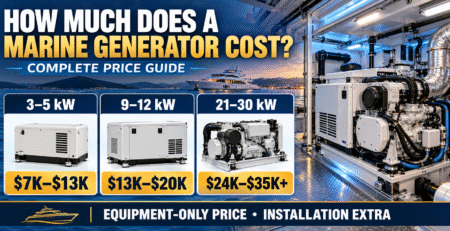
How much does a commercial marine generator cost?
A meaningful price requires a defined model and project scope. Compare complete quotations covering equipment, accessories, installation, commissioning, and required documentation, then assess expected operating costs separately.
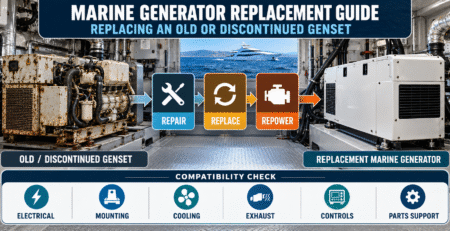
Should I repair or replace an existing commercial genset?
Compare the diagnosed fault, equipment condition, parts support, repair scope, expected downtime, and replacement installation requirements. Neither age alone nor one repair estimate establishes the best decision.
Request a Generator Proposal Built Around Your Vessel
Choosing a commercial marine generator is a decision about electrical performance, operational continuity, and ownership costs.
Start with the vessel’s workload. Confirm the applicable duty and electrical configuration. Resolve installation, support, and documentation requirements. Then compare complete proposals and verify the installed result.
To begin an enquiry with marineinboardspecialists, provide the vessel type, existing generator identification, electrical requirements, load schedule, expected operating hours, and machinery-space photographs. Include any identified documentation requirements, your billing and delivery addresses, and how soon you intend to purchase.
Those details give suppliers a stronger basis for recommending a generator that supports the work your vessel must perform.

Leave a Reply