

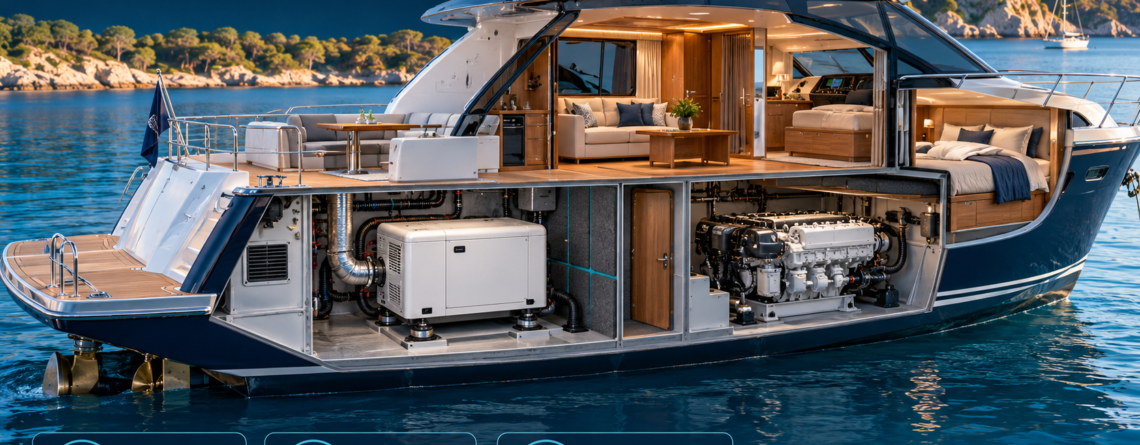
A generator can sound reasonable beside the machinery compartment and still make sleeping aboard difficult. A persistent hum reaches the cabin, vibration travels through the berth, or exhaust noise interrupts an otherwise peaceful anchorage.
That is why choosing a quiet marine generator requires more than comparing the lowest advertised decibel figures. You need to know how the measurements were taken, what equipment was included, and how the generator will interact with your boat.
When preparing an enquiry for marineinboardspecialists, start by explaining where noise matters most. Comfortable overnight operation in the owner’s cabin is a clearer objective than simply asking for the “quietest generator.”
This guide explains how to compare noise claims, identify installation factors, and assess suitable generator options. Manufacturer features are distinguished from practical buying guidance; no model is declared universally quietest without comparable evidence.
What Is the Quietest Marine Generator?
The quietest marine generator for your vessel is a suitably sized unit that achieves acceptable noise and vibration in occupied spaces under realistic operating loads.
There is no dependable universal winner based on brand alone.
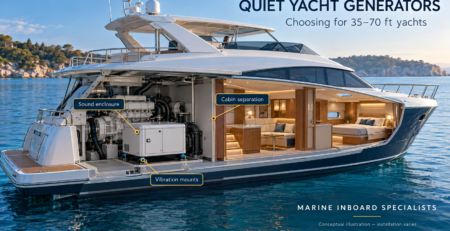
Sound enclosures, mounts, operating characteristics, exhaust arrangements, ventilation, and compartment construction all affect the result. A generator with an attractive published rating may still become intrusive if vibration passes through its foundation or machinery sound escapes through ventilation openings.
Compare the generator and its installation together.
For example, Northern Lights describes its Gem Series enclosures and compound mounts as measures for reducing noise and vibration. Its removable service-side panel also demonstrates why acoustic treatment must preserve maintenance access. www.northern-lights.com
Those are documented features worth investigating. They do not prove that every installation will outperform every competing generator.
Decide What “Quiet” Means for Your Boat
Different operating habits create different priorities.
An owner running the generator briefly for charging may tolerate sound that would be unacceptable during overnight air conditioning. Likewise, a comfortable saloon does not guarantee a quiet cockpit or sleeping cabin.
| Your priority | What to assess |
|---|---|
| Comfortable sleeping | Cabin sound, low-frequency hum, vibration, and starting events |
| Cockpit conversation | Machinery noise, ventilation outlets, and exhaust discharge |
| Quiet anchoring | Noise reaching surrounding vessels |
| Comfortable saloon | Bulkhead transmission, structural vibration, and rattles |
| Short charging periods | Sound at the actual charging load |
| Extended operation | Comfort under sustained demand and correct cooling |
Use these priorities when discussing options with marineinboardspecialists. Describe where the generator will operate, how long it will run, and which equipment it must support.
A combustion generator still produces sound and exhaust. The useful purchasing goal is acceptable onboard comfort through a suitable installation.
Understand the Four Main Generator Noise Paths
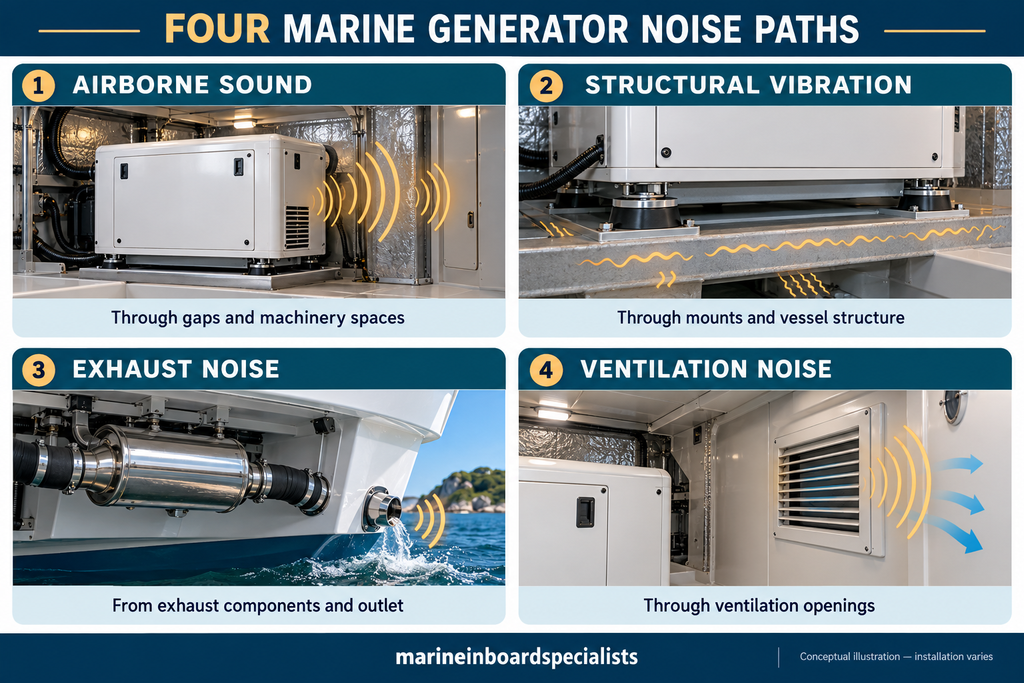
A low-noise marine generator can become unpleasant aboard if its installation allows sound or vibration to reach living spaces.
Airborne Machinery Noise
Engine combustion, moving components, and alternator operation produce airborne sound. It can travel through machinery compartments, access doors, gaps, and ventilation openings.
A properly designed generator sound enclosure helps control sound escaping directly from the equipment. However, missing panels, damaged seals, or unsuitable installation details can reduce its effectiveness.
Compare the complete housed dimensions and the space needed to open or remove enclosure panels. A generator that fits tightly but cannot be serviced is a poor installation choice.
Structure-Borne Vibration
Vibration can pass through mounts and foundations into the vessel’s structure. Connections to surrounding systems can also create transmission paths.
The resulting hum may be heard or felt some distance from the machinery space.
This explains why adding acoustic lining does not always solve a noise complaint. Lining primarily addresses airborne sound; it may not resolve vibration travelling through a foundation.
Mounting arrangements and connections should follow the manufacturer’s requirements and suit the vessel.
Exhaust Noise
Exhaust can remain noticeable even when machinery noise is controlled.
Its effect depends on the generator, exhaust components, routing, discharge location, and vessel layout. Owners may notice it most from cockpit seating or neighbouring boats.
Any marine generator exhaust silencer or other modification must remain compatible with the manufacturer’s installation requirements. Noise reduction cannot compromise back-pressure limits, cooling-water arrangements, or protection against water entering the engine.
Ventilation Noise
Ventilation paths can let machinery sound escape. Restricting those paths, however, can create overheating problems.
Effective marine generator noise reduction preserves the required airflow while addressing sound transmission.
Ask how the proposed installation manages both requirements. Closing openings or adding insulation without checking ventilation needs is not a complete solution.
How to Compare Marine Generator Noise Figures
A decibel figure needs context before it becomes useful purchasing evidence.
Check the Measurement Distance
A reading taken close to a generator is not directly comparable with one recorded farther away.
For example, figures measured at one metre and seven metres do not establish which generator is quieter under equivalent conditions. Do not select a winner from those numbers alone.
Confirm the Operating Load
Establish whether testing occurred unloaded, at a stated percentage of rated output, or under another defined condition.
Your boat may operate at a different load. An unspecified test condition offers limited help when predicting overnight air-conditioning or battery-charging noise.
Identify the Enclosure Configuration
Confirm whether the test included the sound shield offered in your quotation.
Also establish whether that enclosure is included or separately priced. A published figure for a housed generator should not be attributed to an unhoused package.
Distinguish the Measurement Type
Sound pressure and sound power describe different acoustic quantities. They should not be compared as though they are identical.
Many published figures use A-weighted sound pressure, expressed as dB(A). Request the measurement method instead of assuming every specification uses the same approach.
Understand the Test Environment
A manufacturer test and a cabin measurement aboard a yacht represent different conditions.
The vessel’s compartment location, construction, insulation, and surrounding equipment affect the installed result. Where available, evidence from a comparable installation can be useful—but its load and measurement conditions still need to be recorded.
| Comparison detail | Why it matters |
|---|---|
| Distance | Readings change with measurement position |
| Load | Your operating condition may differ from the test |
| Sound enclosure | Housed and unhoused packages are different |
| Acoustic quantity | Sound pressure and sound power are not interchangeable |
| Test environment | A laboratory or open-air result does not predict every cabin |
| Measurement location | Machinery-space comfort differs from cabin comfort |
Why a Low Noise Rating May Still Feel Intrusive
Overall level is only part of the experience.
A persistent hum, repeating rattle, or vibration through a berth can be objectionable even when a single reading appears modest. An A-weighted figure alone does not fully describe those effects.
Combine measurements with observations:
- Where is the sound most noticeable?
- Does it change as electrical demand changes?
- Is vibration felt through floors, furniture, or berths?
- Does closing the machinery-space door change the sound?
- Is the dominant noise machinery, exhaust, ventilation, or a rattle?
These observations help identify the transmission path before you spend money on a remedy.
If noise is driving a replacement enquiry to marineinboardspecialists, describe when and where it occurs. Include photographs of the compartment, mounts, nearby bulkheads, and accessible connections.
Replacing the generator may help, but installation problems should also be investigated.
Does Lower Engine Speed Mean Quieter Operation?
Engine speed is relevant, but it does not independently establish which generator will be quietest aboard.
A conventional fixed-speed AC generator operates at its designed speed to produce the required frequency. A variable-speed inverter system allows engine speed to change while supplying the specified electrical output.
Fischer Panda’s iSeries documentation describes load-dependent engine speed, inverter-supplied output, sound insulation, and water cooling. These features are worth investigating for varying onboard demand, but they do not establish a universal acoustic advantage over every fixed-speed generator. www.fischerpanda.de
For both designs, request model-specific evidence at loads resembling your own.
A variable-speed marine generator should be assessed as a complete system, including its inverter, controls, installation requirements, and support. A fixed-speed candidate needs the same attention to power, starting performance, fit, and sound transmission.
Size Your Quiet Marine Generator for Real Use
Noise should not lead you to select a generator that cannot reliably power the boat.
Prepare a load schedule covering normal running demand, realistic simultaneous use, and motor-starting requirements. Compare those requirements with the proposed generator’s exact rating and transient performance.
Pay particular attention to daytime versus overnight demand. Cooking, watermaking, and substantial charging may create a daytime load much greater than selected cabin equipment uses overnight.
That difference may justify discussing load management, variable-speed options, or an appropriately designed battery/inverter system with your installer.
Comparing Quiet Marine Generator Manufacturers
Once you understand your boat’s loads and the main noise paths, compare models that can meet those requirements. Start with electrical suitability and installation fit, then assess acoustic evidence.
A generator that cannot start your compressors or fit with adequate service clearance should leave the shortlist, regardless of its advertised noise level.
When requesting options from marineinboardspecialists, provide your required voltage, frequency, phase, load schedule, and compartment measurements. This creates a useful basis for comparing complete generator packages.
Fischer Panda: Variable-Speed Options and Sound Insulation
Fischer Panda’s iSeries combines load-dependent engine speed, inverter-supplied AC output, sound insulation, and water cooling. Its published range includes different electrical ratings, so the model name should not be treated as the continuous kW output.
A Fischer Panda marine generator is worth investigating where compact installation and changing electrical demand are priorities. However, ask for the proposed model’s output rating, starting performance, housed dimensions, and installation requirements.
Also consider the inverter. Its location, ventilation, wiring, diagnostic support, and service access belong in the assessment.
The purchasing question is whether the complete system suits your vessel—not whether variable speed automatically makes it the quietest choice.
Cummins Onan: Mounting, Controls, and Diagnostics
Cummins lists electronic frequency control, a digital diagnostic display, and an optimized mounting system for its Onan Marine QD 6/7.5/8kW family. These are features worth examining when comparing power delivery, vibration control, and monitoring. www.cummins.com
For a Cummins Onan marine generator, confirm the exact electrical configuration and included equipment. Different members of a generator family may have different output, frequency, and installation requirements.
For replacement projects, verify compatibility with existing mounts, remote controls, wiring, cooling, and exhaust. An older Onan installation does not establish that a newer unit will be a direct replacement.
Send identification-plate and control-panel photographs with your enquiry to marineinboardspecialists so the proposed configuration can be assessed against the existing installation.
Northern Lights: Enclosures and Maintenance Access
Northern Lights’ documented sound-control approach includes dedicated enclosures and compound mounts. Its enclosure information also addresses access to routine service points.
When assessing a Northern Lights marine generator, compare housed dimensions and panel-removal clearance—not simply the bare generator footprint.
Ask whether the mounting arrangement suits the vessel and whether filters, drains, cooling components, and electrical connections remain accessible after installation.
Sound control should support ownership practicality. A well-insulated generator that is difficult to service can create avoidable maintenance costs.
Other Marine Generator Options
Other marine-generator manufacturers may also offer suitable configurations. Apply the same evidence requirements to every candidate.
Request the exact model documentation, electrical rating, acoustic measurement conditions, installation drawing, and written package contents.
Do not reject a suitable model because its brand appears less often in comparison articles. Equally, do not accept claims such as “silent” or “ultra-quiet” without supporting information.
Compare Features Without Inventing a Quietness Ranking
| Candidate | Feature to investigate | Evidence still needed |
|---|---|---|
| Fischer Panda iSeries | Load-dependent operation, inverter output, sound-insulated package | Exact-model performance at expected loads and inverter integration |
| Cummins Onan | Mounting arrangement, electrical control, diagnostics | Acoustic conditions, package contents, installation compatibility |
| Northern Lights | Dedicated enclosure and mounting options | Housed dimensions, access, installed sound performance |
| Other suitable marine models | Model-specific enclosure, mounts, controls, and output | Comparable documentation and support arrangements |
This is a purchasing comparison, not a measured noise ranking.
A reliable shortlist identifies what is documented, what remains uncertain, and what your installer must verify.
Fixed-Speed Versus Variable-Speed: Which Should You Consider?
When Fixed-Speed Operation Deserves Consideration
A fixed-speed marine generator may be suitable when normal demand is reasonably consistent and the selected rating matches the operating profile.
Assess its performance during both steady operation and significant load changes. Check manufacturer guidance for prolonged light loading and routine operating practices.
Do not assume that all fixed-speed units operate at the same rpm, produce the same noise, or have identical starting capability.
When Variable-Speed Operation Deserves Consideration
A variable-speed inverter generator is worth investigating when demand changes substantially—for example, between daytime charging and watermaking and lower overnight loads.
Compare performance at those actual operating points. Ask about sound, fuel use, starting response, inverter installation, and support.
Any claimed advantage should be tied to the proposed model and test conditions. Performance from a much larger generator or a different operating profile should not be applied automatically to your boat.
Compare the Complete Ownership Requirements
| Question | Fixed-speed candidate | Variable-speed inverter candidate |
|---|---|---|
| Does it meet continuous demand? | Verify exact rating | Verify exact rating |
| Can it handle motor starting? | Request transient-performance information | Request generator and inverter starting limits |
| How does it perform at normal load? | Check loading guidance and acoustic evidence | Check load-dependent performance and acoustic evidence |
| What needs servicing? | Engine, alternator, controls, associated systems | Those components plus inverter electronics |
| Is support practical? | Confirm model-specific service access and support | Confirm both generator and inverter support |
Neither architecture replaces the need for effective mounting, exhaust design, ventilation, and maintenance access.
Use the BERTH Check Before Buying
The BERTH check is an editorial framework for this guide, not an industry standard. It helps organize the evidence needed to select a quiet marine generator.
B — Baseline Your Existing Installation
If the boat already has a generator, identify what makes it objectionable.
Record the operating load, where noise is noticeable, whether vibration is present, and whether opening or closing access doors changes the sound.
For a new installation, define the desired outcome in occupied spaces. A clear objective helps avoid buying equipment without knowing how success will be assessed.
E — Establish Electrical Demand
List normal loads, realistic simultaneous combinations, and motor-starting requirements.
Check exact voltage, frequency, phase, and relevant input limits. A quiet generator still needs to deliver suitable power.
R — Review Noise Routes
Assess airborne sound, structural vibration, exhaust, and ventilation.
Discuss the proposed generator location and nearby sleeping areas with the installer. Identify connections or structures that could transmit vibration.
T — Test the Evidence
Check acoustic measurement distance, load, enclosure configuration, method, and environment.
Treat missing information as an unresolved comparison—not an invitation to assume the lowest number is best.
H — Handle Maintenance and Ownership
Review enclosure access, service clearances, replacement components, manuals, controls, and support.
Confirm what the quotation includes and which responsibilities belong to the supplier and installer.
Use BERTH when preparing your enquiry to marineinboardspecialists. It turns a broad request for quiet operation into specific questions that can be answered.
Compare Total Installed Cost
The generator price is only one part of the project.
A marine generator installation cost assessment may include enclosure and controls, removal of existing equipment, lifting access, foundation work, cooling and exhaust components, cabling, switching, and commissioning.
Not every project requires every item. Request an itemized scope so quotations can be compared fairly.
A lower equipment price may lose its advantage if the generator requires extensive modifications. Conversely, paying more for a package does not prove better cabin comfort unless the installation addresses the relevant noise paths.
For replacement work, establish which existing components can safely remain and which require changes.
Decide Whether Replacement Will Solve the Noise Problem
An intrusive installation does not always require a new generator.
A qualified assessment may identify damaged mounts, loose components, enclosure defects, or other installation and maintenance issues. These should be investigated before assuming replacement is the only solution.
Replacement becomes a separate decision when the unit also has reliability problems, unsupported components, unsuitable capacity, or installation limitations that cannot sensibly be corrected.
When contacting marineinboardspecialists, explain both the noise complaint and the generator’s condition. Include its age, operating hours if known, service history, identification plate, and installation photographs.
The strongest shortlist combines suitable electrical performance with credible acoustic evidence, practical installation, and manageable ownership costs. The final buying checks should confirm those requirements before an order is placed.
Final Checks Before Buying a Quiet Marine Generator
Before approving a purchase, confirm that the proposed generator meets your electrical requirements, fits the vessel, and comes with a clearly defined installation package.
Noise matters, but a quiet marine generator must also provide dependable power and remain practical to maintain.
Use the following checklist when reviewing an offer from marineinboardspecialists and discussing the installation with your marine technician.
| Check | What you need to confirm |
|---|---|
| Electrical output | Correct voltage, frequency, phase, and usable rating |
| Running demand | Capacity for realistic simultaneous loads |
| Starting performance | Ability to handle relevant motor-starting events |
| Acoustic evidence | Measurement distance, load, method, and enclosure configuration |
| Physical fit | Housed dimensions, weight, mounting footprint, and access route |
| Sound control | Suitable enclosure, mounts, exhaust, and ventilation arrangement |
| Maintenance | Clearance for panels, filters, impeller, drains, and electrical components |
| Package contents | Included controls, harnesses, protection, and accessories |
| Support | Manuals, parts availability, service arrangements, and warranty terms |
| Commissioning | Responsibilities and agreed operating checks |
Any unanswered item should be resolved before ordering. An attractive equipment price is not enough if essential installation requirements remain uncertain.
Agree on How Quietness Will Be Assessed
“Quieter than the old generator” is a useful ambition, but it needs a practical assessment method.
Identify the spaces that matter most: the owner’s cabin, guest cabins, saloon, cockpit, or surrounding anchorage. Then define representative operating conditions.
For example, an overnight assessment might involve selected air-conditioning zones and refrigeration. A daytime assessment might include battery charging and watermaking.
Record the equipment operating, measurement positions, and whether machinery-space doors and hatches are closed. Consistent conditions make the findings more useful.
Do not impose an arbitrary cabin-noise target without discussing whether it is achievable in the vessel. Ask your installer what can reasonably be assessed and agreed for the project.
Include Electrical Performance in Commissioning
A marine generator commissioning procedure should also check operation under the intended loads.
Where appropriate, the installer should evaluate voltage, frequency, motor starting, alarms, cooling, exhaust, and connections according to the manufacturer’s instructions.
A short unloaded run does not establish that the installation will perform correctly during extended use.
If sound or vibration remains objectionable, identify the dominant path before changing components. More insulation may not solve vibration passing through a foundation.
Maintain the Installation’s Acoustic Performance
Noise control is not only a purchasing decision. The condition of the installed equipment also matters.
Follow the model-specific maintenance schedule and inspect accessible components for changes such as loose panels, damaged seals, unusual rattles, leaks, or deteriorated mounts.
A new noise deserves investigation, especially if it appears alongside overheating, alarms, irregular running, or reduced electrical performance.
Keep maintenance records and note when the sound changes. This provides better information for a technician than a general description that the generator has become louder.
For a replacement marine generator enquiry, send marineinboardspecialists the existing model, operating hours if known, service history, and photographs. Explain whether your priority is reliability, reduced cabin vibration, improved capacity, or several of these together.
Frequently Asked Questions
What Is the Quietest Marine Generator?
There is no universally quietest marine generator for every boat.
The appropriate choice depends on comparable acoustic evidence, electrical demand, installation location, mounting, exhaust, ventilation, and the vessel’s structure. Evaluate comfort in the spaces where people spend time.
How Many Decibels Should a Quiet Marine Generator Produce?
There is no single useful figure without measurement conditions.
A rating needs distance, load, enclosure configuration, acoustic method, and test environment. A manufacturer figure beside the equipment does not directly predict sound inside your cabin.
Does a Sound Shield Make a Generator Silent?
No. A marine generator sound shield helps control airborne machinery sound, but it does not eliminate every noise path.
Structural vibration, exhaust sound, ventilation noise, and surrounding rattles may remain. These require assessment as part of the installation.
Are Variable-Speed Marine Generators Quieter?
They can offer useful operating characteristics under changing demand, but variable speed alone does not establish a noise winner.
Compare exact-model performance at relevant loads, including starting events. Also assess inverter installation, service access, and support.
Can I Make My Existing Generator Quieter?
Possibly. A qualified inspection may identify enclosure defects, loose components, mounting problems, or installation issues.
Determine the cause before buying additional insulation or replacing equipment. Any changes must preserve cooling, ventilation, exhaust limits, and service access.
Is a Larger Generator Quieter Because It Works Less Hard?
Not necessarily. Size alone does not establish acoustic performance.
Select capacity using realistic running loads and starting requirements, then compare sound under those conditions. Follow manufacturer guidance for the intended loading profile.
Can Batteries Reduce Generator Noise Overnight?
A correctly designed battery/inverter system can support selected loads while the generator is stopped.
Its operating duration depends on usable battery energy, inverter capacity, appliance demand, and charging requirements. Air conditioning needs particular attention because it can substantially increase energy consumption.
Is the Quietest Generator Always the Best Purchase?
No. It must also meet the boat’s electrical needs, fit correctly, remain serviceable, and have suitable support.
A slightly different acoustic result may be acceptable if the complete installation offers a better fit and lower ownership complexity. Make that trade-off using evidence and your priorities.
Choosing the Right Quiet Marine Generator
The strongest buying decision starts with your boat’s operating profile and the spaces where comfort matters.
Compare acoustic figures only when their conditions are clear. Review airborne sound, structural vibration, exhaust, and ventilation. Then confirm electrical performance, installation fit, maintenance access, and total project scope.
A quiet marine generator is most valuable when its installation delivers dependable power and comfortable onboard use over time.
Request a Vessel-Specific Quotation
Contact marineinboardspecialists with your boat’s make, model, year, electrical configuration, major loads, and generator-compartment measurements.
Include photographs of the installation and, for replacement projects, the existing identification plate and control panel. Describe where noise is most noticeable and what improvement you want.
State how soon you intend to purchase, your required delivery date, and your billing and delivery addresses for the formal quotation.
Request a written breakdown of the generator, sound enclosure, controls, accessories, delivery, and installation responsibilities. Clear scope makes suitable options easier to compare before committing.

Leave a Reply