

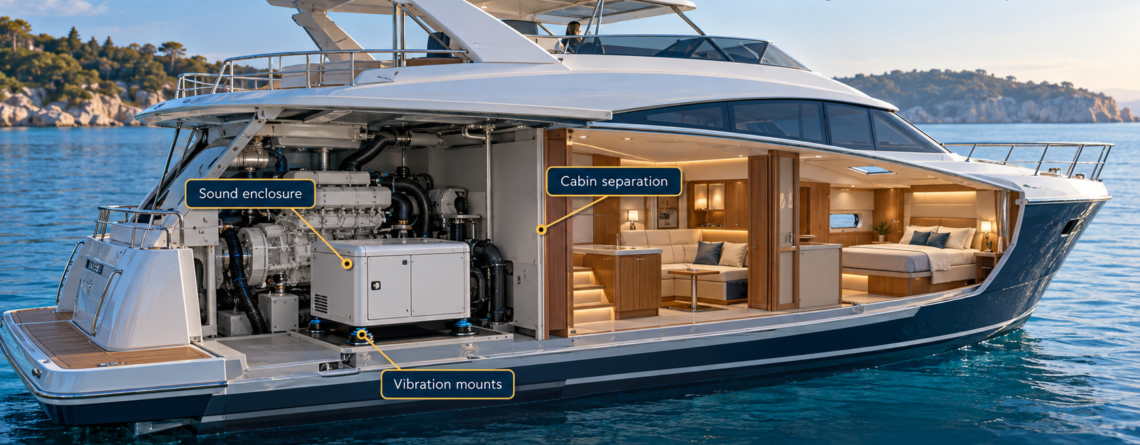
Choosing the Right Power and Quietness for Your Yacht
Picture a quiet evening at anchor. The propulsion engines are off, the air conditioning is cooling the cabins, and dinner is underway. Then the generator starts, and a persistent hum becomes part of the evening.
That familiar buying scenario explains why choosing a yacht generator involves more than finding enough electrical power. Owners also need comfortable cabins, practical maintenance access, and an installation that works with the vessel’s cooling, exhaust, and electrical systems.
For marineinboardspecialists, the starting point of a useful generator enquiry is the yacht itself: its equipment, operating habits, electrical configuration, available space, and existing installation. Those details help turn a broad search for “the best generator” into a shortlist that can be checked against manufacturer documentation.
This guide covers quiet marine generator selection for 35–70 ft yachts. It distinguishes manufacturer specifications from practical buying guidance and does not claim an independently tested winner for noise or reliability.
What Is the Best Yacht Generator?
The best yacht generator meets the yacht’s realistic running loads and motor-starting requirements, matches its electrical system, and fits with adequate cooling, exhaust, ventilation, sound control, and service access.
There is no universally best model for every 35–70 ft yacht.
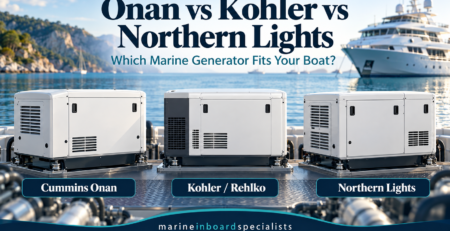
Cummins Onan, Fischer Panda, Northern Lights, and Kohler/Rehlko offer marine generator options worth investigating. However, the correct choice depends on the exact configuration and installation—not simply the manufacturer’s name.
Manufacturer documentation describes different sound-control approaches. Cummins discusses sound shields and vibration-isolating mounts, Northern Lights provides dedicated sound enclosures, and Fischer Panda lists sound-insulation capsules on marine generator products. These features are relevant, but they do not establish which generator will be quietest inside a particular yacht. mart.cummins.com
The practical question is:
Which generator can supply the required power while keeping noise acceptable in the cabins, saloon, and cockpit?
That is a stronger purchasing criterion than selecting the lowest advertised decibel figure without checking how it was measured.
Why Yacht Length Does Not Determine Generator Size
Yacht length provides installation context. It does not measure electrical demand.
Two 45 ft yachts can have substantially different requirements. One may use refrigeration, battery charging, and a single air-conditioning system. Another may have several compressors, electric cooking, a watermaker, and stabilization equipment.
The following table identifies questions to investigate rather than assigning a fixed generator size.
| Yacht length | Electrical equipment to assess | Installation priorities |
|---|---|---|
| 35–45 ft | Refrigeration, chargers, air conditioning, hot water, galley equipment | Compact housed dimensions, cabin proximity, maintenance clearance |
| 45–55 ft | Multiple air-conditioning zones, watermaker, electric cooking, larger chargers | Simultaneous loads, starting performance, exhaust routing, vibration isolation |
| 55–70 ft | Greater hotel demand, laundry, stabilization equipment, multiple compressors | Peak versus overnight demand, service access, redundancy requirements |
These are examples, not assumptions about every vessel in each category.
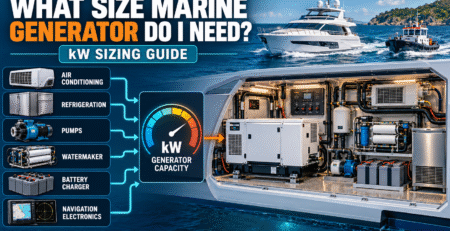
Before approaching marineinboardspecialists with a generator enquiry, record what equipment the yacht actually carries and which appliances you expect to operate together. A vessel-specific load schedule is more useful than a recommendation based only on length.
Running Power Versus Daily Energy Use
Generator output and battery capacity answer different questions.
Power, usually expressed in kW, describes the electrical demand at a particular moment. Energy, usually expressed in kWh, describes consumption over time.
An appliance drawing 1kW for three hours uses approximately 3kWh. That distinction matters when comparing continuous generator operation with a battery/inverter system intended to support selected overnight loads.
A generator must meet the relevant instantaneous demand. A battery system must have both enough usable energy and sufficient power capability for its intended operating period.
Build a Load Schedule Before Comparing Generators
A marine generator sizing assessment should establish normal running demand, realistic simultaneous demand, and the most demanding starting event.
Record electrical input from equipment manuals, nameplates, or appropriate measurements. Avoid relying on appliance descriptions alone.
| Equipment | Information to collect |
|---|---|
| Air conditioning | Electrical input, compressor starting characteristics, number of zones, soft-start equipment |
| Battery charger | Maximum AC input and configurable input limits |
| Refrigerator and freezer | Running input and compressor starting demand |
| Water heater | Heating-element wattage |
| Watermaker | Pump input, starting characteristics, operating schedule |
| Electric cooking | Maximum input and expected simultaneous use |
| Stabilization equipment | Electrical requirements for the intended operating mode |
| Laundry equipment | Motor and heating loads |
| Pumps and electronics | Input ratings and overlap with larger appliances |
For air conditioning, cooling capacity in BTU/h is not the same as electrical input power.
Similarly, a battery charger’s DC output rating does not directly establish its AC input. Conversion efficiency and operating settings affect the demand placed on the generator.
Normal Running Demand
Normal demand is the combination of equipment commonly operating while the generator runs.
At anchor, that might include refrigeration, battery charging, selected air-conditioning zones, lighting, and entertainment equipment.
This operating scenario helps identify the load the generator will carry for much of its service life.
Simultaneous Demand
Some loads overlap even if they are not continuously active.
A water heater may switch on while air conditioning and battery charging are already operating. Adding electric cooking can increase demand further.
Write down realistic scenarios such as overnight cooling, daytime charging and watermaking, or meal preparation. This avoids both underestimating demand and assuming every appliance aboard must run at once.
Starting Demand
Compressors and some pumps can require more electrical input during startup than during steady operation.
A generator must handle the relevant starting event while other connected equipment remains powered. The assessment therefore needs equipment starting data and the proposed generator’s transient performance.
Adding a fixed percentage to running watts does not reliably replace that check.
A Yacht Generator Load Example
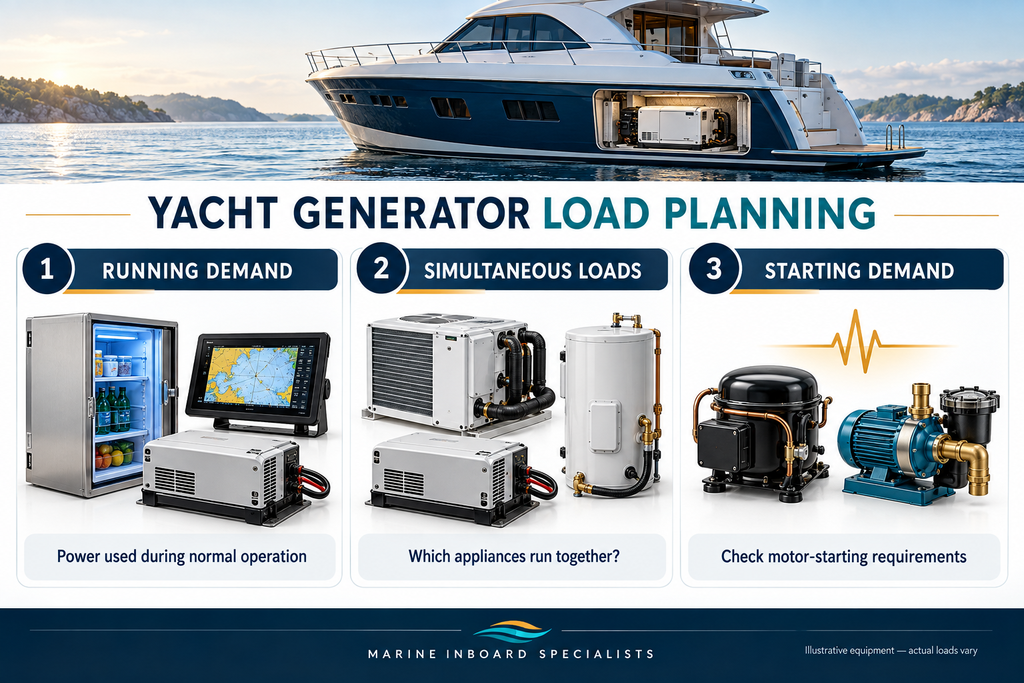
Consider these hypothetical simultaneous electrical inputs:
| Equipment | Assumed running input |
|---|---|
| Air conditioning | 3.0kW |
| Battery charger | 1.5kW |
| Refrigeration and electronics | 0.5kW |
| Water heater | 1.5kW |
| Combined running demand | 6.5kW |
These values are illustrative assumptions, not measurements or a generator recommendation.
If cooking adds another 2.0kW, running demand becomes 8.5kW. A compressor starting during that period introduces a separate transient requirement.
The example shows why choosing a diesel yacht generator from vessel length alone can fail. It also shows why operating habits matter: an appropriately designed load-management arrangement may prevent selected high-demand appliances from overlapping.
Final selection must consider the exact generator rating, applicable operating conditions, starting performance, and electrical design.
For an enquiry to marineinboardspecialists, supply these operating scenarios alongside the equipment data. They make it easier to explain what the proposed generator needs to achieve.
What Makes a Marine Generator Quiet?
Quiet onboard power depends on several sound paths. A sound enclosure addresses part of the problem, but it cannot resolve every installation issue.
Airborne Machinery Noise
Engine and alternator sound can travel through machinery spaces, access doors, ventilation openings, and adjoining compartments.
A suitable generator sound shield can reduce airborne noise. Its installation must still retain the airflow and service access required by the manufacturer.
Northern Lights provides sound enclosures that attach to the generator base frame, along with information about their integrated sound-attenuation arrangement. This makes housed dimensions and enclosure access important purchasing checks. www.northern-lights.com
Structure-Borne Vibration
Vibration can pass through mounts, foundations, pipes, and other connections into the yacht’s structure.
The resulting hum may be noticeable in a cabin even when the airborne sound beside the generator seems modest.
Cummins identifies its mounting system alongside sound shields as part of its approach to reducing marine generator noise and vibration. investor.cummins.com
The buying implication is straightforward: assess mounting and connection design alongside the generator. Adding enclosure insulation may not solve vibration transmitted through the structure.
Exhaust Noise
Exhaust sound can remain noticeable near cockpit seating, cabins, and surrounding vessels.
Any changes intended to reduce exhaust noise must also respect manufacturer requirements for back pressure, cooling-water arrangements, routing, and water-ingress protection.
An exhaust system should be selected and installed for the exact generator and vessel arrangement.
Ventilation Noise
Sound can escape through ventilation paths, but restricting those paths can create overheating problems.
Effective marine generator noise reduction must preserve required airflow. Acoustic treatment should work with the ventilation design rather than obstruct it.
How to Compare Generator Noise Claims
A published noise figure needs context.
Before comparing candidates, establish:
- Measurement distance and location.
- Electrical load during testing.
- Whether a sound enclosure was fitted.
- Whether testing involved a free-standing unit or an installed vessel.
- Whether the figure describes sound pressure, sound power, or another acoustic measure.
A reading taken farther from the equipment should not be treated as directly comparable with one taken nearby. Sound-power and sound-pressure figures also describe different quantities.
For onboard comfort, cabin and cockpit measurements can be more useful than a machinery-space reading alone.
Where available, ask for evidence from a comparable installation with a similar generator location and cabin arrangement. Treat terms such as “quiet” as reasons to investigate—not proof of a universal winner.
The CABIN Check for Yacht Generator Selection
The CABIN check is an editorial buying framework for this guide, not an industry standard.
| Check | Question to answer |
|---|---|
| C — Capacity | Will the generator handle running loads, planned overlap, and motor starting? |
| A — Acoustic evidence | Are noise figures comparable and relevant to occupied spaces? |
| B — Boat integration | Can mounting, ventilation, cooling, and exhaust requirements be met? |
| I — Interfaces | Does the electrical configuration, control wiring, and protection match? |
| N — Necessary service access | Can routine maintenance be completed without major dismantling? |
Use this framework when preparing questions for marineinboardspecialists or discussing installation with your marine technician.
A generator with attractive acoustic claims may still be unsuitable if its enclosure cannot be opened in the available compartment. Another may provide sufficient power but require substantial electrical or exhaust modifications.
The right yacht generator must satisfy the complete installation—not just its rated output or advertised sound level.
Comparing Yacht Generator Brands and Operating Options
Once you understand your yacht’s electrical demand, the next step is to compare generators that can meet it. That comparison should cover the complete installation: output, starting performance, sound enclosure, controls, maintenance access, and support.
When preparing an enquiry for marine in board specialists, describe how you use the yacht—not just its length or the output of the existing generator. Overnight air conditioning, daytime watermaking, and occasional electric cooking can create very different operating requirements.
Comparing Yacht Generator Manufacturers
The following manufacturer comparisons identify documented features worth investigating. They do not establish an independently tested winner for quietness or reliability.
Cummins Onan: Electrical Control and Diagnostics
Cummins lists its Onan Marine QD 6/7.5/8kW family with electronic frequency control, a digital diagnostic display, and an optimized mounting system intended to reduce vibration. The family includes different electrical configurations, so the exact model and rating must be confirmed. www.cummins.com
For owners comparing Cummins Onan marine generators, useful purchasing questions include whether the remote panel, wiring harness, sound enclosure, and protection equipment are included.
If you are replacing an older Onan unit, do not assume that existing controls or mounts will transfer to the new generator. Similar branding and output do not prove installation compatibility.
Include the existing identification plate and control-panel photographs in your enquiry to marine in board specialists. These help establish which interfaces require further checking.
Fischer Panda: Variable-Speed Options for Changing Demand
Fischer Panda’s iSeries uses load-dependent engine speed and an inverter to provide the specified AC output. This allows engine speed to change while the electrical supply maintains its intended frequency. www.fischerpanda.de
A variable-speed marine generator deserves consideration when the yacht’s demand changes substantially throughout the day.
For example, daytime operation may involve battery charging, watermaking, cooking, and several air-conditioning zones. Overnight demand may be much lower.
However, variable speed does not automatically establish the quietest or most economical choice. Request performance information for the exact model at loads that resemble your operating profile.
Check inverter dimensions, installation location, ventilation, cable requirements, and access to diagnostic support. Also distinguish the model name from its electrical rating: Fischer Panda documentation describes one Panda 5000i.Neo configuration as providing up to 4kW and 5kVA. www.fischerpanda.de
Northern Lights: Fixed-Speed Models and Installation Documentation
Northern Lights publishes specifications for fixed-speed marine generators, along with sound-enclosure and accessory information.
Its NL843NW4 is listed at 12kW for 60Hz operation and 10kW for 50Hz operation, with corresponding speeds of 1,800rpm and 1,500rpm. This illustrates why ratings within a model family must be checked against the required frequency. www.northern-lights.com
When comparing Northern Lights yacht generators, examine housed dimensions rather than the bare generator footprint.
Confirm that enclosure panels can be removed and that filters, drains, cooling components, and electrical connections remain accessible. Northern Lights provides enclosure and accessory documentation to support that review. www.northern-lights.com
A generator that fits tightly into a machinery compartment may still be impractical if routine maintenance requires dismantling surrounding equipment.
Kohler/Rehlko: Sound-Control Packages and Controls
Rehlko’s pleasure-craft documentation describes sound-control measures involving separate engine and alternator compartments and revised air management. Its sound-shield accessory information also addresses service access. www.marine.rehlko.com
For Kohler/Rehlko marine generators, confirm the complete quoted package. A sound shield, remote panel, or installation accessory shown on a manufacturer’s website is not necessarily included in every supplier quotation.
Rehlko also describes selected multi-generator arrangements in which another generator comes online as demand increases. Such functions require compatible equipment, controls, and an engineered installation; they should not be assumed available on every model. www.marine.rehlko.com
Yacht Generator Brand Comparison
| Manufacturer | Documented feature to investigate | Main purchasing check |
|---|---|---|
| Cummins Onan | Electronic frequency control, diagnostics, vibration-reducing mounts | Exact electrical configuration and included controls |
| Fischer Panda | Load-dependent iSeries with inverter output | Continuous rating, inverter integration, performance at expected loads |
| Northern Lights | Fixed-speed models and dedicated enclosure documentation | Frequency-specific output, housed dimensions, service access |
| Kohler/Rehlko | Sound-shield and air-management features | Included accessories and model-specific control compatibility |
Use this table to organize a shortlist, not to rank manufacturers by unverified claims.
The most useful proposal from marine in board specialists will identify the exact configuration being considered. A brand name alone is not enough to compare power, fit, or installation cost.
Fixed-Speed Versus Variable-Speed Yacht Generators
How Fixed-Speed Generators Operate
A conventional fixed-speed AC generator maintains its designed operating speed to produce the required electrical frequency. The governor adjusts fueling as the connected load changes.
Some four-pole marine generators operate at 1,500rpm for 50Hz or 1,800rpm for 60Hz, as demonstrated by the Northern Lights example. Other designs use different operating speeds.
A fixed-speed yacht generator may be suitable where demand is reasonably consistent and its capacity matches the vessel’s normal use.
The assessment should also consider periods of low demand. Ask the manufacturer about permitted loading and operating practices for the exact model rather than applying a universal minimum-load rule.
How Variable-Speed Generators Operate
A variable-speed inverter generator changes engine speed with demand while power electronics supply the specified AC output.
This architecture can be relevant where the yacht has a wide gap between daytime and overnight loads. Its suitability depends on the complete system, including inverter installation, controls, starting performance, and service support.
Lower operating speed alone does not prove lower cabin noise. Compare actual acoustic evidence under similar loads and installation conditions.
| Factor | Fixed-speed option | Variable-speed inverter option |
|---|---|---|
| Engine operation | Maintains its designed operating speed | Adjusts speed within its operating range |
| Frequency control | Linked to generator design and speed control | Supplied through power electronics |
| Important assessment | Loading profile and transient response | Load-dependent performance and inverter integration |
| Service requirements | Engine, alternator, governor, and controls | Those components plus inverter electronics |
| Noise comparison | Requires matched measurement conditions | Requires matched measurement conditions |
Neither design removes the need for suitable vibration isolation, exhaust routing, ventilation, and sound treatment.
Building a Shortlist for 35–70 ft Yachts
35–45 ft Yachts: Fit and Cabin Proximity
For smaller yachts, begin with the load schedule and then eliminate generators that cannot fit with their enclosure and required service clearance.
Measure the installation route as well as the final compartment. A generator may fit beneath the cockpit but be too large to pass through the available hatch.
Consider the nearest sleeping cabin. Its position relative to the generator foundation, ventilation openings, and exhaust system can affect perceived comfort.
For a replacement enquiry, send marine in board specialists photographs showing access openings and surrounding equipment—not only the existing generator.
45–55 ft Yachts: Simultaneous Loads
For this group, compare distinct operating scenarios.
An overnight scenario might include selected air-conditioning zones, refrigeration, and limited battery charging. A daytime scenario may add watermaking, hot water, or electric cooking.
These scenarios help establish whether one generator can serve the yacht’s needs or whether load management deserves further consideration.
They also provide useful conditions for comparing a quiet yacht generator. A noise figure measured under an unspecified load offers limited help when assessing overnight comfort.
55–70 ft Yachts: Demand Range and Redundancy
Larger yachts may have a substantial difference between peak demand and routine demand.
Depending on the vessel, options worth discussing with the electrical designer include one appropriately sized generator, managed loads, two generators, or a battery/inverter system supporting selected periods of reduced generator use.
These are design choices—not automatic recommendations based on yacht length.
A second generator adds weight, installation work, maintenance, and controls. A battery system requires sufficient usable energy, power capability, charging capacity, and protection.
Should Your Yacht Have One Generator or Two?
Two generators may provide redundancy or operating flexibility, but the arrangement must be defined clearly.
Some installations operate one unit at a time through approved switching. Others use compatible equipment designed for parallel operation and load sharing.
Generators must not be connected together simply because their voltage and frequency ratings match. Parallel operation requires synchronization, suitable controls, protection, and manufacturer-supported equipment.
Before choosing a two-generator arrangement, establish which loads must remain available after a failure and whether the additional ownership cost is justified.
Compare Total Installed Cost
A lower equipment price does not necessarily mean a lower project cost.
Ask for quotations that identify the same scope:
- Generator, enclosure, and controls.
- Mounting or foundation work.
- Cooling-water and exhaust components.
- Fuel connections.
- Protection, switching, and cabling.
- Removal, installation, and commissioning.
For replacement work, establish which existing components can be retained and which require changes.
When reviewing an offer from marine in board specialists, distinguish the supplied equipment from the installer’s work. Clear responsibilities help avoid gaps between purchasing, installation, and commissioning.
Turn the Shortlist Into a Documented Decision
Before selecting a yacht generator, obtain its exact datasheet, installation drawing, enclosure dimensions, service requirements, and written package contents.
Request starting-performance information relevant to your largest motor load. For sound comparisons, ask for measurement conditions and evidence from comparable installations where available.
That produces a practical shortlist: generators that meet the yacht’s demand, fit its systems, support onboard comfort, and remain accessible for maintenance.
Yacht Generator Buying Checklist, FAQs, and Final Recommendation
A suitable yacht generator must do more than produce enough power. It should fit the vessel, work with its electrical system, remain accessible for maintenance, and deliver acceptable comfort in occupied spaces.
The final buying decision should therefore connect the load assessment
Before requesting a quotation from marineinboardspecialists, gather the vessel information that allows each proposed generator to be assessed against the same requirements.
Your Yacht Generator Buying Checklist
Use this checklist for a new installation or a replacement marine generator.
| Area | What to confirm | Evidence to request |
|---|---|---|
| Electrical demand | Running loads, simultaneous use, and motor starting | Equipment input data and vessel load schedule |
| Generator output | Rating at the required voltage, frequency, and phase | Exact model datasheet |
| Physical fit | Housed dimensions, weight, mounts, and installation route | Installation drawing and compartment measurements |
| Sound control | Enclosure, vibration mounts, exhaust, and ventilation | Package specification and acoustic measurement conditions |
| Service access | Access to filters, impeller, belts, drains, and controls | Maintenance documentation and installer assessment |
| System compatibility | Cooling, fuel, exhaust, wiring, and switching | Manufacturer installation manual |
| Ownership | Maintenance requirements, warranty, and service support | Written terms and support arrangements |
| Project scope | Supplied equipment, accessories, installation, and commissioning | Itemized quotation |
The table also helps identify missing information. If a proposed generator fits dimensionally but its service requirements have not been checked, the installation assessment is incomplete.
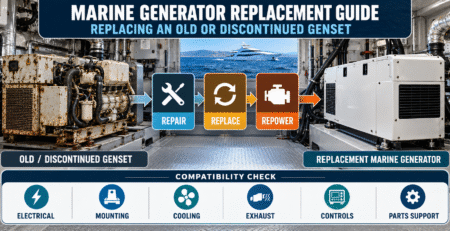
Additional Checks for Generator Replacement
Photograph the existing identification plate, control panel, mounting arrangement, exhaust connections, and cooling-water installation.
Record the existing voltage, frequency, phase, and output. Include access-hatch measurements and photographs showing nearby equipment.
When sending these details to marine in board specialists, explain why you are replacing the generator. Recurring faults, unavailable components, increased electrical demand, and excessive noise can lead to different replacement priorities.
Matching the old kW rating alone does not establish that a new generator will fit or meet the yacht’s current needs.
Plan Commissioning Before Installation Begins
Commissioning should confirm that the generator operates correctly in its installed environment. It is also the opportunity to assess onboard comfort under realistic operating conditions.
Agree on the procedure and responsibilities with the installer before work starts.
Check Electrical Performance
Use the operating scenarios established in the load schedule. These may include overnight air conditioning, daytime battery charging, watermaking, or meal preparation.
Where appropriate, test the most demanding planned motor-starting event while other equipment remains connected. Record voltage, frequency, loading, alarms, and any unexpected shutdowns.
Testing must follow the manufacturer’s instructions and the installer’s approved procedure. Avoid deliberately overloading the generator to discover its limits.
Check Cooling, Exhaust, and Connections
The installer should verify the cooling-water arrangement, ventilation, exhaust routing, fuel connections, mounting, and electrical protection against the applicable installation requirements.
A brief unloaded run does not demonstrate that the generator will perform correctly during extended operation.
Check for leaks, unusual vibration, overheating indications, and other abnormalities through the approved commissioning process.
Assess Noise Where People Spend Time
Evaluate the installation in the owner’s cabin, guest cabins, saloon, cockpit, and other important spaces.
Record which appliances are operating and whether machinery-space doors and hatches are closed. Consistent conditions make observations and measurements more useful.
For a quiet yacht generator, the relevant result is comfort aboard—not simply the sound beside the enclosure.
If an objectionable hum or rattle remains, identify its path before choosing a remedy. Airborne machinery noise, structural vibration, exhaust sound, and ventilation noise require different responses.
Common Yacht Generator Buying Mistakes
Choosing by Yacht Length
Two yachts of similar length can have different electrical equipment and operating habits.
Use the vessel’s load schedule to select capacity. Use yacht length and layout to understand installation constraints.
Comparing Model Names Instead of Ratings
A model designation may not equal continuous output in kW. Ratings can also differ between 50Hz and 60Hz configurations.
Check the exact datasheet for the proposed unit.
Treating “Quiet” as a Complete Specification
A marine generator noise level needs measurement distance, load, enclosure configuration, and method.
Without those details, comparisons can suggest differences that have not actually been established.
Assuming Accessories Are Included
Confirm the sound enclosure, remote panel, wiring harness, protection equipment, and installation components in writing.
When reviewing a quotation from marine in board specialists, distinguish the supplied package from work and materials provided by your installer.
Ignoring Maintenance Access
A generator may fit into a compartment while leaving insufficient room to remove its enclosure or replace routine service components.
Check access before purchase. Consider future removal as well as installation.
Oversizing Without Reviewing Normal Demand
Selecting capacity for an unrealistic combination of every appliance aboard can produce a poor match for routine operation.
Conversely, overlooking genuine simultaneous loads can result in insufficient capacity. Compare realistic scenarios and follow model-specific operating guidance.
Frequently Asked Questions
What Is the Best Yacht Generator?
The best yacht generator meets the vessel’s running and starting demand, matches its electrical configuration, and fits with suitable cooling, exhaust, ventilation, sound control, and maintenance access.
Manufacturer choice matters, but the exact model and installation determine suitability.
What Size Generator Does a 35–70 ft Yacht Need?
There is no dependable kW recommendation based only on yacht length.
Calculate simultaneous electrical input, evaluate motor starting, and check the proposed generator’s rating under the intended operating conditions.
Which Yacht Generator Is Quietest?
This guide does not establish a universally quietest model.
A fair comparison requires matched acoustic measurement conditions. Cabin comfort also depends on location, mounts, foundations, exhaust, ventilation, and surrounding structures.
Is a Variable-Speed Generator Better?
A variable-speed marine generator is worth investigating when electrical demand changes substantially. A fixed-speed generator may suit other operating profiles.
Compare model-specific performance, starting response, installation requirements, maintenance, and support. Neither design guarantees the best result for every yacht.
Can a Yacht Generator Run All the Air Conditioning?
Yes, if its usable continuous output and starting performance meet the combined requirements.
Check compressor starting characteristics, associated pumps, other connected equipment, and any supported sequencing arrangements. Air-conditioning cooling capacity is not the same as electrical input.
Can Batteries Reduce Generator Operating Hours?
A correctly designed battery/inverter system can support selected loads for a defined period.
Its suitability depends on usable battery energy, inverter capacity, appliance demand, charging arrangements, and protection. Extended air-conditioning use requires a different assessment from lighting and refrigeration alone.
Should I Choose One Generator or Two?
Two generators may provide redundancy or operating flexibility, but they add weight, installation work, controls, and maintenance.
Define which loads must remain available after a failure before deciding whether a second generator is justified.
Can I Replace My Generator With Another Brand?
Possibly, but compatibility must be checked.
Compare mounting points, housed dimensions, electrical output, controls, cooling, exhaust, fuel connections, and service access. Similar power ratings do not guarantee a direct replacement.
Final Recommendation: Choose for the Complete Vessel
For a 35–70 ft yacht, begin with electrical demand and installation constraints. Shortlist generators that meet those requirements, then compare sound-control packages, starting performance, service access, and support.
Pay particular attention to the difference between daytime and overnight demand. A generator selected for occasional heavy loads may need a broader system assessment if it will spend most of its operating hours supporting modest cabin loads.
The best yacht generator provides dependable power through an installation that remains comfortable and practical to maintain.
Request a Yacht Generator Quotation
Contact marine in board specialists with your yacht’s make, model, year, and length; required voltage, frequency, and phase; major electrical loads; and generator-compartment measurements.
For replacement projects, include the existing generator’s identification plate and installation photographs. Explain your priorities, such as improved cabin comfort, increased capacity, or replacing an unsupported unit.
State how soon you intend to purchase, your required delivery date, and your billing and delivery addresses for the quotation.
Request an itemized proposal identifying the generator configuration, sound enclosure, controls, accessories, delivery scope, and commissioning responsibilities. Clear information helps make the available options easier to compare before you commit.

Leave a Reply