

What Is the Best Marine Generator for a Sailboat?
The marine generator for sailboat is not automatically the largest, quietest, or most expensive model. It is the generator that provides enough usable electrical power for your real onboard loads while fitting the available compartment, ventilation, exhaust, cooling, mounting, and service requirements.
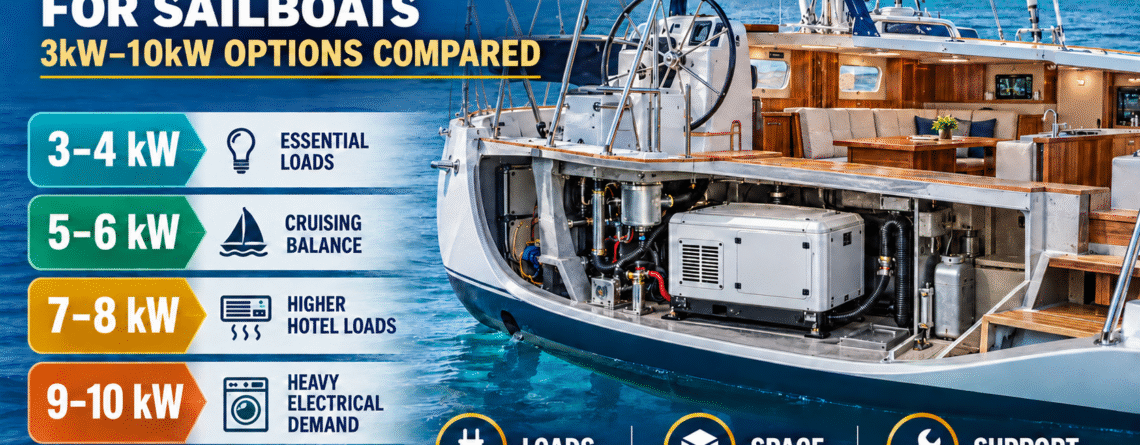
For many cruising sailboats, the practical range is approximately:
- 3–4kW: Basic electrical loads, battery charging, refrigeration, watermaker use, and occasional small appliances.
- 5–6kW: A common range for cruising sailboats with refrigeration, battery chargers, water heaters, navigation equipment, and one air-conditioning unit.
- 7–8kW: Suitable for larger electrical systems, multiple high-demand appliances, or more than one air-conditioning unit.
- 9–10kW: Better suited to larger sailboats with substantial hotel loads, multiple air-conditioning systems, laundry equipment, watermakers, or heavier simultaneous demand.
However, these are starting points—not universal recommendations. The correct size depends on the equipment you expect to operate at the same time, the electrical standard onboard, starting surges, available space, and how the boat is used.
Marine Generator Depot’s practical recommendation is to choose the smallest generator that can reliably support your planned continuous and starting loads without operating close to its maximum rating for long periods.
Why Sailboats Need a Different Generator-Sizing Approach
A sailboat may have lower average electrical demand than a motor yacht, but that does not mean generator selection is simple. Space is often limited, engine-room access can be difficult, and the generator may be installed below living areas where vibration and exhaust noise are immediately noticeable.
A sailboat generator must be evaluated across several connected requirements:
- Electrical load: What equipment must run simultaneously?
- Starting demand: Which motors create a temporary surge?
- Physical fit: Will the generator fit through the access hatch and into the compartment?
- Service access: Can filters, belts, impellers, and control components be reached?
- Cooling and exhaust: Can the system be installed safely without excessive back pressure or heat?
- Noise and vibration: Will the installation remain comfortable during overnight operation?
- Voltage and frequency: Does the unit match the boat’s shore-power and onboard distribution system?
- Support: Are parts, technicians, manuals, and diagnostics available where the boat operates?
A generator that looks ideal on a specification sheet may become a poor choice if it cannot be serviced, produces incompatible electrical output, or requires major modifications to the boat.
Start With the Boat’s Actual Electrical Loads
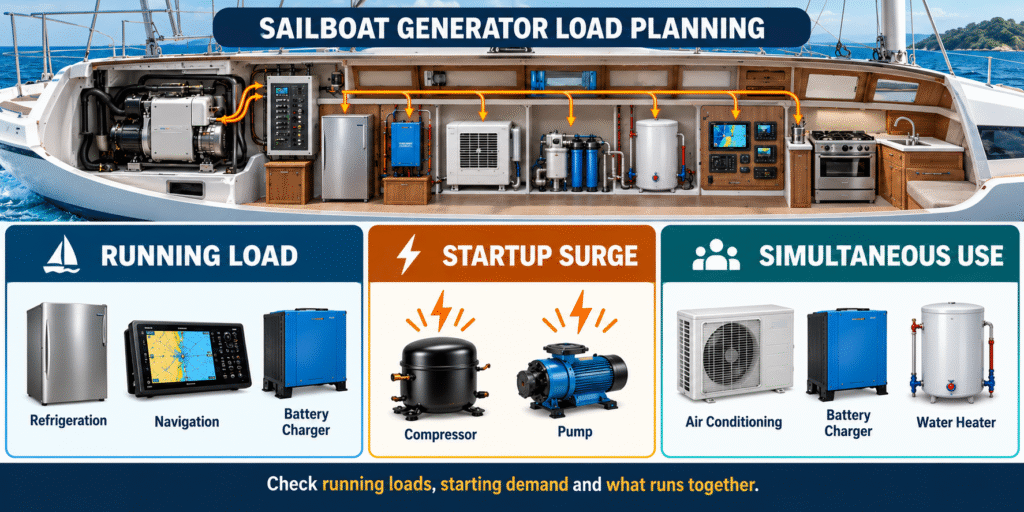
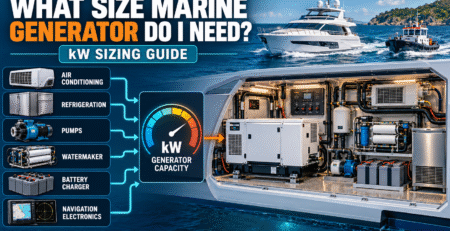
Before comparing brands, prepare a load list. Include appliances and systems that operate continuously, intermittently, or only during startup.
Typical sailboat loads include:
| Load category | Examples |
|---|---|
| Navigation | Chartplotter, radar, autopilot, AIS, communications |
| Galley | Refrigerator, freezer, microwave, induction hob, coffee machine |
| Comfort | Air conditioning, fans, water heater |
| Machinery | Battery charger, watermaker, pumps, refrigeration compressors |
| Entertainment | Television, audio system, internet equipment |
| Utility | Washing machine, tools, workshop equipment |
The important figure is not simply the total of every appliance installed on the boat. It is the maximum realistic combination of equipment that may operate at the same time.
For example, a cruising sailboat may have a microwave, water heater, battery charger, refrigerator, and air-conditioning system installed. It may not use all of them simultaneously. But if the owner expects to run the air conditioning while charging batteries and preparing food, those loads belong in the sizing calculation.
Running load versus starting load
Some equipment draws significantly more power for a short time when its motor starts. Common examples include:
- Air-conditioning compressors
- Refrigeration compressors
- Watermakers
- Pressure pumps
- Hydraulic pumps
- Battery chargers with large initial demand
A generator may have enough continuous capacity but still struggle when several motors start together. This can cause voltage dips, nuisance shutdowns, breaker trips, or poor performance from sensitive electronics.
That is why a generator comparison should examine both:
- Continuous running load
- Highest likely starting combination
Do not size a sailboat generator only by adding the nameplate wattage of stationary appliances.
How Much Generator Capacity Does a Sailboat Need?
As a general planning guide:
3kW–4kW marine generators
A 3kW or 4kW generator may suit a smaller sailboat with modest electrical requirements. It can often support essential hotel loads, battery charging, refrigeration, navigation equipment, and selected appliances.
This range may be appropriate when the boat does not require large air-conditioning systems or several motor-driven loads at the same time.
The main risk is limited surge capacity. If the boat has a watermaker, air conditioner, and large battery charger, a small unit may need careful load management.
5kW–6kW marine generators
The 5kW–6kW range is often a practical starting point for a cruising sailboat with moderate comfort and electrical demand.
A generator in this class may support combinations such as:
- Battery charging
- Refrigeration
- Navigation equipment
- Hot-water heating
- One air-conditioning system
- Selected galley appliances
Northern Lights lists marine generator options around the 5kW–6kW class, including the M673L3, which the manufacturer describes as a compact 6kW generator set. mtu.northern-lights.com
Cummins’ marine generator portfolio also includes Onan marine products in the smaller output range, with marine generator documentation covering applications from approximately 4kW upward. mart.cummins.com
7kW–8kW marine generators
A 7kW–8kW generator may be more suitable for a larger sailboat or a vessel with several systems operating simultaneously.
This range becomes more attractive when the boat includes:
- More than one air-conditioning unit
- A larger watermaker
- Induction cooking
- A washing machine
- Multiple battery chargers
- Heavier workshop or power-tool use
Nanni’s current generator listings include models around 7.6kW and 7.7kW, with different frequency and phase configurations. This illustrates why output alone is not enough; the electrical configuration must also match the boat. nannienergy.com
9kW–10kW marine generators
Generators in the 9kW–10kW range may be appropriate for larger cruising sailboats with substantial hotel loads.
They can provide additional operating margin, but oversizing also has disadvantages. A generator that is consistently operated at very low load may run inefficiently and may experience carbon buildup or other problems associated with prolonged light loading.
The right goal is not maximum generator capacity. It is a balanced installation that operates efficiently under the boat’s normal cruising load.
S.A.I.L.: A Practical Framework for Choosing a Sailboat Generator
To compare a marine generator for sailboat applications, use the S.A.I.L. framework:
S — Shipboard electrical demand
Calculate normal running loads, motor-starting demand, and the largest realistic combination of simultaneous loads.
A — Available space and access
Check the generator’s length, width, height, weight, mounting points, and the route used to move it into the boat. A unit that fits the engine room may still be impossible to install through the companionway or access hatch.
I — Interfaces
Verify fuel supply, raw-water intake, exhaust routing, ventilation, control wiring, battery requirements, AC output, grounding, and remote-panel compatibility.
L — Long-term support
Consider parts availability, service network coverage, manuals, warranty conditions, diagnostic support, and the supplier’s ability to help with installation questions.
This framework prevents a common purchasing mistake: choosing by kW alone while ignoring the installation and ownership requirements that determine whether the generator will work well in practice.
Marine Generator Brands to Compare
Several established manufacturers produce generators in or near the 3kW–10kW range. The best choice depends on the exact model, configuration, support network, and installation package.
Cummins Onan
Cummins Onan is widely associated with compact marine generator sets for recreational and commercial vessels. Cummins describes its marine portfolio as covering applications from small marine gensets to much larger ship-service systems. mart.cummins.com
Potential strengths include:
- Broad marine product experience
- Compact generator options
- Marine-specific control and protection systems
- Established service and parts infrastructure in many regions
Confirm the exact output, frequency, phase, sound shield, control panel, and installation accessories for the proposed model.
Fischer Panda
Fischer Panda emphasizes compact, lightweight, water-cooled marine generator systems designed for boats and yachts. Its marine range includes compact models such as the Marine AC 5.5e and Marine AC 8 Mini. Fischer Panda Boat …
Potential strengths include:
- Compact installation footprint
- Low-noise design options
- Lightweight systems for space-constrained boats
- A strong focus on yacht and boat applications
Fischer Panda also notes that model selection should be based on the vessel’s specific electrical requirements rather than a universal generator size. Fischer Panda Boat …
Northern Lights
Northern Lights offers marine generator sets across a wide output range, including compact units around the 5kW–10kW class. Its M673L3 is positioned as a compact 6kW generator set, while other models cover higher outputs. mtu.northern-lights.com
Potential strengths include:
- Marine-focused product range
- Heavy-duty construction
- Compact small-generator options
- Long-term serviceability
Nanni
Nanni lists marine generators from approximately 5kW upward, with options in 50Hz and 60Hz configurations and both single-phase and three-phase versions. nannienergy.com
Potential strengths include:
- Multiple output ranges
- Different frequency and phase choices
- Compact generator families
- International distributor and service coverage
Westerbeke and Kohler/Rehlko
Westerbeke and Kohler/Rehlko are also relevant brands when comparing marine generators for cruising sailboats. Their suitability depends on the exact model, electrical standard, physical dimensions, service support, and availability of current documentation.
Older models should be checked carefully because marine generator product lines change over time. A model shown in an old article or forum discussion may no longer be in production, even if replacement parts remain available.
The Most Important Comparison Is Not Brand Versus Brand
The most useful comparison is usually:
Which generator best matches this sailboat’s loads, space, electrical system, installation conditions, and long-term support?
A compact 5kW unit may be better than a 7kW unit if the boat has limited space and modest demand. Conversely, a 5kW generator may be inadequate if air-conditioning, watermaking, induction cooking, and battery charging are expected to run together.
Output Classes, Electrical Compatibility, Noise, and Installation
Choosing a marine generator for sailboat use requires more than comparing the kW number on the nameplate. Two generators with similar output can differ significantly in dimensions, starting performance, cooling arrangement, noise level, service access, and electrical configuration.
The best option is the one that delivers the required power without creating installation problems or operating inefficiently during normal use.
Comparing 3kW–10kW Generator Classes
| Generator range | Typical sailboat application | Main advantage | Main concern |
|---|---|---|---|
| 3–4kW | Smaller cruising sailboats and essential loads | Compact and economical | Limited surge capacity |
| 5–6kW | Mid-sized cruising sailboats | Good balance of output and size | May not support several large loads together |
| 7–8kW | Larger sailboats with multiple systems | More operating margin | Greater space, weight, and fuel requirements |
| 9–10kW | High-demand cruising and liveaboard vessels | Supports heavier simultaneous loads | Risk of low-load operation if oversized |
These categories are only planning ranges. The actual requirement should be confirmed through a load calculation and installation review.
3kW–4kW: Compact Power for Essential Loads
A 3kW–4kW generator may suit a sailboat with modest onboard demand. It can be appropriate for:
- Battery charging
- Refrigeration
- Navigation electronics
- Lighting
- Small pumps
- Limited galley use
- Occasional watermaker operation
This size is attractive where the engine room is small or the generator must pass through a narrow access hatch.
The main limitation is starting demand. A small generator may run the boat’s normal electrical loads successfully but struggle when a compressor, pump, and battery charger start at the same time.
A 3kW–4kW system is usually best when the owner is comfortable with load management. High-demand appliances may need to be operated separately rather than simultaneously.
5kW–6kW: A Practical Middle Range
For many cruising sailboats, 5kW–6kW is a reasonable starting point because it provides more usable capacity without the size and weight of a much larger set.
This range may support a combination of:
- Refrigeration
- Battery chargers
- Navigation and communications equipment
- Water heating
- One air-conditioning system
- Selected cooking appliances
- Small pumps and tools
Northern Lights identifies its M673L3 as a compact 6kW marine generator set, making this output class relevant for owners who need more than basic electrical support but still have limited installation space. mtu.northern-lights.com
Fischer Panda also lists compact marine models around the 5kW–8kW range, with a focus on lightweight and space-efficient installation. fischerpanda.com
The key question is whether the generator can handle your highest likely starting combination. A 6kW generator may be perfectly adequate for one air conditioner and normal hotel loads, but not if multiple compressors, an induction cooker, and a watermaker are expected to start together.
7kW–8kW: More Margin for Larger Loads
A 7kW–8kW generator may be appropriate for larger sailboats or vessels with higher comfort and utility demands.
This range becomes more relevant when the boat includes:
- Multiple air-conditioning units
- A large watermaker
- Induction cooking
- Washing machine or dryer
- Multiple battery chargers
- Large refrigeration systems
- Workshop equipment
- Several pumps operating together
Nanni’s product listings include generators around 7.6kW and 7.7kW, with different frequency and phase configurations. This shows why buyers must compare the complete electrical specification rather than looking only at rated power. nannienergy.com
A larger generator also needs adequate ventilation, exhaust capacity, raw-water flow, mounting strength, and service clearance. If the existing compartment was designed for a smaller unit, installation costs can increase significantly.
9kW–10kW: High-Demand Sailboat Systems
A 9kW–10kW generator may be suitable for a large cruising sailboat, liveaboard vessel, or yacht with several major systems operating at once.
Possible applications include:
- Multiple air-conditioning systems
- Large watermakers
- Induction cooking
- Laundry equipment
- Extensive battery charging
- Refrigeration and freezer systems
- Workshop or power-tool use
- High hotel loads during extended anchoring
However, oversizing creates its own risks. If the generator regularly operates at a very light load, fuel efficiency may suffer and engine health can be affected over time.
The correct question is not, “What is the biggest generator I can fit?” It is:
What generator will operate efficiently across the load range I actually use?
Voltage, Frequency, and Phase Must Match
A generator can have the correct kW rating and still be unsuitable if its electrical output does not match the boat.
Before selecting a model, confirm:
- Voltage
- Frequency
- Single-phase or three-phase output
- Amperage
- Shore-power compatibility
- Distribution-panel configuration
- Neutral and grounding arrangement
- Transfer-switch requirements
- Battery and control voltage
For example, a 5kW 50Hz single-phase generator is not automatically interchangeable with a 5kW 60Hz three-phase unit.
Nanni’s generator range demonstrates the importance of these differences. Its listings include models with 50Hz and 60Hz outputs as well as single-phase and three-phase configurations. nannienergy.com
A mismatch may cause motors to run incorrectly, damage sensitive equipment, create nuisance trips, or require major changes to the boat’s electrical system.
Noise and Vibration Matter More on a Sailboat
On a motor yacht, generator noise may be masked by engine-room insulation and higher cruising noise. On a sailboat, the generator may operate while the vessel is anchored in quiet surroundings. Noise and vibration can therefore affect comfort more noticeably.
When comparing a marine generator for sailboat applications, review:
- Sound-shield design
- Engine operating speed
- Flexible mounting system
- Exhaust-water injection arrangement
- Air intake and ventilation noise
- Generator location relative to cabins
- Vibration isolation
- Remote control-panel options
A sound shield can reduce perceived noise, but it does not eliminate the need for correct mounting and ventilation.
Low noise also depends on the installation. A quiet generator can still become unpleasant if it is mounted directly to a thin bulkhead, connected to rigid exhaust piping, or installed without adequate vibration isolation.
Cooling and Exhaust Requirements
Most marine generators use a seawater circuit to remove heat from the exhaust and a closed freshwater circuit to cool the engine.
The installation may require:
- Raw-water intake and seacock
- Strainer
- Seawater pump
- Siphon break
- Water-injected exhaust
- Proper exhaust hose and muffler
- Exhaust rise
- Ventilation openings
- Engine-room air supply
- Safe discharge location
The exact arrangement must follow the manufacturer’s installation manual. Exhaust routing, back pressure, seawater flow, and siphon protection are not areas where assumptions are safe.
A generator that fits dimensionally may still be unsuitable if the boat cannot provide the required exhaust rise, cooling-water intake, ventilation, or service access.
Physical Fit Is More Than Length and Width
Before ordering, measure the complete installation route:
- Removal path for the existing generator
- Companionway and hatch openings
- Engine-room access
- Generator compartment dimensions
- Mounting footprint
- Service clearance
- Exhaust and cooling connection locations
- Control-panel cable route
- Weight-bearing capacity
- Space needed for future removal
Also compare the proposed unit’s:
- Dry weight
- Height with sound shield
- Mounting-hole pattern
- Oil-drain position
- Filter access
- Control-panel location
- Cable-entry points
- Fuel and exhaust connection positions
A generator may fit inside the compartment but still be impossible to install because it cannot be rotated or lowered into place.
Generator Comparison: What to Record
Use a comparison sheet like this before requesting a quotation:
| Specification | Existing or required value | Generator A | Generator B |
|---|---|---|---|
| Rated output | ___ kW | ___ | ___ |
| Voltage | ___ V | ___ | ___ |
| Frequency | 50/60 Hz | ___ | ___ |
| Phase | 1/3 phase | ___ | ___ |
| Starting capacity | Required surge | ___ | ___ |
| Length | Maximum ___ mm | ___ | ___ |
| Width | Maximum ___ mm | ___ | ___ |
| Height | Maximum ___ mm | ___ | ___ |
| Dry weight | Maximum ___ kg | ___ | ___ |
| Sound shield | Required? | ___ | ___ |
| Cooling system | Required type | ___ | ___ |
| Control system | Existing interface | ___ | ___ |
| Service access | Acceptable? | ___ | ___ |
This format separates confirmed specifications from assumptions and makes it easier to identify installation risks before purchase.
Practical Example: Choosing Between 5kW and 8kW
Consider a cruising sailboat with the following expected simultaneous demand:
- Refrigerator and freezer: 0.4kW
- Battery charger: 1.2kW
- Navigation and electronics: 0.3kW
- Water heater: 1.5kW
- Air conditioning: 1.8kW running, higher starting demand
- Watermaker: 1.0kW running, higher starting demand
The estimated running load is approximately 6.2kW before allowing for starting surges or additional appliances.
In this case, a 5kW generator would likely be too small for the planned combination. An 8kW generator may provide a more practical operating margin, provided the boat has the space, ventilation, cooling, exhaust capacity, and electrical distribution required for that size.
This is an example only. Final selection should use the actual nameplate data and manufacturer installation requirements for the specific equipment onboard.
Do Not Compare Generator Prices Without Comparing the Package
The advertised generator price may not include every item needed for installation.
Ask whether the quotation includes:
- Generator set
- Sound shield
- Remote control panel
- Wiring harness
- Mounting brackets
- Exhaust system
- Muffler or waterlock
- Siphon break
- Raw-water strainer
- Fuel filters
- Battery cables
- AC breaker or protection equipment
- Installation accessories
- Freight
- Commissioning
- Warranty registration
- Technical support
A lower equipment price may not result in a lower installed cost if it requires more modifications, accessories, or engineering work.
How to Choose the Right Marine Generator Brand
There is no single generator brand that is best for every sailboat. The correct choice depends on your vessel, electrical system, cruising location, installation limitations, and long-term service requirements.
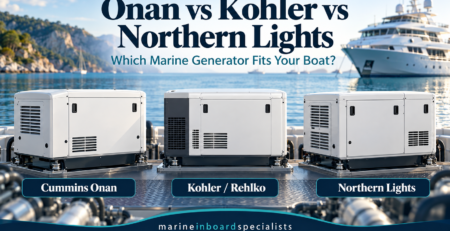
Use these factors when comparing Cummins Onan, Fischer Panda, Northern Lights, Nanni, Westerbeke, Kohler/Rehlko, and other marine-generator manufacturers.
Choose a compact generator when space is limited
A compact generator may be the best option for a smaller sailboat or a repower project where the existing compartment has limited clearance.
Fischer Panda places particular emphasis on compact, lightweight marine generator systems for boats and yachts. Its product range includes models in the approximate 5kW–8kW class, depending on configuration. fischerpanda.com
A compact unit can simplify installation, but confirm that its service access, cooling requirements, and starting performance are suitable for the boat.
Choose a heavy-duty generator for demanding use
A larger or more heavily built generator may be preferable when the boat operates for long periods, supports commercial activity, or regularly carries high electrical loads.
Heavy-duty selection may make sense for:
- Full-time liveaboard use
- Long offshore passages
- Frequent air-conditioning operation
- Commercial or charter service
- High daily generator hours
- Large battery-bank charging
- Multiple high-demand appliances
The additional durability may justify a higher purchase price when downtime, repairs, or difficult access would be costly.
Prioritize service support where the boat operates
A generator is only useful if it can be maintained and repaired. Before choosing a brand, identify:
- Local dealers
- Independent marine technicians
- Parts availability
- Service documentation
- Diagnostic equipment
- Warranty support
- Typical lead times for filters and major components
Nanni states that it supports its products through a sales and service network covering 90 countries and almost 850 qualified partners. nannienergy.com
That does not automatically make Nanni the correct choice for every vessel, but it demonstrates why service-network coverage belongs in the comparison.
When Should You Choose a 5kW, 7kW, or 10kW Generator?
A simple decision guide is:
Consider 5kW–6kW when:
- The sailboat has moderate electrical demand
- You normally operate one major appliance at a time
- There is one small or medium air-conditioning unit
- Space and weight are important
- You want to minimize fuel consumption and installation work
- The calculated continuous load is comfortably below the generator’s rating
Consider 7kW–8kW when:
- Several systems may run simultaneously
- The boat has multiple compressors or pumps
- You use a watermaker and air conditioning together
- Battery charging is a major part of generator operation
- The boat has more extensive galley equipment
- A 5kW unit would operate close to maximum output
Consider 9kW–10kW when:
- The vessel is larger or used as a full-time liveaboard
- Several air-conditioning units operate together
- Laundry equipment and induction cooking are common
- High electrical loads are expected for extended periods
- The installation can accommodate the additional size and weight
- The calculated load justifies the additional capacity
Do not select 10kW simply because it provides the greatest margin. If the normal load is only 2kW–3kW, a smaller generator may operate more efficiently and be easier to maintain.
Sailboat Generator Buying Checklist
Before ordering a marine generator for sailboat use, confirm the following.
Electrical requirements
- Rated output calculated from actual loads
- Starting surge reviewed
- Voltage confirmed
- Frequency confirmed
- Single-phase or three-phase confirmed
- Amperage compatible with the boat
- Transfer switch and distribution panel reviewed
- Sensitive electronics protected
Physical installation
- Generator fits through the access route
- Mounting footprint is suitable
- Dry weight is acceptable
- Service clearance is available
- Filters and belts can be reached
- Oil-drain access has been considered
- Control-panel location is practical
- Removal path has been considered for future replacement
Cooling and exhaust
- Raw-water intake is properly sized
- Seacock and strainer are accessible
- Siphon-break requirements are understood
- Exhaust back pressure is within the manufacturer’s limit
- Exhaust outlet is safely located
- Ventilation is adequate
- Engine-room heat is controlled
Fuel and safety
- Fuel supply and return arrangements are compatible
- Fuel filters are accessible
- Fuel shutoff location is practical
- Carbon-monoxide risk has been considered
- Fire protection requirements have been reviewed
- Bonding and grounding have been checked
- Installation will follow applicable marine standards
Ownership and support
- Parts are available in the cruising area
- Service technicians can support the brand
- Manuals and wiring diagrams are available
- Warranty terms are understood
- Quotation clearly identifies included accessories
- Commissioning responsibilities are defined
- Delivery and lead time are confirmed
Common Mistakes to Avoid
Choosing by kW alone
A generator’s output does not tell you whether it will fit, start your compressors, match your electrical system, or remain serviceable.
Ignoring frequency
A 50Hz and 60Hz generator are not interchangeable for every boat. Motors, appliances, chargers, and control systems may be frequency-sensitive.
Forgetting starting loads
A generator can have enough running capacity and still fail when several motors start at once.
Buying the smallest possible unit
Undersizing may lead to voltage instability, nuisance shutdowns, excessive load management, and poor performance.
Buying a unit that is too large
Oversizing may increase cost, weight, installation complexity, and low-load operating problems.
Treating a sound shield as a complete noise solution
Noise also depends on flexible mounts, exhaust routing, ventilation, bulkhead construction, and the location of the generator relative to sleeping areas.
Assuming the generator price includes installation
The generator set may be only one part of the project. Exhaust, cooling, controls, cabling, mounting, commissioning, and modifications can materially affect the total cost.
Frequently Asked Questions
What size marine generator do I need for a sailboat?
Many cruising sailboats fall somewhere between 3kW and 10kW, but the correct size depends on the boat’s simultaneous running loads and starting surges. A 5kW–6kW generator may suit moderate loads, while larger vessels with multiple air-conditioning units or heavy hotel loads may need 7kW–10kW.
Is a 3kW generator enough for a sailboat?
A 3kW generator may be sufficient for essential loads, refrigeration, battery charging, navigation electronics, and limited appliance use. It may not be suitable for multiple air conditioners, induction cooking, or several motor-driven loads starting together.
Is 5kW enough to run air conditioning on a sailboat?
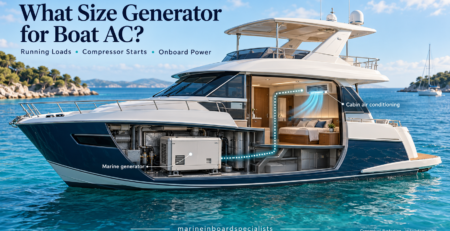
It may be enough for one appropriately sized air-conditioning system combined with moderate hotel loads. The final answer depends on the compressor’s starting demand, battery-charger load, water heater, refrigeration, and other equipment operating at the same time.
Is a diesel generator better for a sailboat?
A marine diesel generator is often preferred for regular or extended operation because it can integrate with the vessel’s diesel-fuel system and is designed for continuous marine use. The final choice should also consider fuel storage, ventilation, noise, maintenance, and the boat’s existing systems.
What is the quietest marine generator for a sailboat?
There is no universally quietest model for every installation. Perceived noise depends on the generator, sound shield, mounting, exhaust system, ventilation, compartment construction, and distance from living spaces. Compact enclosed systems from manufacturers such as Fischer Panda are often considered where low noise and limited space are priorities, but the installation remains decisive. fischerpanda.com
Should I choose 50Hz or 60Hz?
Choose the frequency that matches the boat’s appliances, shore-power system, electrical distribution, and intended cruising region. Do not assume that a generator with the same kW rating can replace a unit with a different frequency.
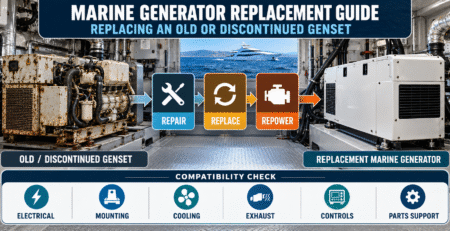
Can I replace my old generator with a different brand?
Possibly, but replacement is not always plug-and-play. Check the mounting footprint, fuel system, exhaust, cooling circuit, electrical output, control wiring, remote panel, weight, and service access before selecting a different brand.
How much spare generator capacity should I allow?
Allow enough capacity for starting surges and realistic future loads, but avoid excessive oversizing. The correct margin depends on the type of equipment onboard and the generator manufacturer’s recommendations.
Does a bigger generator use more fuel?
Generally, a larger engine can consume more fuel at a given operating condition, although actual consumption depends on load, engine design, speed, efficiency, and maintenance. A generator that is too large for the vessel may also spend too much time operating at light load.
Final Recommendation
For many cruising sailboats, the most practical starting point is a properly sized 5kW–6kW marine generator. This range can provide a useful balance between electrical capacity, compact installation, serviceability, and operating cost.
A 3kW–4kW unit may be sufficient for essential loads and smaller boats. A 7kW–8kW generator may be more suitable when several compressors, pumps, air-conditioning systems, or high-demand appliances operate together. A 9kW–10kW generator should be selected when the vessel’s calculated load and installation conditions genuinely require that capacity.
The marine generator for sailboat applications is the one that matches the complete vessel—not just the advertised output.
Before requesting a quotation, prepare the boat’s load list, electrical configuration, generator-compartment measurements, photos of the existing installation, and preferred purchase timeline. Marine Generator Depot can then help compare suitable generator options, confirm the required accessories, and identify the information needed for a technically accurate quotation.

Leave a Reply