

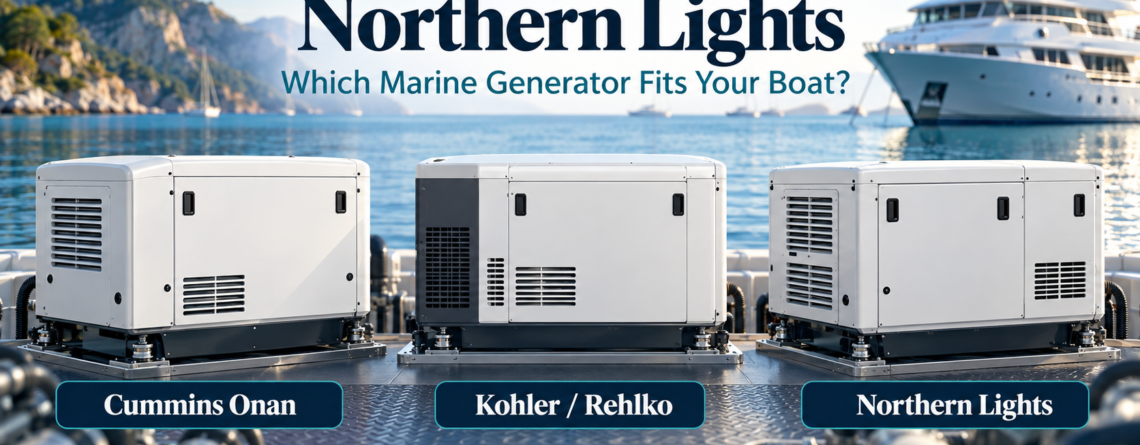
Choosing a marine generator means choosing how your boat will power air conditioning, refrigeration, battery charging, cooking appliances, and other onboard equipment. The right unit also needs to fit the available space, allow routine maintenance, and receive dependable support wherever you cruise.
When comparing Onan vs Kohler vs Northern Lights, there is no single winner for every vessel. The best choice depends on the specific generator model, your electrical requirements, the installation, and access to qualified service.
For readers of marineinboardspecialists, the most useful starting point is a comparison of complete installations. Two generators with similar output can require different controls, exhaust arrangements, mounting positions, and service clearances. Those differences can affect both ownership costs and everyday convenience.
This guide explains how to evaluate Cummins Onan, Kohler/Rehlko, and Northern Lights without relying on brand reputation alone.
Onan vs Kohler vs Northern Lights: The Quick Answer
Choose the generator that meets your boat’s electrical requirements, fits with adequate service access, and has qualified support along your cruising route. Use brand features to narrow the shortlist after those requirements are satisfied.
Each manufacturer offers features worth investigating:
- Cummins Onan: Compare the electrical controls and frequency regulation of the model you are considering.
- Kohler/Rehlko: Examine the sound enclosure, control options, and equipment included in the quoted configuration.
- Northern Lights: Check the model’s output at your required frequency, operating speed, and maintenance access.
These are starting points for evaluation, rather than evidence that one brand is universally quieter, more reliable, or cheaper to own.
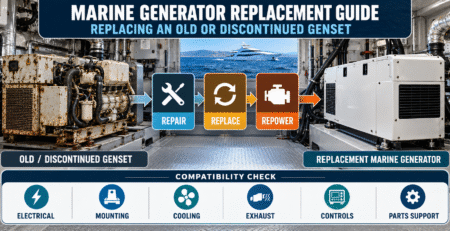
A familiar brand can be a sensible replacement candidate, but the new generator still needs a complete compatibility check. An existing installation does not guarantee that a newer model will use the same mounting footprint, wiring, remote panel, or exhaust connections.
Compare Specific Models Before Comparing Brands
A brand comparison becomes useful only when the shortlisted generators serve the same purpose.
For example, comparing a smaller enclosed generator with a larger unit supplied without its enclosure does not establish which manufacturer offers better value. The units differ in both capacity and included equipment.
Create a comparison sheet that records the following for every candidate:
| Comparison item | What to confirm |
|---|---|
| Electrical output | Rated kW at the required frequency and voltage |
| Electrical configuration | Single-phase or three-phase output |
| Operating requirements | Intended duty and manufacturer operating guidance |
| Installation dimensions | Overall size, mounts, enclosure, and service clearance |
| Controls | Local panel, remote panel, alarms, and compatible accessories |
| Included equipment | Sound enclosure, harnesses, breakers, and installation accessories |
| Support | Qualified service, parts availability, and warranty arrangements |
| Total price | Generator, installation, commissioning, and necessary modifications |
This approach makes marine generator comparison more practical. It also helps explain why a lower equipment price may produce a higher installed cost.
For marineinboardspecialists readers requesting quotations, providing every supplier with the same requirements makes those quotations much easier to compare.
What the Manufacturer Information Actually Shows
Manufacturer documentation can establish model features and rated output. It does not, by itself, establish an independent ranking for reliability, cabin noise, or lifetime cost.
Cummins Onan: Examine Electrical Control Features
Cummins lists electronic frequency control among the features of its Onan Marine QD 6/7.5/8 kW generator family. This is a relevant feature to investigate when assessing the electrical supply requirements of onboard equipment. Buyers should still confirm the exact output configuration and specifications of the model being quoted. Cummins Inc.
The practical question is how that particular generator matches your boat’s loads and electrical system. Ask the installer to explain the applicable voltage, frequency, starting-load capability, and control arrangement.
Kohler/Rehlko: Examine the Enclosure and Quoted Configuration
Rehlko’s pleasure-craft information describes a redesigned sound shield with separate engine and alternator compartments and an improved air-management system. These are relevant design features when evaluating generator noise control, but they do not establish a noise ranking against competing models under identical conditions. Global EN
When requesting a Kohler/Rehlko quotation, confirm the exact model designation and whether the proposed sound enclosure is included. Also ask how its panels will be removed once the generator is installed.
A sound enclosure needs enough access for servicing as well as enough room to fit.
Northern Lights: Read Frequency and Output Together
Northern Lights lists the NL843NW4 at 12 kW for 60 Hz operation at 1,800 rpm and 10 kW for 50 Hz operation at 1,500 rpm, in the stated single-phase configurations. This illustrates why a model described as “12/10 kW” cannot be compared using the larger number alone. northern-lights.com
Use the rating that matches your vessel’s electrical system. Then compare that configuration with equivalent candidates from the other manufacturers.
These examples identify useful questions for buyers; they are not a comparison of three generators with identical capacities.
Start With Your Boat’s Electrical Requirements
Before deciding between brands, establish the specification the replacement or new generator must meet.
Confirm Frequency, Voltage, and Phase
Record the vessel’s required:
- Frequency: 50 Hz or 60 Hz.
- Voltage: The supply required by the boat’s distribution system and equipment.
- Phase: Single-phase or three-phase.
- Capacity: Sufficient output for the intended operating loads.
Have a qualified marine electrician verify these requirements against the vessel’s electrical drawings and installed equipment.
Do not assume that two generators with the same advertised kW rating are interchangeable. Their available electrical configurations may differ.
Identify Which Loads Will Run Together
A useful generator sizing assessment considers operating combinations.
For example, an owner might want to run air conditioning, refrigeration, and a battery charger together, while using a water heater or cooking appliance separately. Another owner may expect all those loads to operate simultaneously.
Those expectations create different sizing requirements.
Prepare a load schedule covering equipment ratings, likely simultaneous use, and significant starting loads. Ask the supplier to assess the proposed generator against that schedule, including the effects of load management.
Choosing the largest unit that fits is not a substitute for matching capacity to actual use.
Installation Fit Can Decide the Winner
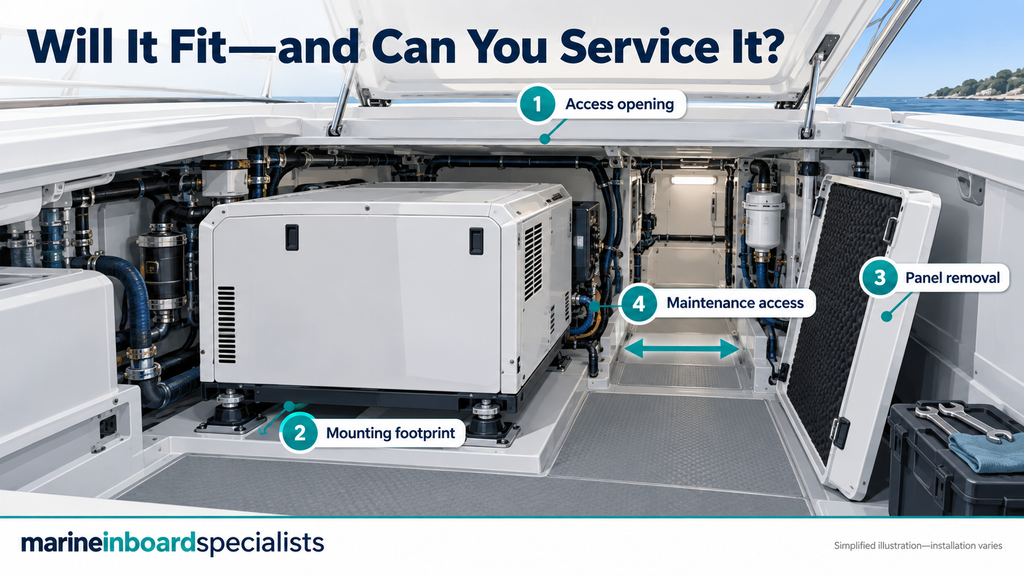
A generator must fit through the access opening, sit correctly on its mounting arrangement, and remain serviceable after installation.
Before placing an order, obtain the manufacturer’s dimensional drawing and check:
- The route into the machinery space.
- The installed footprint and mounting positions.
- Clearance for enclosure-panel removal.
- Access to filters, fluid service points, and cooling-system components.
- Space for electrical, fuel, cooling, and exhaust connections.
For a replacement marine generator, also identify which existing components can be retained and which require modification.
Consider a hypothetical owner replacing an older genset. One candidate costs less to purchase but requires substantial changes to the mounting base and exhaust route. Another costs more initially but fits with fewer modifications and better maintenance access.
The second option may offer better overall value. The conclusion should come from itemised installation quotations, rather than the brand name.
Service Support Should Match Your Cruising Plans
The useful question is not simply whether a manufacturer has a dealer network. It is whether the exact generator can receive qualified support in the places you expect to visit.
Before choosing, ask:
- Which nearby technicians service this model?
- Are routine service parts available locally?
- What are the likely lead times for less common components?
- How are warranty repairs arranged?
- What maintenance can the owner perform using the supplied documentation?
For a boat that stays near one marina, a capable local service provider may strongly influence the decision. For extended cruising, support across the planned route becomes more significant.
When evaluating Onan vs Kohler vs Northern Lights, shortlist the models that satisfy the boat’s electrical and installation requirements first. Then compare their noise evidence, controls, maintenance needs, support, and complete installed price. That gives you a defensible basis for choosing the best generator for your vessel.
Which Marine Generator Is Best for Your Boating Style?
The best choice in an Onan vs Kohler vs Northern Lights comparison depends on how you use your boat. Occasional weekend trips, extended cruising, and frequent overnight stays create different demands.
Start by describing a typical day onboard: which appliances run, when they run together, how long the generator operates, and where you expect to obtain service. That operating profile is more useful than choosing a brand before identifying your requirements.
For Weekend Cruising and Occasional Use
If your generator mainly supplies air conditioning, cooking appliances, and battery charging during short trips, prioritise straightforward operation, suitable capacity, and accessible maintenance.
Compare how each proposed model starts, displays operating information, and communicates faults. Also check whether the remote panel can be positioned where you can conveniently monitor it.
An occasional-use generator still needs maintenance according to its manufacturer’s schedule. Low operating hours do not automatically remove time-based service requirements.
For this type of owner, the strongest option may be the model that combines a suitable installation with dependable local support.
For Extended Cruising and Liveaboard Use
For longer periods aboard, marine generator serviceability deserves particular attention.
Review the maintenance schedule for each shortlisted model against your expected operating hours. Identify which tasks you can reasonably perform onboard and which require specialist assistance.
Check access to routine service points, the space needed to remove components, and the availability of the correct consumables. A generator that fits tightly into the machinery space may become expensive to maintain if servicing requires moving other equipment.
Support along your cruising route also matters. Before choosing, establish how you would obtain technical assistance and replacement parts away from your home marina.
For Overnight Air Conditioning
If sleeping comfort is the priority, compare noise where people actually sleep.
A manufacturer’s sound figure can help screen candidates, but it does not predict cabin noise by itself. The mounting arrangement, machinery-space construction, ventilation openings, exhaust system, and distance from the cabin all influence the result.
Ask whether the installer can provide comparable measurements from a similar installation. Establish the generator load, measurement location, and enclosure configuration behind any quoted figure.
No brand should be declared the quietest without comparable evidence for the specific models and installations.
Comparing Noise: Look Beyond the Sound Enclosure
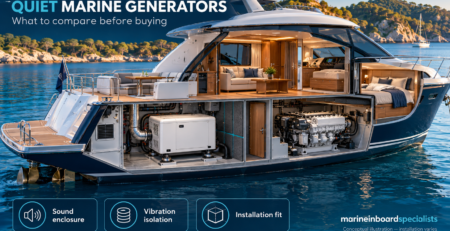
A quiet marine generator needs a suitable enclosure and a well-planned installation. Buying a sound shield alone does not resolve every source of noise.
There are several paths to examine:
| Noise path | What to evaluate |
|---|---|
| Airborne machinery noise | Enclosure configuration, panel fit, and machinery-space construction |
| Structural vibration | Mount selection, mounting base, and connections that may transmit vibration |
| Ventilation noise | Airflow requirements and the route between the machinery space and occupied areas |
| Exhaust noise | Manufacturer-approved exhaust arrangement and discharge location |
Use this table to discuss the proposed installation with your supplier. Avoid treating sound insulation as a reason to restrict required ventilation or change exhaust arrangements without approval.
Ask for Comparable Sound Measurements
When evaluating marine generator noise levels, request the conditions behind the measurement:
- Was the generator enclosed or unenclosed?
- What load was it carrying?
- How far away was the measurement taken?
- Was the figure measured beside the unit, in a cabin, or elsewhere?
- Were other engines and machinery operating?
If those conditions differ, the figures do not support a straightforward brand ranking.
A useful acceptance target should identify a measurement location and operating condition. For example, an owner may want the installer to assess noise in the aft cabin while the generator supplies the intended overnight loads.
That creates a clearer discussion than asking whether a generator is “silent.”
Reliability: Evaluate Support and Maintenance Alongside the Machine
Owners understandably want the most reliable marine generator. However, a defensible reliability ranking requires comparable evidence, including operating hours, maintenance history, installation conditions, and failure definitions.
Owner reports can reveal useful questions, but they rarely establish how entire brands perform. A report about one older genset may have little relevance to a different model or installation.
For buying purposes, evaluate how the proposed system will be maintained and how faults will be resolved.
Check the Maintenance Requirements Before Ordering
Request the operating and maintenance manuals for the exact models under consideration.
Compare the scheduled tasks, service intervals, required fluids and consumables, and access needed to complete the work. Build the maintenance plan around both anticipated operating hours and applicable calendar intervals.
For readers of marineinboardspecialists, this is an opportunity to evaluate ownership costs before committing to a purchase. A maintenance schedule can reveal practical differences that a product description leaves out.
Check How Faults Will Be Diagnosed
Ask the supplier to demonstrate what happens when the generator reports a fault.
Can the owner read a useful message or code? What information should be recorded before contacting a technician? Which checks are described in the owner’s manual, and which require specialist equipment?
Useful diagnostics can help a technician identify the next step. They do not make a generator immune to faults or replace proper maintenance.
Confirm Support for the Exact Model
A technician who services one manufacturer’s engines may not support every generator or control system from that manufacturer.
Provide the full model designation when asking about service. Confirm access to the relevant technical information, diagnostic equipment where required, and parts for that configuration.
The best-supported generator for your boat may differ from the best-supported option in another region.
Fuel Consumption: Compare the Same Electrical Work
A fair marine generator fuel consumption comparison needs matching conditions.
Comparing one generator at half load with another at full load tells you little about their relative efficiency. Likewise, equal percentages of load can represent different electrical outputs when the generators have different capacities.
For example, 50% load on an 8 kW unit represents 4 kW, while 50% load on a 12 kW unit represents 6 kW. Those are different amounts of electrical work.
Where manufacturer data permits, compare fuel consumption at the electrical output you expect to use. Consider several operating conditions rather than one headline number.
Build a Typical Operating Profile
A simple planning worksheet can separate your expected use into:
| Operating period | Loads to assess |
|---|---|
| Morning | Battery charging, water heating, and breakfast appliances |
| Daytime | Refrigeration, selected appliances, and occasional charging |
| Evening | Cooking equipment, lighting, entertainment, and air conditioning |
| Overnight | Intended air-conditioning zones and essential background loads |
These are examples, not a sizing calculation. Record the actual equipment aboard your vessel and have the proposed combinations assessed.
Also review the manufacturer’s guidance on loading. If your electrical demand is frequently very low, discuss suitable capacity and load management before selecting a larger generator.
Purchase Price vs Complete Installed Cost
The lowest generator price does not necessarily produce the lowest project cost.
A useful marine generator cost comparison includes the equipment, installation, commissioning, and modifications needed to make the system operational.
Request itemised quotations covering:
- The exact genset and electrical configuration.
- The enclosure and control equipment.
- Mounting work and access requirements.
- Necessary cooling, fuel, and exhaust changes.
- Wiring, protection, and electrical integration.
- Removal and disposal of the existing unit, where applicable.
- Commissioning and handover.
Separate required work from optional upgrades. This makes it easier to understand price differences and identify exclusions.
Use a Replacement Scenario to Compare Value
Imagine two quotations for replacing an older generator.
The first offers a lower equipment price but requires a new remote panel, changes to the mounting base, and additional installation labour. The second costs more for the generator but requires fewer modifications.
Neither quotation is automatically better. Compare the complete scope, service access, support, and final installed price.
Keeping the existing brand may reduce some changes, but that must be confirmed for the exact replacement model.
Controls and Integration Can Influence the Decision
The generator needs to work with the vessel’s electrical system and the way you manage onboard power.
Check the quoted remote panel, wiring harness, alarm functions, and any monitoring or automatic-start options. Availability and compatibility can vary by model and configuration.
If automatic starting is proposed, ask the installer to explain its operating conditions, shutdown behaviour, and procedures for safely disabling it during servicing.
For boats with multiple power sources, clarify how generator power will interact with shore power, inverters, and the distribution system. Do not assume that existing switching or monitoring equipment will support a replacement without modification.
More functions are useful only when they serve your needs. A simpler control arrangement may suit one owner, while another needs integration with a broader monitoring system.
Turn the Brand Comparison Into a Practical Shortlist
At this stage, your Onan vs Kohler vs Northern Lights comparison should contain specific models and complete installation proposals.
First, eliminate any candidate that fails a mandatory requirement. Then compare the remaining options against your priorities.
| Decision factor | Evidence to request |
|---|---|
| Electrical suitability | Exact output configuration and assessment of intended loads |
| Installation fit | Dimensional drawing and installer’s access assessment |
| Noise | Measurement conditions and proposed noise-control arrangement |
| Maintenance | Model-specific schedule and service-access review |
| Support | Confirmed service arrangements along your cruising route |
| Cost | Itemised installed quotation with exclusions identified |
Use this process to discuss your requirements with marineinboardspecialists and prospective installers. It gives the conversation a clear direction: identify the models that suit the vessel, establish the differences that matter, and choose on documented value.
A brand name belongs on the shortlist. The final decision should rest on the complete system you will own and operate.
Making the Final Choice: Onan, Kohler/Rehlko, or Northern Lights?
The best marine generator is the specific model that meets your electrical needs, fits a serviceable installation, and has dependable support where you operate. A brand preference can help you build a shortlist, but it should not override those requirements.
In an Onan vs Kohler vs Northern Lights comparison, make the final decision using written specifications and complete quotations. Avoid awarding a winner based on one feature, an isolated owner review, or an equipment price that excludes installation.
When Cummins Onan Belongs on Your Shortlist
Consider a Cummins Onan model when its electrical configuration, controls, dimensions, and local service arrangements match your requirements.
If you already have an Onan installation, investigate whether another Onan model offers practical advantages for replacement. Ask the installer to confirm mounting compatibility, remote-panel requirements, wiring changes, and cooling and exhaust connections.
Keeping the brand may simplify some work, but only a model-specific assessment can establish that.
When Kohler/Rehlko Belongs on Your Shortlist
Consider a Kohler/Rehlko model when its quoted enclosure, control arrangement, output, and installation requirements suit the vessel.
Check the exact model designation across the quotation, datasheet, accessories, and warranty documentation. For an older Kohler installation, identify the existing equipment by its model and serial number before discussing replacement compatibility.
Evaluate the complete configuration being supplied. Features described for a product range should not be assumed to appear on every model or quotation.
When Northern Lights Belongs on Your Shortlist
Consider a Northern Lights model when its rated output at your required frequency, installation dimensions, maintenance requirements, and service support match your operating plans.
Review the dimensional drawing alongside the service instructions. Confirm that the installed position allows the necessary maintenance work and that the quoted controls provide the functions you need.
As with the other brands, assess the exact generator rather than relying on a general reputation for simplicity or durability.
A Practical Way to Compare Your Final Quotations
Once you have two or three suitable candidates, use a weighted decision sheet. This helps prevent one attractive feature from dominating the purchase.
First, treat electrical compatibility, installation suitability, and applicable vessel requirements as mandatory checks. A generator that fails one of these should not remain a candidate simply because it scores well elsewhere.
Then compare the eligible models using your priorities.
| Decision factor | Example weighting |
|---|---|
| Maintenance access and serviceability | 25% |
| Qualified support along the cruising route | 25% |
| Complete installed cost | 20% |
| Evidence of suitable noise performance | 20% |
| Controls and monitoring suitability | 10% |
These percentages are an illustrative buying tool, not an industry standard. Adjust them to your circumstances.
An owner sleeping aboard regularly may give noise performance more weight. A vessel operating far from its home marina may prioritise service support and parts logistics.
Score each candidate from one to five only where you have evidence. Mark unresolved items as “not confirmed” and obtain the missing information before ordering. An unknown should not receive an average score simply to complete the table.
For marineinboardspecialists readers, the value of this exercise is the discussion it creates: which differences matter, which claims are documented, and which questions remain unanswered?
What to Confirm Before Paying a Deposit
A marine generator purchase checklist should turn the selected quotation into a clear record of what you are buying.
Confirm the Exact Equipment
The quotation should identify the model, rated output, frequency, voltage, phase, and included accessories.
Clarify the condition of the equipment—new, used, or refurbished—and request the relevant documentation. If the unit is already identified, record its serial number where available.
Make sure the enclosure, remote panel, harnesses, and other agreed equipment appear in the written scope.
Confirm Installation Responsibilities
Establish who is responsible for removing the existing generator, preparing the mounting arrangement, completing the installation, and commissioning the system.
Ask which existing components will be retained and which will be replaced. Include any required electrical, fuel, cooling, ventilation, and exhaust work in the scope.
Also identify exclusions. Access work, lifting arrangements, transport, taxes, and yard charges can materially affect the final project cost.
Confirm Delivery and Warranty Arrangements
Obtain written confirmation of availability, delivery terms, payment stages, and quotation validity.
For marine generator warranty coverage, ask which terms apply to the exact unit, what registration or commissioning documentation is required, and how a claim would be handled in your operating region.
Clarify responsibility for labour, travel, removal, and reinstallation if a repair becomes necessary. Do not assume every related expense is covered.
Agree on Commissioning and Handover
Before installation begins, agree on the checks and records that will form the handover.
The installer should follow the applicable manufacturer procedures and document the relevant operating checks. Request a demonstration of normal operation, controls, monitoring, and owner procedures.
Collect the manuals, installation records, warranty documents, and initial maintenance requirements together. These records will also help future technicians understand the system.
Common Buying Mistakes to Avoid
Choosing by Boat Length Alone
Boat length provides context, but it does not establish electrical demand. Two similar-sized yachts can have different air-conditioning systems, cooking appliances, charging equipment, and operating habits.
Base marine generator sizing on the equipment aboard and the loads expected to run together.
Assuming More Capacity Is Always Better
Extra capacity has value only when it serves a documented requirement. A larger generator may introduce additional cost, weight, space demands, and a different loading profile.
Discuss anticipated demand and manufacturer loading guidance before buying additional capacity.
Comparing Incomplete Quotations
One quotation may include an enclosure, controls, installation, and commissioning while another covers the generator alone.
Compare matching scopes before deciding which offers better value.
Treating Replacement as a Direct Swap
A new genset with a similar kW rating may have different dimensions, mounting positions, controls, or connection requirements.
A marine generator replacement needs a compatibility assessment even when you retain the manufacturer.
Accepting Unsupported Brand Rankings
Claims such as “the most reliable,” “the quietest,” or “the cheapest to maintain” need comparable evidence.
Ask what models were compared, under which conditions, and using which records. If those details are unavailable, treat the claim as an opinion.
Frequently Asked Questions
Which is best: Onan, Kohler/Rehlko, or Northern Lights?
There is no defensible universal winner. The best choice is the model that satisfies your electrical requirements, installation constraints, operating priorities, and service needs at an acceptable complete cost.
Which marine generator brand is quietest?
A brand-level answer is insufficient. Compare specific models under matching measurement conditions, then assess how the proposed installation will affect noise in occupied areas.
Should I replace my generator with the same brand?
Keeping the same brand is worth investigating, particularly if it reduces installation changes or retains useful service arrangements. Confirm those advantages for the exact replacement model before deciding.
Can I reuse my existing remote control panel?
Possibly, but compatibility must be confirmed. Provide the existing generator and panel identification details to the supplier, and obtain a clear statement of the required controls and wiring.
Is a lower-rpm generator automatically better?
Operating speed alone does not establish overall quality, noise, efficiency, or suitability. Evaluate it alongside rated output, loading guidance, dimensions, controls, maintenance requirements, and installation conditions.
How do I compare running costs?
Assess expected fuel use at relevant electrical loads, scheduled maintenance, consumables, service labour, and likely support expenses. Keep purchase and installation costs visible separately so you can understand both the initial investment and ongoing costs.
What information should I send when requesting a quotation?
Provide the boat make and model, existing generator identification, required electrical configuration, intended loads, machinery-space measurements, and photographs. Include the delivery location and intended purchase date so the quotation can address logistics and timing.
Choose the Generator That Fits Your Vessel and Ownership Plans
A useful Onan vs Kohler vs Northern Lights comparison ends with a documented choice.
You should be able to explain why the selected model has suitable capacity, how it will be installed and serviced, what the complete project will cost, and where support will come from.
To begin your enquiry with marineinboardspecialists, send a photograph of the existing generator’s identification plate, machinery-space photographs, your electrical requirements, and the equipment you want to run. Include your billing and delivery addresses and how soon you intend to purchase.
Those details provide a stronger basis for a quotation—and help turn a broad brand comparison into a generator choice suited to your boat.

Leave a Reply