

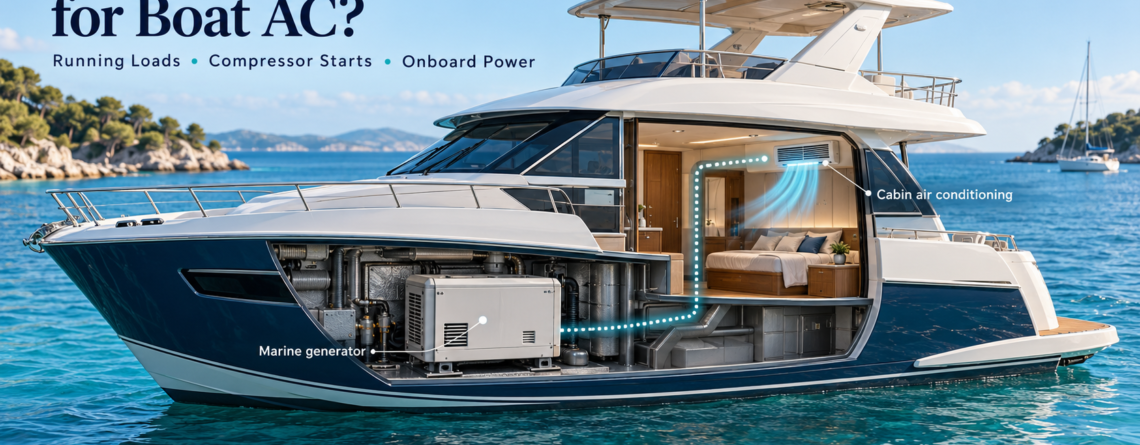
Imagine anchoring for the night, starting your generator, and switching on the cabin air conditioning. The fan runs, but when the compressor tries to start, the lights dip and the AC shuts down.
That situation does not automatically mean you need a larger generator. The cause could involve starting demand, other connected loads, voltage drop, or an equipment fault. Choosing the right generator for boat AC begins with understanding the electrical requirements of the complete system.
The right size depends on your air conditioner’s running input, compressor starting characteristics, seawater pump, and other equipment operating at the same time. Cooling capacity alone cannot provide an accurate generator recommendation.
For marineinboardspecialists readers, this guide explains how to build a useful load assessment before requesting a quotation—and how to avoid buying capacity you do not need.
What Size Generator Do You Need for Boat AC?
Choose a generator that can supply the combined running loads and start the required compressor while the other intended loads remain connected. It must also match the boat’s voltage, frequency, and phase requirements.
There is no universal generator size for a 12,000, 16,000, or 24,000 BTU/h marine air conditioner. Units with similar cooling capacities can have different electrical inputs and starting characteristics.
An accurate recommendation needs:
- The air conditioner’s exact model and electrical specifications.
- The number of compressors expected to operate together.
- The starting method, including any compatible soft starter or inverter control.
- The seawater pump and other associated loads.
- The appliances and battery charger running alongside the AC.
- The proposed generator’s motor-starting performance.
Cummins’ generator application guidance identifies motor starting requirements, voltage-dip limits, and load sequencing as factors in sizing. It also recommends assessing individual air-conditioning components and which loads may start simultaneously. cummins.com
The practical lesson is simple: running capacity and starting capability are separate checks. Passing one does not guarantee that the system will pass the other.
Why BTU Ratings Do Not Tell You the Generator Size
A marine air conditioner’s BTU/h rating describes its cooling capacity. A generator’s kW rating describes electrical power output.
These measurements answer different questions.
A 16,000 BTU/h air conditioner provides approximately 4.69 kW of thermal cooling capacity. That does not mean it draws 4.69 kW of electricity.
Its electrical input depends on equipment efficiency, design, and operating conditions. Use the manufacturer’s electrical data for the exact model rather than converting cooling capacity directly into generator capacity.
Cooling Capacity and Electrical Input Must Stay Separate
When reviewing a marine air conditioning power requirement, distinguish between:
| Specification | What it tells you |
|---|---|
| BTU/h | The rated cooling capacity |
| Electrical input in watts or kW | Real electrical power consumed under stated conditions |
| Running current in amps | Current during operation under stated conditions |
| Starting-current information | Demand associated with compressor starting |
| Voltage and frequency | Required electrical supply |
| Breaker or circuit rating | Circuit protection requirements, rather than normal consumption |
A breaker rating is not a substitute for measured running demand. Likewise, a compressor current rating may exclude fans, controls, or a separate seawater pump.
Before adding figures together, establish what each specification includes.
Running Load vs Compressor Starting Load
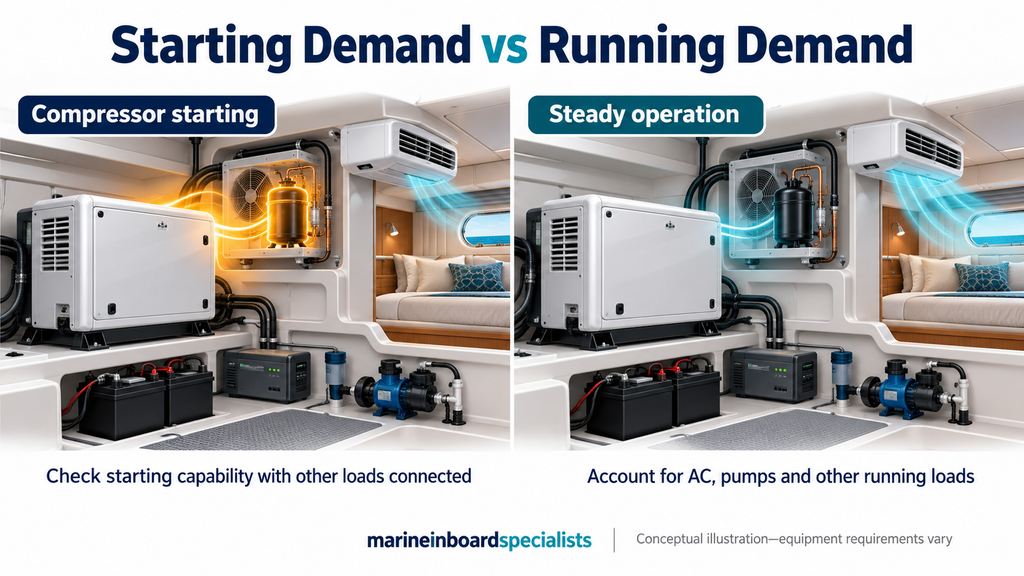
An air conditioner needs electrical power while operating, but starting the compressor creates a different demand.
The magnitude and duration of that demand depend on the compressor and its starting arrangement. Conventional fixed-speed equipment, soft-start-equipped systems, and inverter-controlled equipment should not be treated as interchangeable.
Running Load Determines Sustained Demand
The boat AC running load is part of the power the generator must continuously supply while cooling.
For a complete assessment, account for the compressor, fans or blowers, controls, and associated pumps. Some manufacturer figures cover the complete unit; others describe individual components.
If the seawater pump serves multiple AC units, count its actual electrical load once in the appropriate operating scenario. Do not add the same shared pump separately for every cabin.
Starting Demand Tests the Generator’s Response
The marine AC compressor starting load affects how the generator responds during the start.
A generator can have enough rated kW to carry an air conditioner once it is running yet struggle when the compressor starts against an existing background load.
This is why the assessment should consider voltage and frequency response, starting duration, and the equipment’s acceptable operating limits.
Do not apply a universal “three times running watts” rule to every marine AC system. Obtain model-specific starting information and have it assessed against the proposed genset.
Thermostat Cycling Matters Too
Starting the AC successfully once is not enough.
Later, a compressor may restart while other cabins are cooling and the battery charger is operating. That restart can create a more demanding condition than the initial start with other loads switched off.
Your sizing assessment should cover normal compressor cycling, not just a carefully controlled demonstration.
How to Read Your Marine Air Conditioner’s Electrical Data
Start with a clear photograph of the equipment identification plate. Then locate the installation manual or technical data for the exact model and electrical version.
Record the following:
| Information to collect | Why it matters |
|---|---|
| Manufacturer and model | Identifies the correct technical documentation |
| Supply voltage | Confirms electrical compatibility |
| Frequency and phase | Prevents comparison with an unsuitable configuration |
| Rated electrical input | Supports the running-load assessment |
| Compressor and total-unit current | Helps identify what the figures include |
| Starting data or manufacturer guidance | Supports the motor-starting assessment |
| Soft starter or inverter details | Identifies the starting arrangement |
| Seawater-pump specifications | Captures associated demand |
If a plate shows RLA, use the manufacturer’s definition and do not assume it represents complete-system consumption under every condition.
If it shows LRA, understand that locked-rotor amperage is not the normal running current or a complete description of a successful start. It is useful technical information, but it should not be converted directly into a final generator recommendation.
When contacting marineinboardspecialists, send the plate photographs alongside details of the pump and other loads. Those records are more useful than boat length or cooling capacity alone.
Converting Amps Into a Useful Load Estimate
For a single-phase load:
Apparent power in kVA = voltage × current ÷ 1,000
Real power in kW = voltage × current × power factor ÷ 1,000
For example, an illustrative load drawing 10 amps at 230 volts represents 2.3 kVA. If its power factor is 0.9, the corresponding real power is approximately 2.07 kW.
These are hypothetical figures, not specifications for a particular marine air conditioner.
Why kW and kVA Both Matter
Real power and current demand impose different requirements on the generating system. Consequently, a boat generator sizing calculation should account for both where applicable.
When power factor is unknown, voltage multiplied by current gives apparent power. Do not automatically present that result as an exact kW figure.
Use manufacturer input-power data where available. A qualified marine electrician can obtain appropriate measurements when documentation is incomplete.
Avoid sizing from a brief reading taken while only the fan is running or the compressor is lightly loaded.
Include the Equipment Running Alongside Your AC
Air conditioning is rarely the only generator load aboard.
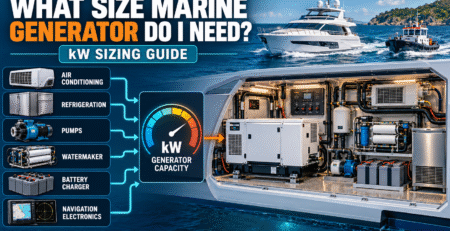
Your generator for boat AC may also need to supply refrigeration, a battery charger, cooking appliances, a water heater, and other equipment. What matters is which loads overlap.
A useful worksheet separates operating scenarios:
| Scenario | Loads to assess |
|---|---|
| Overnight cooling | Intended AC zones, associated pump, refrigeration, and essential background loads |
| Evening onboard | AC plus cooking appliances and other expected equipment |
| Battery recovery | AC while the charger operates at its intended input |
| Compressor restart | Existing running loads plus the compressor starting |
| Supply restoration | Loads that may reconnect or restart after an interruption |
Battery-charger input deserves particular attention. A charger restoring depleted batteries may draw differently from one maintaining batteries near full charge.
Also distinguish appliances supplied directly by the generator from DC equipment supplied through the battery system. Avoid counting the same energy demand twice through both the charger and its downstream loads.
The First Sizing Decision: Define Your Comfort Requirements
Before choosing a generator, decide what you expect the AC system to do.
Do you need one sleeping cabin cooled overnight, or several zones operating together? Must the water heater and cooking appliances remain available while cooling? Are you comfortable managing selected loads?
Those choices influence capacity and installation cost.
Write a clear requirement such as:
“The generator must run both intended overnight AC zones, their associated pump, refrigeration, and the battery charger, while allowing normal compressor restarts.”
That statement gives the supplier a concrete operating condition to assess.
How to Calculate the Generator Capacity Your Boat AC Needs
Start with the loads you expect to run together. Then assess the compressor starts that can occur while those loads are operating.
A useful generator for boat AC assessment has two stages:
- Establish the sustained electrical demand.
- Confirm that the proposed generator can handle the required starting events within the equipment’s voltage and frequency limits.
The first stage creates a capacity estimate. The second determines whether a particular generator can perform the job.
Build a Complete Running-Load Schedule
Use manufacturer electrical-input figures or suitable measurements for the actual equipment aboard.
The following example illustrates the method. These values are hypothetical and should not be used as specifications for your boat.
| Equipment | Assumed running input |
|---|---|
| Cabin AC unit, including its fan and controls | 1.30 kW |
| Separate seawater pump | 0.15 kW |
| Battery charger: AC input at the planned charging setting | 0.60 kW |
| Refrigeration | 0.10 kW |
| Other generator-supplied loads | 0.15 kW |
| Combined running demand | 2.30 kW |
This identifies a 2.30 kW operating scenario. It does not establish that a generator rated slightly above 2.30 kW will start the compressor successfully.
You still need the applicable current and power-factor information, compressor starting characteristics, and generator performance data.
Also confirm that every load has been counted correctly. If the AC manufacturer’s total input already includes the pump, adding it again would overstate demand.
Build the Starting Scenario Separately
Record which equipment remains running when each compressor starts.
For the example above, the starting assessment would include the compressor’s starting demand alongside the pump, charger, refrigeration, and other connected loads. The AC fan may also remain operating during the start.
Do not add the complete starting demand on top of the same compressor’s running demand as though both occur independently. The starting condition replaces that compressor’s normal running condition during the relevant interval.
This distinction matters when preparing a marine generator load calculation. A supplier needs a realistic sequence of events rather than a sum of unrelated maximum figures.
Treat Headroom as a Planning Choice
Operating headroom can accommodate expected variations and future equipment. However, a universal percentage does not prove starting capability.
For example, adding 25% to a running-load total may provide additional continuous capacity, but it says little about the generator’s response to a particular compressor start.
Ask the supplier to explain the proposed allowance, applicable rating conditions, and starting assessment. Any reduction in available output under the expected installation or environmental conditions should also be considered.
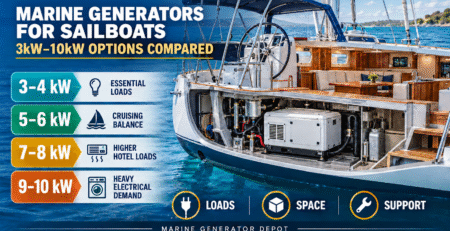
Can a 3 kW, 5 kW, or 8 kW Generator Run Boat Air Conditioning?
Possibly—but the generator rating alone is insufficient to answer. Each capacity must be assessed against the exact AC equipment, associated loads, and starting requirements.
| Generator capacity being considered | What must be established |
|---|---|
| 3 kW marine generator | Whether the complete running load fits and the specific compressor can start with the intended background loads |
| 5 kW marine generator | Whether its electrical configuration and starting response suit the proposed operating combinations |
| 8 kW marine generator | Whether the additional capacity serves the actual demand and the unit fits a suitable installation |
| 10 kW marine generator | Whether multiple AC zones and other loads justify the capacity, with acceptable starting performance |
This table is a screening guide, not a BTU-to-generator sizing chart.
A 5 kW unit should not be described as suitable for every 16,000 BTU/h air conditioner. Likewise, an 8 kW unit cannot be assumed to run a particular number of cabins without reviewing their equipment.
For marineinboardspecialists readers, the useful enquiry is: “Can this exact generator operate this load schedule?” That question invites a model-specific answer.
Sizing for Two or More Air-Conditioning Units
Multiple AC units create several operating combinations. Your assessment should cover the combinations you intend to use and the starts that the controls may permit.
Check the Worst Intended Operating Combination
If both cabins must remain cool overnight, include both units’ running demand, their associated pump arrangements, and other overnight loads.
Then assess situations such as:
- One compressor starting while the other is running.
- Either compressor cycling while battery charging continues.
- Both compressors attempting to restart after power is restored.
- A shared pump starting alongside the AC equipment.
The most demanding event may occur during normal cycling rather than when you first switch everything on.
Verify Any Start Sequencing
Starting compressors one at a time may reduce simultaneous starting demand. However, the sequence must be supported by the installed controls.
Manually switching units on separately does not necessarily prevent later overlapping starts. Thermostats can call for cooling independently, and supply interruptions can change the restart sequence.
If your sizing relies on staggered starts, have the installer confirm how that behaviour is achieved during normal operation and after power restoration.
Identify Shared Equipment
A shared seawater pump should be counted once in each relevant scenario. Separate pumps should be assessed according to which ones operate.
For chilled-water systems, identify the chiller, circulation pumps, seawater pumps, and air handlers. The number of cabins alone does not reveal the system’s electrical demand.
Can a Soft Starter Allow a Smaller Generator?
A compatible soft starter may reduce compressor starting demand, but it does not replace a complete sizing assessment.
Its effect depends on the AC equipment, device compatibility, installation, and operating conditions. Confirm suitability with the relevant manufacturer before including it in the design.
What a Soft Starter May Change
A suitable device can change the electrical demand during compressor acceleration. That may help a proposed generator handle a start that would otherwise cause excessive disturbance.
However, it does not remove the need to supply the AC system’s sustained running input. It also does not eliminate pump loads or unrelated appliances.
Avoid assuming that a soft starter will reduce every system’s starting demand by the same percentage.
Verify the Installed Result
If a smaller generator is being considered because of a soft starter, request a documented assessment of that combination.
Commissioning should evaluate the intended operating scenarios, including compressor restarts with other loads connected. The test conditions and acceptance limits should follow applicable equipment guidance.
An inverter-controlled compressor has a different starting arrangement. Do not assume it needs, or accepts, an additional external soft starter.
Load Management: Decide What Must Run Together
Boat generator load management can reduce simultaneous demand without changing the air-conditioning system.
For example, you may choose to heat water before starting the overnight cooling schedule. You might also limit charger input while using cooking appliances, where the charger supports an appropriate setting.
These are operating choices, so they should match how people actually use the boat.
Separate Essential Loads From Flexible Loads
| Load category | Example planning decision |
|---|---|
| Required overnight loads | Keep intended AC zones and essential refrigeration available |
| Flexible loads | Schedule water heating or selected cooking appliances separately |
| Adjustable loads | Review compatible charger input settings |
| Automatically cycling loads | Include their possible overlap in the assessment |
Do not base the purchase on an operating routine that occupants are unlikely to follow.
If automatic load control is needed, specify it as part of the installation. A written instruction to avoid simultaneous loads is different from a system that actively manages them.
Match the Generator’s Electrical Configuration
A generator with sufficient capacity can still be unsuitable if its output configuration does not match the vessel.
Confirm Voltage, Frequency, and Phase
Use the AC equipment documentation and vessel electrical drawings to confirm the required supply.
A similar kW rating does not make 50 Hz and 60 Hz configurations interchangeable. The same applies to voltage and single-phase versus three-phase output.
Changing a supply setting is not a substitute for verifying compatibility across the installation.
Check Loads on Individual Legs or Phases
Where a generator supplies a split-phase or three-phase distribution system, the total kW figure does not describe every circuit’s available capacity.
Individual legs or phases can reach their limits even when the combined load appears acceptable. Have the installer assess current limits, load distribution, and allowable imbalance for the proposed generator.
This is particularly relevant when several single-phase AC units share a larger distribution system.
Assess the Installation Alongside Capacity
Selecting a marine generator for air conditioning also requires space, service access, and suitable supporting systems.
Before ordering, review the access route, mounting arrangement, ventilation, cooling, exhaust, wiring, and maintenance clearances.
For overnight operation, assess the generator’s location relative to sleeping cabins and how the installation will control airborne sound and vibration. An enclosure specification alone cannot predict cabin comfort.
If you are replacing an existing genset, identify necessary modifications before comparing complete installed prices.
Prepare a Sizing Enquiry That Produces a Useful Answer
Send marineinboardspecialists a clear equipment schedule rather than asking for a generator size based only on boat length.
Include the AC model plates, number of units, pump specifications, supply requirements, soft-starter or inverter details, and other simultaneous loads. Add photographs and measurements of the proposed installation space.
Explain your intended operating requirement—for example, both sleeping cabins cooled overnight while refrigeration and battery charging remain available.
How to Confirm Your Generator Will Run the Boat AC
A suitable generator for boat AC should do more than start the air conditioner once. It should support the operating combinations you agreed with the supplier, including normal compressor cycling with other equipment connected.
Before ordering, ask for a written recommendation identifying the exact generator configuration, assessed loads, and any required controls or operating restrictions.
After installation, commissioning should check those assumptions against the completed system.
Agree on the Operating Scenarios Before Installation
Give the installer a clear description of the performance you expect. For example:
“Both sleeping-cabin AC units must operate overnight alongside refrigeration and the battery charger, with normal compressor restarts.”
This is an illustrative requirement, not a specification for every boat.
If the design depends on staggered compressor starts, limited charger input, or switching off the water heater, record those conditions. They should be understandable to everyone who operates the vessel.
For marineinboardspecialists readers, documenting the operating requirement helps connect the quotation, installation, and handover.
Verify Performance Under Representative Loads
Have a qualified installer follow the applicable manufacturer commissioning procedures and evaluate the intended operating scenarios.
Depending on the equipment and installation, the assessment may include:
- Starting each AC unit with the expected background loads connected.
- Operating the intended combination of cooling zones.
- Checking compressor restarts during normal cycling.
- Confirming any automatic start sequencing or load management.
- Recording voltage, frequency, and current where appropriate.
The acceptance limits should come from the relevant equipment documentation. Avoid substituting a generic voltage-drop allowance for model-specific requirements.
Do not force rapid compressor restarts to test the system. Follow the AC manufacturer’s restart delays and operating instructions.
Keep the Handover Records
Request the generator and AC documentation, commissioning results, control instructions, warranty records, and maintenance requirements.
Where equipment settings affect generator demand, record them. A later increase in charger input or change to start sequencing could alter the conditions used for sizing.
These records also give technicians a useful baseline if performance changes.
If the Generator Runs but the Air Conditioner Will Not Start
An unsuccessful compressor start does not prove that the generator is undersized. It identifies a condition that needs investigation.
Record what happens before changing equipment: which loads are connected, what the AC display reports, whether the generator changes speed or shuts down, and whether protective devices operate.
The Fan Runs, but the Compressor Does Not
Possible causes include a normal restart delay, an AC control condition, inadequate electrical supply, or a fault within the air-conditioning equipment.
Check the display and owner’s manual first. If the compressor repeatedly attempts to start unsuccessfully, stop repeated attempts and arrange diagnosis.
A larger generator will not correct a failed compressor or defective starting component.
The AC Starts With Other Loads Off
This pattern suggests that the connected background load or electrical response deserves investigation.
Compare the actual operating loads with the original sizing schedule. Check whether charger settings, appliances, or additional equipment have changed.
A technician should assess the generator’s response and voltage at the AC equipment before recommending more capacity.
A Breaker Trips During Starting
A trip can have several causes, including overload, an equipment fault, or an unsuitable protection arrangement.
Do not increase the breaker rating to prevent trips. Have the circuit, protection, wiring, and equipment checked against the applicable installation requirements.
Cooling Is Poor Even Though the Compressor Runs
Poor cooling is not automatically a generator-capacity problem.
Airflow, seawater circulation, equipment condition, and cooling-system sizing may need investigation. Record any alarms and describe whether the problem occurs on generator power, shore power, or both.
That comparison can help guide diagnosis, but it does not establish the cause by itself.
Avoid These Boat AC Generator Sizing Mistakes
Choosing Capacity From BTU Ratings Alone
BTU/h describes cooling output. It does not establish electrical input or compressor starting demand.
Use the exact AC model’s electrical data when selecting a marine generator for air conditioning.
Forgetting Associated Equipment
Fans, seawater pumps, circulation pumps, and controls may contribute to total demand. Establish what the manufacturer’s published input figure includes before adding separate loads.
Checking Only the Initial Start
The compressor may restart later against a higher background load. Include thermostat cycling and applicable power-restoration behaviour in the assessment.
Assuming a Soft Starter Guarantees Compatibility
A compatible soft starter may help with starting demand. It does not guarantee that an otherwise unsuitable generator can carry the complete running load.
Verify the proposed combination and installed performance.
Buying Excess Capacity Without a Reason
Additional capacity should serve a documented requirement, expected variation, or planned upgrade.
An unnecessarily large unit can add cost, weight, and installation demands. Review its expected loading against manufacturer guidance rather than choosing the largest generator that fits.
Confusing Shore-Power Performance With Generator Performance
Successful operation on shore power does not establish that a particular generator will handle the same starting event.
Generator selection requires an assessment of its own electrical configuration and transient response.
A Final Checklist Before Buying
Use this checklist to confirm that the recommendation addresses the complete system:
| Item | What should be confirmed |
|---|---|
| AC equipment | Exact models, electrical versions, and associated pumps |
| Running demand | Intended simultaneous loads and what each input figure includes |
| Starting demand | Relevant compressor starts with background loads connected |
| Electrical compatibility | Voltage, frequency, phase, and applicable current limits |
| Controls | Any soft starter, start sequencing, or load-management requirements |
| Installation | Access, mounting, ventilation, cooling, exhaust, and service clearance |
| Quotation | Exact equipment, included accessories, installation scope, and exclusions |
| Handover | Commissioning checks, operating instructions, and documentation |
Unresolved items should remain visible. A quotation with a generator model and price alone is not a complete boat AC power assessment.
Frequently Asked Questions
What size generator do I need for a 16,000 BTU boat air conditioner?
There is no universal answer. Obtain the exact unit’s running input and starting information, include its associated equipment and other simultaneous loads, and assess a specific generator against those requirements.
Will a 3 kW generator run my boat AC?
It may suit some installations, but its rating alone cannot establish compatibility. Confirm the complete running demand and whether that generator can start the compressor under the intended operating conditions.
Can a 5 kW generator run two boat air conditioners?
Possibly. The answer depends on both units’ electrical requirements, pump loads, other connected equipment, and how compressor starts overlap. Do not assume that cabin count determines generator capacity.
Does a soft starter reduce the generator size I need?
It may reduce starting demand enough to change the suitable generator shortlist. It does not remove the need to supply sustained running loads, and compatibility must be confirmed.
Should I start the air conditioning before other appliances?
Follow the equipment and installer’s operating instructions. A controlled starting sequence may help manage demand, but the sizing assessment must also account for later compressor cycling.
Can I use a portable generator for boat air conditioning?
Do not assume a portable unit is suitable simply because its advertised wattage appears sufficient. Suitability also depends on its permitted use, exhaust and carbon-monoxide risks, environmental exposure, and electrical connection arrangements. Have the proposed setup assessed by a qualified marine professional.
How much spare generator capacity should I allow?
There is no single percentage that guarantees suitability. Ask the supplier to explain the allowance for expected variations, planned additions, rating conditions, and starting performance.
Can I keep my existing generator after upgrading the AC?
Possibly, but the upgraded system needs a new assessment. Compare the replacement AC’s running and starting requirements with the existing generator’s capabilities and the other onboard loads.
Choose Capacity Around the Comfort You Need
The right generator for boat AC is the unit that powers your intended cooling system and associated loads, handles the required starts, and fits a serviceable installation.
Begin with equipment identification and a realistic operating schedule. Then obtain a model-specific recommendation with clear assumptions and confirm the installed performance during commissioning.
To discuss your requirements with marineinboardspecialists, send the AC and existing generator identification plates, pump details, intended simultaneous loads, and machinery-space photographs. Include your billing and delivery addresses and how soon you plan to purchase.
Those details help turn “Will this run my AC?” into a clear quotation for the system your boat needs.
Leave a Reply