

Imagine pressing the generator’s start button before leaving the marina. The engine turns but does not fire. Later, it starts successfully—only to shut down when the air conditioning comes on.
A blinking lamp or displayed fault number gives you useful evidence. It does not necessarily identify the failed part.
Effective Onan marine generator troubleshooting starts with three things: the exact generator identification, the complete fault indication, and a precise description of what happened.
For marineinboardspecialists readers, this guide explains how to approach starting problems, protective shutdowns, overheating, and loss of electrical output without confusing marine equipment with RV generators or applying another model’s instructions.
Onan Marine Generator Troubleshooting: What to Do First
Identify the model and specification, photograph the fault indication, and classify the symptom before resetting or attempting another start.
Your initial description should establish whether the generator:
- Does not crank.
- Cranks slowly or intermittently.
- Cranks normally but does not start.
- Starts, then stops.
- Shuts down as temperature rises.
- Stops when a load connects.
- Runs without supplying electrical power.
These conditions require different investigations. “The generator will not work” is too broad to guide a useful diagnosis.
Before further attempts, stop if there is a fuel or exhaust leak, a carbon-monoxide alarm, unusual mechanical resistance, or suspected water ingestion. Follow the equipment’s instructions for safe shutdown and isolation.
Identify Your Onan Generator Before Looking Up Codes
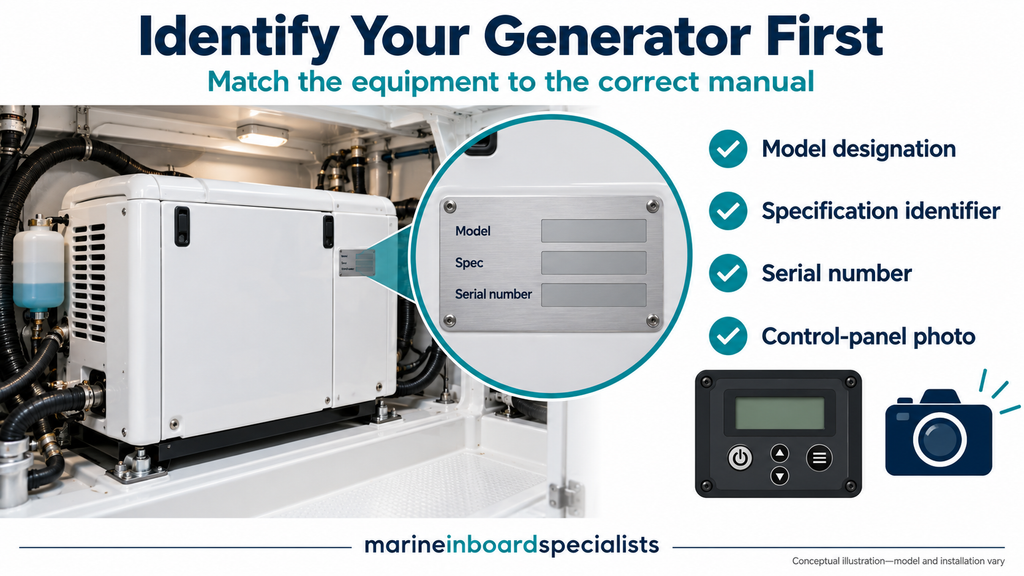
“Cummins Onan” identifies the manufacturer, not the complete troubleshooting procedure.
Record the full model designation, specification identifier, and serial number from the generator’s identification plate. Also photograph the installed control panel.
Why the Specification Identifier Matters
Generators within a model family can have different configurations or revisions. The manual must cover the equipment you actually own.
For example, Cummins publishes operator manual 981-0180, Issue 5, specifically identifying MDKBH Spec A–E on its cover. That document is a model-specific reference, not a universal code guide for every Onan marine generator. cummins.com
Use the applicable manual supplied with the equipment or confirmed through Cummins support. A document’s online upload date does not establish that its instructions apply to a newer or different generator.
Keep Marine and RV Instructions Separate
Search results for Onan generator fault codes often mix marine and recreational-vehicle equipment.
A familiar code number or similar-looking switch does not prove that the retrieval procedure, meaning, or corrective action is interchangeable.
When searching, include the complete marine model designation. Check the manual’s cover and applicability before following instructions.
How to Record an Onan Marine Generator Fault
Preserve the indication before clearing it.
Photograph the display, record the exact wording, and note the operating hours and circumstances of the event. If a lamp is blinking, a short video can help preserve the sequence.
Digital Displays
For the MDKBH Spec A–E example above, the manual describes a display showing the fault number, description, and operating-hour information. It also describes access to recent fault history. Confirm the corresponding functions and button sequence for your installed display. cummins.com
Do not repeatedly press controls while trying to capture the evidence. First establish what your manual says each button does.
Blinking Status Lamps
Some controls communicate through grouped flashes. Distinguish a general service indication from a detailed shutdown code.
Record the groups and pauses rather than counting every flash as one continuous number. Use the exact manual to interpret the sequence and retrieve further information where applicable.
Avoid copying a button sequence from an unrelated video. Similar controls may have different procedures.
Historical Faults Versus the Present Symptom
A stored fault may describe an earlier event. Record when it occurred and compare it with the current behaviour.
A generator that will not crank today should not automatically be diagnosed using an old temperature-related shutdown.
What an Onan Fault Code Actually Tells You
A fault code reports a condition recognised by the controller. It does not always establish the underlying cause or the part that needs replacement.
A temperature indication may direct the investigation toward cooling, sensing, or connections. A voltage indication may require examination of generation, loading, or electrical sensing.
The next step comes from the model-specific diagnostic procedure and supporting observations.
Selected Model-Specific Code Examples
The following meanings come from the MDKBH Spec A–E manual identified above. They are examples only; verify applicability before using them.
| Code | Meaning listed for this example |
|---|---|
| 1 | High engine temperature |
| 2 | Low oil pressure |
| 4 | Overcrank |
| 12 | High AC voltage |
| 13 | Low AC voltage |
| 36 | Unknown shutdown |
| 58 | High exhaust temperature |
| 61 | External shutdown |
These labels describe the manual’s fault categories. They are not diagnoses or repair instructions. cummins.com
In particular, an Onan fault code 36 should not automatically be treated as proof of a failed fuel pump. Establish its meaning for your generator, then investigate the recorded circumstances.
When Your Onan Marine Generator Will Not Crank
A Cummins Onan marine generator starting problem begins with whether the engine rotates.
No Response at the Controls
Record whether the panel is powered and whether the symptom occurs at both local and remote controls.
Check accessible operating controls according to the manual, including any indicated emergency-stop or external shutdown condition. Do not bypass a start inhibit.
If one control works and another does not, report that difference. It helps direct investigation without proving which component is faulty.
Clicking or Intermittent Starter Engagement
Clicking can indicate a starting-supply or circuit problem, but it does not establish that the battery needs replacement.
With the equipment correctly isolated, inspect accessible connections for visible corrosion, looseness, or damage where the manual permits.
A technician may need to assess battery performance and voltage drop during starting. An unloaded voltage reading alone cannot confirm that the complete starting circuit is healthy.
Do not bridge starter terminals or improvise connections.
Slow Cranking or Sudden Resistance
Describe whether cranking is slower than normal, stops abruptly, or changes between attempts.
Stop if there is unexplained mechanical resistance, particularly where water ingestion is possible. Repeated attempts can turn a diagnostic problem into additional damage.
Use the manufacturer’s permitted starting duration and recovery instructions.
When the Engine Cranks but Will Not Start
Normal cranking without firing requires a different investigation from a dead starter circuit.
Review Fuel Supply and Recent Work
For diesel equipment, record the available fuel, accessible valve positions, and recent filter or fuel-system work.
If the fault began immediately after servicing, provide that history to the technician. It is a useful clue, not proof of an incorrectly fitted component.
Use only the prescribed priming procedure. Do not loosen high-pressure injection lines as an owner troubleshooting step.
Follow the Correct Starting Procedure
Check the applicable instructions for preheat, starting, and permitted attempts.
Avoid starting-fluid use unless explicitly permitted for the equipment. Do not extend cranking because the engine appears close to firing.
Marine exhaust arrangements make repeated failed starts especially important to manage correctly. Stop at the manual’s limits and investigate rather than continuing indefinitely.
Build a Useful Record Before Replacing Parts
For a focused Onan marine generator troubleshooting enquiry, send marineinboardspecialists or your service provider:
- Identification-plate and control-panel photographs.
- The exact fault indication or blinking sequence.
- Operating hours and recent service history.
- Whether the engine cranks, starts, or continues running.
- Time between starting and the fault.
- Equipment connected when the problem occurs.
- Any leaks, unusual sounds, or changes in behaviour.
Keep confirmed observations separate from suspected causes.
“The generator runs for several minutes and then displays a fault” is useful evidence. “It needs a new controller” requires diagnostic support.
Once the model, code, and starting behaviour are established, the next step is to examine cooling-related shutdowns, load-related faults, and the separate problem of an engine running without supplying usable power.
Onan Marine Generator Overheating and Cooling-Related Shutdowns
An overheating indication is a reason to stop and investigate, not simply reset the controller. Before restarting, establish which temperature condition the generator reported and follow the applicable manual.
For effective Onan marine generator troubleshooting, distinguish between engine coolant temperature, exhaust temperature, and any raw-water-flow indication fitted to the model.
These conditions can overlap, but they do not identify the same fault.
Record the Exact Indication
Photograph the display or preserve the complete blinking sequence. Note whether the shutdown occurred soon after starting, after warming up, or when electrical demand increased.
Avoid reporting only “temperature fault.” The precise indication helps direct the investigation toward the relevant system.
Do not apply temperature thresholds or fault meanings from a different Onan model.
Separate Engine Coolant From Seawater Cooling
Many marine installations use a closed engine-coolant circuit and a separate seawater circuit. Identify the arrangement fitted to your equipment before checking components.
| System | Information worth recording |
|---|---|
| Engine coolant circuit | Cold coolant level, visible leakage, and recent cooling-system work |
| Seawater circuit, where fitted | Intake arrangement, strainer condition, and observed discharge changes |
| Water-injected exhaust, where fitted | Exact temperature indication and visible leakage or deterioration |
| Monitoring system | Fault wording, timing, and readings available at the panel |
These observations help narrow the investigation. None proves that a component is functioning correctly.
Check Accessible Cooling Items Safely
Allow the engine to cool before opening a pressurised cooling system. Use the manual’s method for checking coolant and the specified fluid.
If strainer inspection is an approved owner task, follow the vessel’s isolation procedure before opening it. Secure the assembly, restore the correct valve positions, and check for leaks before returning the system to operation.
Do not keep the generator running to see whether an apparent loss of cooling improves.
Consider the Complete Flow Path
A restriction, pump problem, damaged hose, or heat-transfer issue may require further investigation.
If an impeller is fitted and inspection reveals missing pieces, the downstream circuit may also need checking. Replacing the impeller alone does not establish that the system is clear.
For marineinboardspecialists readers, useful information includes the exact fault, cooling arrangement, time to shutdown, and any work completed immediately before the problem began.
Low Oil-Pressure Indications: Check Before Restarting
A Cummins Onan low oil-pressure fault should be treated as an unresolved protective condition until the cause is established.
Oil level and oil pressure are different measurements. A correct dipstick level does not prove that operating pressure is satisfactory.
Check the Oil Level Using the Correct Procedure
Follow the model-specific instructions for checking oil level, including the required engine condition and waiting period.
Look for visible leakage and review recent oil or filter work. Confirm the specified oil and filter were used where that information is available.
Do not overfill the engine in an attempt to clear a pressure indication.
Keep Sensing Faults Separate From Pressure Faults
A controller may distinguish an operating-pressure condition from a sender or circuit condition. Interpret the exact fault using the correct manual.
Do not assume the sender is defective because the engine sounds normal. Equally, do not replace internal engine components solely because a pressure-related indication appeared.
A technician may need to verify actual pressure and assess the sensing circuit. Bypassing the protective function does not provide that evidence.
Understanding an Unknown or Unexpected Shutdown
An Onan generator unexpected shutdown can be frustrating because the indication may describe the event without identifying its cause.
Start with timing and circumstances rather than a parts list.
Build a Timeline
Record:
- How long the generator operated.
- Whether it was cold or already warm.
- Which equipment was running.
- Whether a new load connected immediately before stopping.
- Any change in engine sound.
- Faults or alarms shown before and after the event.
A repeatable shutdown after warming up gives different evidence from an immediate stop during starting.
Review Recent Changes
Fuel-system servicing, electrical additions, control work, and storage history can provide useful context.
If the fault started after maintenance, describe the work precisely. That does not establish that the work caused the shutdown, but it gives the technician a sensible starting point.
Avoid repeatedly replacing fuel pumps, filters, or controllers without confirming the diagnosis.
Check for External Shutdown Information
Some installations connect the marine generator to external control or protective systems.
If an external shutdown is indicated, establish which installed system issued the command. Do not disconnect the interface or bypass its function to force continued operation.
The external system and generator may both need assessment.
When the Onan Generator Stops as a Load Starts
A load-related shutdown does not automatically mean the generator is too small. Electrical demand is one possibility, but fuel delivery, cooling, equipment condition, and control behaviour may also need investigation.
Identify What Actually Stopped
Distinguish between these events:
| Event | What to record |
|---|---|
| Engine stopped | Fault indication and conditions immediately before stopping |
| Engine continued running but output disappeared | Generator status and accessible breaker indications |
| Main breaker operated | Connected loads and the initiating event |
| One downstream breaker operated | Affected circuit and appliance |
| Only the appliance stopped | Appliance fault display and whether other equipment remained powered |
This distinction prevents an appliance or distribution fault from being misidentified as an engine shutdown.
Describe the Starting Load
An air-conditioning compressor, pump, charger, and water heater impose different electrical demands.
Record the exact equipment that connected and what else was already operating. If equipment was recently added, compare the revised demand with the original generator assessment.
Do not assume available capacity from a single reading taken during light operation.
Avoid Repeated Trip Tests
Repeatedly connecting the troublesome load until the system shuts down provides little useful evidence and can increase stress on equipment.
Where appropriate, a qualified technician can assess the system using controlled loads and suitable measurements. The test should follow applicable procedures and operating limits.
Do not increase breaker ratings or bypass protection to prevent shutdown.
Onan Marine Generator Runs but Supplies No Power
A marine Onan generator no-power problem needs a separate electrical investigation. A running engine does not establish that usable output is reaching the vessel.
First determine whether all generator-supplied circuits are unavailable or only one part of the boat has lost power.
Review Accessible Controls and Indications
Follow the vessel’s approved procedure for selecting generator power.
Record generator-panel indications, accessible breaker positions, and the status of any transfer equipment. Some installations use manual switching, while others use automatic controls.
Do not assume the generator is connected to the distribution system because its engine has started.
Investigate Before Resetting Breakers
If a breaker has operated, identify the affected loads and follow the applicable reset procedure.
If it trips again, stop resetting it and arrange diagnosis. Do not bypass switching interlocks or improvise connections between shore power and generator power.
Keep Internal Testing With a Qualified Technician
Further Onan marine generator electrical troubleshooting may involve the alternator, excitation system, voltage regulation, protection, or distribution wiring.
These tasks require appropriate isolation, procedures, and expertise. Other onboard supplies may remain connected even when the generator is stopped.
Do not attempt generic online “field-flashing” instructions, bridge internal terminals, or adjust voltage controls without the correct service procedure and qualified support.
Voltage and Frequency Faults Need Context
An abnormal voltage or frequency indication reports a condition requiring investigation. It does not automatically identify a failed voltage regulator or controller.
Record whether the event happened during starting, steady operation, or a load change. Preserve any displayed readings and identify where they were obtained.
A technician may need to assess engine behaviour, electrical loading, sensing, and generation together.
If one appliance fails while others operate, include the appliance’s own fault information. Successful operation on shore power is a useful comparison, but it does not prove compatibility with the generator’s starting response.
Decide Whether Another Start Is Appropriate
Before restarting, review the evidence:
- Is the model and specification confirmed?
- Has the exact fault been recorded?
- Is the shutdown cause understood and addressed?
- Have permitted checks been completed?
- Are valves, panels, and connections restored correctly after inspection?
- Does the applicable procedure permit another start?
An unexplained protective shutdown should remain unresolved until properly investigated.
Share the identification plate, fault record, timing, connected loads, and recent maintenance with marineinboardspecialists or the technician supporting your equipment. That information provides a stronger basis for diagnosis than clearing the indication and hoping the problem has disappeared.
How to Reset an Onan Marine Generator Fault
Record the fault first, address the cause, and then follow the reset procedure for your exact model and control panel. Clearing a displayed alarm does not establish that the generator is ready to operate.
A reset may acknowledge an indication, while the underlying problem remains. The generator may also retain fault-history information separately from the active display.
Preserve the Evidence Before Clearing It
Photograph the fault number and description. For blinking controls, record the complete sequence and pauses.
Note the operating hours, connected loads, and time between starting and shutdown. If the indication disappears, this record still gives your technician useful evidence.
Avoid repeatedly pressing buttons to retrieve or clear faults without checking the correct procedure.
Separate Resetting From Restarting
These are two different decisions.
The manual may explain how to acknowledge a fault, but restarting requires the relevant checks and corrective action. An unresolved overheating, oil-pressure, or electrical fault should not be treated as corrected because the lamp stops blinking.
If the same indication returns, stop repeated resets and arrange diagnosis.
Prevent Automatic Starting During Service
Where remote or automatic starting is fitted, follow the manufacturer’s isolation procedure before inspection or maintenance.
A stopped engine can remain capable of starting. Other electrical supplies may also remain connected aboard, so engine shutdown alone does not establish electrical isolation.
When Owner Checks Should Become Professional Diagnosis
Useful Onan marine generator troubleshooting identifies the next appropriate action. It should not turn into speculative component replacement or unapproved testing.
Stop for Suspected Water Ingestion
Stop cranking if the engine develops sudden resistance, locks, or may have taken in water.
Provide the technician with the failed-start history and any recent exhaust or cooling-system work. Do not attempt to force the engine through the resistance.
The equipment needs an appropriate assessment before another start.
Escalate Recurring Protective Shutdowns
Repeated temperature or oil-pressure indications require investigation, even if the generator operates again after cooling.
Do not disconnect senders, bridge protective circuits, or hold a bypass to continue running. A sensing fault and a genuine operating fault need to be distinguished through proper testing.
Leave Internal Electrical Work to Qualified Support
A Cummins Onan marine generator electrical fault may require measurements and procedures involving hazardous voltages.
Alternator, excitation, voltage-regulation, and internal control-system investigations belong with a suitably qualified technician using the applicable service information.
Generic internet instructions are not a substitute for that procedure.
Request Parts Only After Confirming the Diagnosis
A fault code is not a parts number.
For example, a low-voltage indication does not automatically establish that a regulator needs replacement. A temperature-related indication does not, by itself, identify a failed thermostat or impeller.
Match Parts to the Complete Generator Identification
Provide the model, specification identifier, and serial number when requesting Onan marine generator parts.
Where relevant, include the identification of the existing component and clear photographs. Similar appearance is insufficient to confirm compatibility.
Ask the supplier to confirm the correct part and any applicable replacement or installation requirements.
Separate Diagnosis From a Repair Estimate
A useful repair proposal should explain:
- The fault established through inspection or testing.
- The corrective work recommended.
- The parts and labour included.
- Any unresolved findings.
- How the repair will be checked afterward.
This helps you understand whether the proposed work addresses the cause or only a suspected component.
For marineinboardspecialists readers, accurate equipment identification and a documented diagnosis provide a stronger basis for parts enquiries than an online code interpretation alone.
Should You Repair or Replace Your Onan Marine Generator?
Compare a diagnosed repair with a complete replacement project. Age alone does not determine the better choice.
When Repair May Make Sense
Repair deserves consideration when the fault is identified, the remaining equipment is serviceable, suitable parts are available, and the generator still meets the vessel’s requirements.
Review the repair scope alongside the maintenance history and any other known problems.
A relatively limited repair can be sensible, but its value depends on the condition of the complete unit.
When Replacement Deserves Investigation
A replacement Onan marine generator may be worth investigating when there is substantial damage, recurring expensive faults, difficult parts support, or changed electrical demand.
Obtain an installed quotation rather than comparing the repair estimate with a generator-only price.
Include removal, access work, mounting, controls, cooling, exhaust, electrical integration, and commissioning where required.
Address Installation Problems During Either Project
If an installation issue contributed to the fault, correct it during the repair or replacement.
A new genset can face the same cooling restriction, exhaust problem, or unsuitable electrical demand if the surrounding system remains unchanged.
Keeping the same manufacturer also does not guarantee compatibility with existing mounts, remote controls, or connections.
Reduce Repeat Problems With a Maintenance Record
A practical Onan marine generator maintenance plan uses the schedule for the exact model and records what was completed.
Track Hours and Calendar Intervals
Apply the relevant operating-hour and time-based requirements. Low hours do not automatically eliminate calendar-based servicing.
Record the specified fluids, filters, parts, dates, and operating hours. Keep professional service reports with the equipment documentation.
Record Normal Operation
Using approved operating procedures, note the generator’s normal starting behaviour, displayed readings, and performance with familiar loads.
These observations provide a baseline when behaviour changes. They do not replace measurements or diagnosis.
Document Changes After Service
Record fuel-filter work, coolant servicing, battery replacement, control changes, and other repairs.
Before returning the generator to operation, complete the applicable checks and restore valves, connections, guards, and panels correctly.
If a problem begins afterward, that record helps the technician investigate efficiently.
Reassess Added Electrical Equipment
New air conditioning, chargers, cooking appliances, or other loads can change the generator’s operating demands.
Have significant additions assessed, including their starting characteristics and intended simultaneous use. Do not assume spare capacity from an occasional light-load reading.
Frequently Asked Questions
How do I read Onan marine generator fault codes?
Identify the exact model, specification, and control panel first. Then follow its manual for retrieving displayed faults or interpreting grouped flashes. Record the indication before clearing it.
What does Onan fault code 36 mean?
Its applicability and meaning must be checked against your model’s manual. The MDKBH Spec A–E example discussed earlier labels it an unknown shutdown. That description does not identify a failed fuel pump or another specific component.
Are Onan marine and RV fault codes interchangeable?
Do not assume they are. Confirm the generator identification and use the applicable marine documentation, even when a number or control looks familiar.
Why does my Onan generator start and then stop?
Record the exact fault, operating duration, engine behaviour, and connected loads. Protective conditions, fuel delivery, controls, and other faults may require investigation. Timing alone cannot establish the cause.
Can I restart after an overheating shutdown?
Only after completing the applicable checks and corrective action and confirming that the manufacturer’s procedure permits restarting. Cooling down does not resolve the reason for overheating.
Why does the engine run without supplying AC power?
The investigation may involve generation, protection, supply selection, transfer equipment, or distribution. Check accessible indications according to the operating instructions and leave internal testing to qualified support.
Does resetting the code fix the fault?
No. Resetting changes the indication or control state according to the system’s procedure. It does not repair a cooling, mechanical, fuel, or electrical problem.
What should I send when requesting help?
Send the identification plate, control-panel photographs, exact fault indication, operating hours, recent maintenance, and a description of when the problem occurs.
Turn the Fault Indication Into an Informed Decision
Effective Onan marine generator troubleshooting begins with accurate identification and preserved evidence. Match the code to the correct manual, distinguish the symptom, complete permitted checks, and obtain qualified diagnosis when the cause remains unresolved.
To make an enquiry with marineinboardspecialists, provide the generator’s identification details, fault photographs, operating history, vessel location, and recent work. If diagnosed parts or replacement equipment are required, include your intended purchase timing and billing and delivery addresses.
Those details help turn a blinking lamp or shutdown message into a focused next step—whether that is further testing, a confirmed repair, or a replacement assessment.

Leave a Reply