

Imagine your generator starting normally before a trip, then stopping a few minutes later. On another occasion, the starter turns slowly—or the engine runs while the boat receives no electrical power.
Each symptom points toward a different investigation. Replacing a battery, impeller, or control component without identifying the problem can waste money and leave the underlying fault unresolved.
Effective Northern Lights generator troubleshooting starts with the exact equipment identification, a clear description of the symptom, and the correct manufacturer documentation.
For marineinboardspecialists readers, this guide explains how to separate starting faults, cooling problems, shutdowns, and electrical-output loss. It also distinguishes practical owner observations from testing that requires a qualified technician.
Northern Lights Generator Troubleshooting: What to Check First
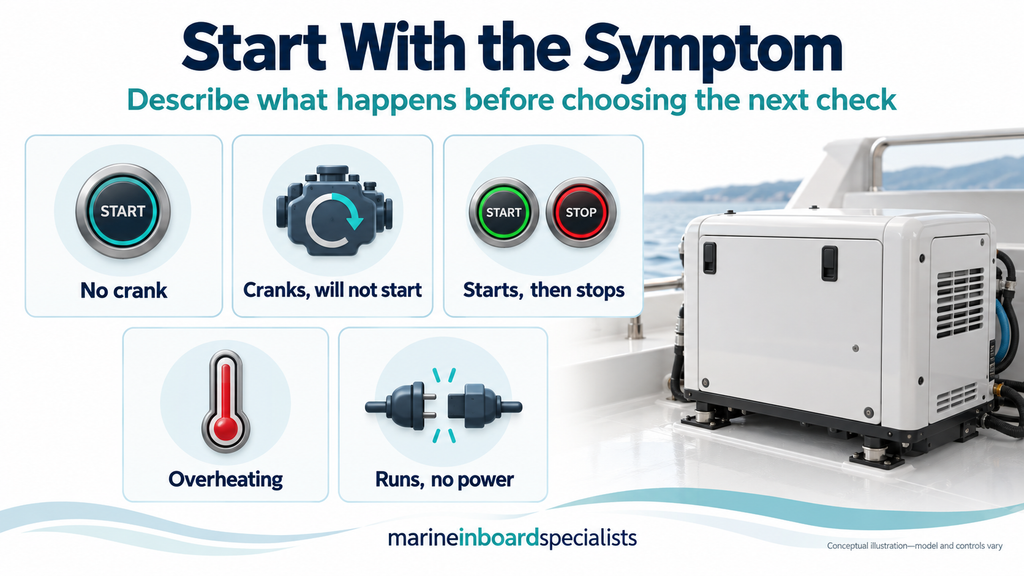
Identify the generator and installed control system, record any warning, and establish whether the engine fails to crank, fails to start, stops after starting, or runs without supplying power.
Before attempting another start, check for conditions that require you to stop: fuel or exhaust leakage, a carbon-monoxide alarm, abnormal mechanical noise, or suspected water ingestion.
Follow the applicable instructions for shutdown and isolation. Prevent remote or automatic starting before inspection, and keep clear of moving components.
Use this table to classify the problem:
| What happens | Initial investigation |
|---|---|
| Nothing happens when Start is pressed | Starting supply, controls, and start-permission conditions |
| Starter clicks or turns slowly | Battery performance, cable connections, and possible mechanical resistance |
| Engine cranks normally without firing | Starting procedure, fuel supply, and relevant controls |
| Engine starts, then stops | Shutdown indication, timing, and operating conditions |
| Temperature rises or an alarm appears | Exact indication and the applicable cooling arrangement |
| Engine runs but circuits remain unpowered | Output indications, protection, and supply selection |
These categories organise the evidence. They do not identify a failed part by themselves.
Identify the Generator and Control Panel Before Diagnosing It
“Northern Lights” identifies the manufacturer. It does not establish which starting procedure, protection system, or diagnostic instructions apply.
Photograph the generator’s identification plate and record its complete model and serial number. Photograph the local and remote controls as well.
Use the Manual for the Exact Model
Northern Lights publishes model-specific operator manuals, including OM773LW3. Confirm that the document’s listed coverage matches your equipment before using its procedures or specifications. An online upload date alone does not establish applicability. northern-lights.com
Keep the correct documentation available aboard. If identification is unclear, send photographs to the manufacturer’s support channel or a service provider familiar with the equipment.
Identify Any Separate Controller Documentation
The generator’s engine documentation and installed controller instructions may be separate.
For example, Northern Lights publishes an OS-TSC controller manual covering its operating modes, displayed failures, and event-history functions. Those instructions apply to that controller; they should not be transferred to a different panel. northern-lights.com
Record what is actually fitted, including any later control-system changes.
Do Not Assume Every Generator Uses Fault Codes
Some installations provide gauges, warning lamps, switches, or digital messages. Diagnostic information can differ between models and control arrangements.
Northern Lights’ ONL773LW4 documentation includes engine-ECU lamp patterns. That does not make those patterns a universal Northern Lights fault-code list. northern-lights.com
If a lamp flashes, preserve the pattern and identify which device produced it before interpreting the sequence.
Describe the Symptom Before Naming the Cause
“The generator will not start” can describe several different conditions.
“The starter clicks once and the engine does not rotate” is more useful. So is “the engine starts, runs for six minutes, and stops with a temperature warning.”
Record the Timing
Note whether the problem occurs:
- Immediately when starting is requested.
- During cranking.
- Seconds after the engine starts.
- After warming up.
- When a particular appliance connects.
- After an interruption or change in supply.
Timing helps guide the next test, but it does not prove the cause.
Record Recent Changes
Include recent battery work, fuel-filter servicing, coolant replacement, electrical additions, and storage history.
If a problem began after maintenance, describe the work precisely. Treat it as context rather than proof of an installation or servicing error.
Preserve Warnings Before Resetting
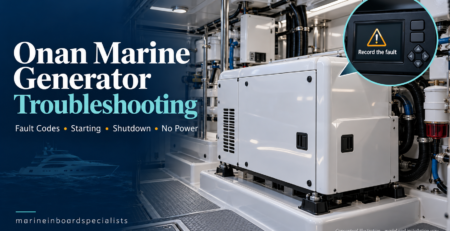
Photograph displays and warning lamps before acknowledging them. A short video can preserve a blinking sequence.
Also note whether the indication appeared before the engine stopped or only afterward. Some readings change naturally when the engine is no longer running, so the sequence matters.
Northern Lights Generator Will Not Crank
A Northern Lights generator starting problem begins with establishing whether the engine rotates.
No Response From the Controls
Check accessible operating controls and panel indications according to the manual.
Record whether the symptom occurs at both local and remote controls. Confirm the normal positions of any applicable battery isolator, emergency stop, or controller mode selector.
Do not bypass an interlock or external shutdown system to obtain a start.
If one panel works while another does not, report that difference. It helps narrow the investigation without establishing which component has failed.
Clicking Without Engine Rotation
Clicking may be associated with the starting supply, connections, or starter circuit. It does not automatically mean the battery needs replacement.
With the equipment properly isolated, inspect accessible cables and terminals for visible corrosion, looseness, or damage where the manual permits.
A technician may need to assess battery performance and voltage drop during a start attempt. A normal unloaded voltage reading alone does not confirm that the complete starting circuit is healthy.
Do not bridge starter terminals or improvise connections.
Slow or Laboured Cranking
A Northern Lights generator slow-cranking fault may involve inadequate starting supply, resistance in the circuit, unsuitable oil for the conditions, or mechanical resistance.
Describe whether the change was sudden or gradual. Stop attempts if the engine locks, produces unusual mechanical sounds, or may have ingested water.
Repeated cranking should not be used to force the engine through unexplained resistance.
Generator Cranks but Will Not Start
If the engine turns normally without firing, follow the applicable starting and troubleshooting instructions.
Confirm Fuel Supply and Recent Fuel-System Work
Record the indicated fuel level and accessible valve positions according to the vessel’s operating procedures.
If the symptom began after a filter change or running low on fuel, include that information. Air entry, restrictions, and other fuel-supply conditions may require assessment.
Use the exact manufacturer procedure if priming or bleeding is needed. Do not loosen high-pressure injection lines as an owner check.
Follow the Correct Preheat Procedure
Where preheat is fitted or required, use the instructions for that model and the actual operating conditions.
Avoid applying a familiar procedure from another generator. Do not use starting fluid unless the manufacturer explicitly permits it for the equipment.
Limit Failed Start Attempts
Follow the model’s limits for individual attempts and required pauses.
On water-lift exhaust installations, repeated unsuccessful cranking can create a water-ingestion risk. Do not keep trying because the engine appears close to firing, or improvise a seawater-valve procedure.
If the permitted attempts fail, stop and investigate before continuing.
Generator Starts, Then Stops
A Northern Lights generator shutdown needs a different assessment from failure to start.
First establish whether the engine stopped, electrical output disconnected, or only a connected appliance stopped.
Record Conditions Immediately Before Shutdown
Note operating time, connected equipment, available warnings, and any change in sound or discharge behaviour.
A stop after warming up deserves a different investigation from a stop when a compressor starts.
Keep Protective Conditions Unresolved Until Checked
Do not assume a temperature or oil-pressure indication is a defective sensor. A genuine operating problem and a sensing fault require different corrective work.
Avoid disconnecting protective components or holding a bypass to keep the generator running.
Distinguish a Shutdown From Lost Electrical Supply
If the engine continues running while boat circuits lose power, move to the output and distribution investigation.
Starting-system or fuel repairs will not necessarily address an electrical switching, protection, or generation fault.
Prepare a Useful Service Enquiry
For a focused Northern Lights generator troubleshooting enquiry, send marineinboardspecialists or your model’s service provider:
- Identification-plate and control-panel photographs.
- Exact warnings, messages, or lamp patterns.
- Operating hours and recent maintenance.
- A precise description of cranking, starting, or running behaviour.
- Time between starting and the problem.
- Equipment connected when the event occurred.
- Any observed leakage, unusual noise, or changed behaviour.
Keep observations separate from suspected causes. “The generator stops when the pump starts” is evidence. “It needs a new alternator” requires diagnostic support.
Once the starting behaviour and indications are recorded, the next step is to examine cooling-related shutdowns, load-dependent problems, and electrical-output loss.
Northern Lights Generator Overheating: Identify the Cooling Arrangement
If the generator reports overheating, stop according to its operating instructions and investigate before restarting. Cooling down does not establish that the cause has been corrected.
For effective Northern Lights generator troubleshooting, first identify the cooling arrangement fitted to the exact model. A heat-exchanger installation and a keel-cooled installation require different checks.
Separate Coolant Temperature From Exhaust Temperature
Record the precise warning, displayed message, or gauge behaviour.
An engine-coolant temperature problem is not the same as an exhaust-temperature problem. Where seawater enters the exhaust, inadequate water delivery may affect the exhaust system even when the coolant indication does not appear unusually high.
Do not interpret every temperature-related shutdown as the same fault.
Compare Observations With Normal Operation
Note when the temperature changes:
- Soon after starting.
- Gradually during operation.
- Only under a higher electrical load.
- Immediately after cooling-system maintenance.
These patterns help guide diagnosis. They do not identify a failed thermostat, pump, or sensor by themselves.
Avoid using a temperature threshold from another Northern Lights model. Use the applicable manual and operating limits.
Check Seawater Cooling Where Fitted
A Northern Lights generator cooling problem may involve the intake, strainer, pump, hoses, heat exchanger, or exhaust-water arrangement.
Start with accessible observations and approved owner checks.
Observe Discharge Safely
If the installation discharges cooling water with the exhaust, record any change from its normal pattern.
Some arrangements separate water and exhaust through different outlets. Visible discharge therefore does not prove adequate cooling flow, and an unfamiliar pattern does not establish a blockage.
Keep away from exhaust gases. If there is an overheating indication or apparent loss of cooling, stop the generator rather than continuing to run it for observation.
Inspect the Strainer Using the Correct Isolation Procedure
Where strainer inspection is a permitted owner task, isolate it according to the vessel’s instructions before opening it.
Secure the assembly afterward, restore the required valve positions, and check for leakage before operation. Below-waterline fittings require particular care because opening them incorrectly can admit water into the vessel.
Do not restart with the cooling-water supply unintentionally closed.
Assess the Pump and Complete Flow Path
With the generator safely isolated, inspect accessible hoses for visible leakage, deterioration, or collapse.
If an impeller is fitted and pieces are missing, the downstream circuit may need inspection to locate them. Fitting a new impeller does not establish that the remaining flow path is clear.
Internal restrictions, air entry, and pump performance may require professional testing. Do not assume that apparently normal discharge rules them out.
Check the Closed Coolant Circuit
The engine’s coolant system needs a separate assessment from the seawater circuit.
Check Coolant After the Engine Has Cooled
Follow the model’s procedure for checking coolant level and use the specified coolant.
Never open a hot, pressurised cooling system. Confirm where the manual requires the level to be checked rather than relying on an overflow bottle alone.
If coolant is low, investigate why. Repeated topping-up leaves an unexplained loss unresolved.
Review Recent Maintenance
A problem appearing after coolant replacement, hose work, or component servicing deserves a review of the completed procedure.
Incorrect filling or incomplete venting may require investigation. Use the manufacturer’s method rather than opening vents or connections experimentally.
Do not remove the thermostat to make the generator continue operating.
Account for Keel Cooling Where Applicable
For a keel-cooled installation, the heat-rejection arrangement differs from a seawater heat-exchanger system.
Provide the technician with details of the fitted cooling system and recent hull or cooling-system work. Do not apply seawater-pump troubleshooting to equipment that uses a different arrangement.
For marineinboardspecialists readers, identifying the cooling configuration early prevents the enquiry from being directed toward components the vessel does not have.
Low Oil-Pressure Warnings Need Verification
A Northern Lights low oil-pressure problem should remain unresolved until the relevant checks establish its cause.
Oil level and oil pressure are different. A correct dipstick reading does not confirm satisfactory operating pressure.
Check Level and Service History
Use the prescribed procedure to check the oil level. Record visible leakage and any recent oil or filter changes.
Confirm the specified oil and filter where that information is available. Do not overfill the engine to try to clear a pressure indication.
Distinguish Actual Pressure From Indication
A warning may require assessment of actual oil pressure, the sender, wiring, or controller.
The engine sounding normal does not prove that the indication is false. Likewise, the warning alone does not establish internal engine damage.
Leave pressure verification and circuit diagnosis to suitable testing. Do not disconnect the protective function to continue operation.
When the Generator Stops Under Electrical Load
A Northern Lights generator shutting down under load is not automatically undersized. The event could involve electrical demand, fuel delivery, cooling, control behaviour, or another fault.
Establish What Stopped
Record whether the engine stopped, output disconnected, a breaker operated, or only one appliance became unavailable.
| Observation | Evidence to collect |
|---|---|
| Engine stops | Warnings, operating duration, loads, and changes in sound |
| Engine runs but all generator circuits lose power | Output indications, protection status, and supply selection |
| One circuit breaker trips | Affected circuit and equipment |
| One appliance stops | Appliance fault information and whether other loads remain powered |
| Engine speed changes noticeably | Load connected immediately beforehand and available readings |
These distinctions help separate engine faults from electrical-distribution and appliance problems.
Identify the Relevant Load Change
Record the exact pump, compressor, charger, tool, or appliance that connected before the event.
Starting demand differs from steady running demand. Several loads reconnecting after an interruption may also create a demanding condition.
If equipment was added recently, review the revised operating combinations against the original generator assessment.
Avoid Repeated Shutdown Tests
Do not repeatedly connect the same troublesome load until the system trips.
A qualified technician can use controlled tests and suitable measurements to assess the response. Increasing breaker ratings or bypassing protection does not resolve the cause.
Northern Lights Generator Runs but Produces No Usable Power
A Northern Lights generator no-power fault needs an electrical investigation. Engine operation alone does not establish that usable output reaches the boat.
Start by identifying the extent of the loss.
Check Accessible Supply Selection and Indications
Follow the vessel’s approved procedure for selecting generator power.
Record accessible breaker positions, panel indications, and transfer-system status. Do not assume the generator is connected because its engine has started.
If only one circuit is affected, preserve that distinction when reporting the fault.
Reset Protection Only as Instructed
A tripped breaker may indicate overload or another fault.
Follow the applicable reset procedure after completing its required checks. If protection operates again, stop resetting and arrange diagnosis.
Do not bypass switching interlocks or improvise connections between power sources.
Leave Internal Generator Testing to a Technician
Further Northern Lights alternator troubleshooting may involve excitation, voltage regulation, sensing, protection, or internal connections.
These tasks require appropriate procedures and isolation. Shore power, inverters, or other supplies may remain connected even with the generator stopped.
Do not perform generic field-flashing instructions or adjust voltage controls based on an online description. The correct method depends on the installed equipment.
When the Controller Displays a Fault Message
A controller message must be interpreted using the documentation for that controller and generator arrangement.
Record the Exact Wording
Photograph the message before acknowledging it. Note whether it occurred during cranking, while running, or after a load change.
A message can describe what the controller detected without establishing a mechanical diagnosis. Avoid treating the wording as an automatic parts recommendation.
Separate Active Events From History
Where event history is available, compare its timing with the present symptom.
An older shutdown record may be useful context, but it should not automatically determine the diagnosis of a new starting problem.
Confirm Any Reset Procedure
Acknowledging a message and authorising another start are separate decisions.
Use the prescribed procedure and address the relevant condition first. If the indication returns, stop repeated resets.
Bring the Evidence Together Before Restarting
Before another attempt, establish whether the applicable instructions permit it and whether the reason for a protective shutdown has been addressed.
Your troubleshooting record should now identify the model, controller, exact symptom, timing, connected loads, cooling observations, recent maintenance, and checks completed.
Share that information with marineinboardspecialists or the service provider supporting your equipment. A documented sequence helps direct the next test and reduces the temptation to replace parts without confirming the cause.
Turn Your Observations Into a Repair Plan
The next step in Northern Lights generator troubleshooting is to decide what the evidence supports: an approved owner correction, professional testing, a confirmed repair, or a replacement assessment.
Do not turn an unresolved symptom into a parts order. A temperature warning does not establish that the thermostat needs replacement. Loss of electrical output does not automatically identify a failed voltage regulator.
Ask the technician to separate confirmed findings from remaining possibilities.
Request a Diagnosis That Explains the Fault
A useful diagnostic report should identify the symptom reproduced, the checks completed, and the findings supporting the recommended work.
If the problem is intermittent, the technician may need further operating information before confirming the cause. That uncertainty should remain visible rather than becoming an unsupported diagnosis.
Ask how the proposed repair addresses the observed problem and what will be checked afterward.
Confirm the Repair Scope
Before authorising work, establish:
- The diagnosed condition.
- Parts and labour included.
- Any installation work required.
- Findings that remain unresolved.
- The planned checks before returning the generator to service.
This helps distinguish a complete corrective repair from a temporary restoration of operation.
For marineinboardspecialists readers, clear identification and documented findings also make parts enquiries more accurate.
Match Northern Lights Parts to the Exact Equipment
When requesting Northern Lights generator parts, provide the generator model and serial number. Include the installed controller’s identification where relevant.
A generator may have received replacement components or control upgrades during its working life. Photographs and service records can help establish what is currently fitted.
Do Not Choose Parts by Appearance Alone
Similar-looking filters, pumps, senders, or electrical components are not proof of compatibility.
Provide existing part markings where readable and ask the supplier to confirm the correct replacement. Also establish whether related seals, fittings, or installation items are required.
Avoid ordering a collection of suspected components simply to see which one fixes the problem.
Record What Was Replaced
Keep the part identification, installation date, operating hours, and reason for replacement in the maintenance record.
If the symptom returns, that history helps the next technician avoid repeating work without understanding its result.
Verify the Repair Before Returning to Normal Use
A generator starting successfully once does not prove that the original fault has been resolved. Verification should address the operating conditions under which the problem occurred.
Agree on a Suitable Test
The technician should follow the applicable procedures and determine which checks are appropriate.
Depending on the repair, these may include starting behaviour, operation after warming up, representative electrical loads, cooling performance, or output measurements.
Do not force an overheating event or repeatedly trip protection to reproduce a fault.
Use the Original Symptom as the Acceptance Question
If the generator previously stopped after several minutes, a brief unloaded start is insufficient evidence of resolution.
If it lost output when a pump connected, the assessment should address that operating condition using suitable procedures.
A hypothetical example illustrates the point: a generator previously shut down after warming up, and a cooling restriction was confirmed. The repair should be followed by an appropriate operating check that verifies cooling performance, rather than only confirming that the engine starts.
Collect the Results
Request the repair record, relevant readings, settings changed, and any remaining recommendations.
If the technician identifies an operating restriction or further work, make that condition clear to everyone using the boat.
Should You Repair or Replace the Generator?
A Northern Lights marine generator replacement decision should compare the diagnosed repair with the complete replacement project.
Age and operating hours provide context, but neither establishes the answer alone.
When Repair Deserves Consideration
Repair may be practical when the fault is identified, the remaining equipment is serviceable, suitable parts are available, and the generator still meets the vessel’s requirements.
Review the repair scope alongside maintenance history and other known issues.
A limited repair can offer good value, but its usefulness depends on the condition of the complete system.
When Replacement Deserves Investigation
Replacement may warrant closer assessment where there is substantial damage, recurring costly faults, difficult parts support, or changed electrical demand.
Obtain an installed quotation covering removal, access work, mounting, controls, cooling, exhaust, electrical integration, and commissioning where applicable.
Comparing a repair estimate with a generator-only price leaves important costs out of the decision.
Resolve Installation Problems During Either Project
If the installation contributed to the fault, address it during repair or replacement.
A new generator can encounter the same restricted cooling path, unsuitable exhaust arrangement, or excessive load demand if the surrounding system remains unchanged.
Keeping the same manufacturer does not guarantee compatibility with existing mounts, controls, or connections.
Build a Maintenance Record That Helps Future Diagnosis
A useful Northern Lights generator maintenance plan does more than list service dates. It preserves the equipment’s history and provides a baseline when behaviour changes.
Follow the Model-Specific Schedule
Apply the manufacturer’s operating-hour and calendar requirements for the exact equipment and conditions.
Record fluids, filters, parts, dates, and operating hours. Keep professional service reports with the manuals.
Do not copy service intervals from another model because its appearance or output is similar.
Record Normal Behaviour
Using approved operating procedures, note normal starting behaviour, panel indications, and performance with familiar loads.
These observations can help identify changes. They are not a substitute for measurements or diagnostic testing.
Document Changes Aboard
Record generator work and additions to the vessel’s electrical system.
New air conditioning, chargers, appliances, or specialist equipment can alter operating demand. Have significant changes assessed, including starting events and intended simultaneous use.
Prepare for Storage and Return to Service
Use the applicable manufacturer procedures for storage and recommissioning.
Do not assume that occasional starting alone provides complete storage protection. Fuel, cooling, batteries, and other systems may require specific attention.
Frequently Asked Questions
Why does my Northern Lights generator click but not crank?
The starting supply, connections, controls, or starter circuit may need assessment. Clicking alone does not identify the failed component. Record the behaviour and follow the correct manual’s permitted checks.
Why does it crank normally but fail to start?
Review the model’s starting procedure, available fuel, relevant preheat arrangements, and recent maintenance. Limit failed attempts according to the manual, particularly with a water-lift exhaust installation.
Why does my Northern Lights generator start and then stop?
Record the exact warning, operating duration, engine behaviour, and connected loads. Protective conditions, fuel delivery, controls, or other faults may require investigation.
Can I use one fault-code list for every Northern Lights generator?
No. Diagnostic information depends on the generator, engine controls, and installed panel. Match any lamp pattern or message to the applicable documentation.
Does visible cooling-water discharge mean cooling is satisfactory?
Not necessarily. Visible discharge is an observation, rather than proof of adequate flow or heat transfer. Interpret it alongside the cooling arrangement, temperature indications, and appropriate checks.
What if the engine runs but the boat receives no power?
Check accessible supply-selection and protection indications using the operating instructions. Internal generation and distribution testing require qualified support.
Can I clear a warning and continue operating?
Clearing an indication does not correct the cause. Complete the applicable checks and corrective action before restarting. Recurring protective events need diagnosis.
Should I replace the generator after a major fault?
First establish the damage and repair scope. Compare repair with a complete replacement quotation, considering equipment condition, support, installation, and future requirements.
Request Help With a Clear Equipment Record
Effective Northern Lights generator troubleshooting begins with the exact model, an accurate symptom description, and preserved warnings. It progresses through permitted checks and appropriate testing, then ends with a verified correction.
For an enquiry to marineinboardspecialists, send the identification plate, control-panel photographs, fault information, operating hours, recent maintenance, and vessel location. Explain what happens, when it happens, and which equipment is connected.
If confirmed parts or replacement equipment are required, include your intended purchase timing and billing and delivery addresses.
Those details help turn an uncertain symptom into a focused next step—and a repair or replacement decision supported by evidence.

Leave a Reply